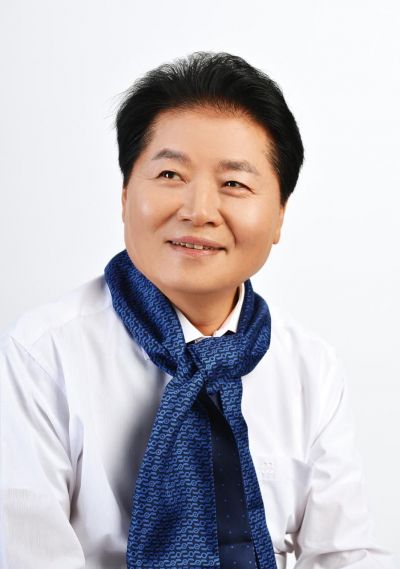
[Asia Economy Honam Reporting Headquarters Reporter Park Seon-gang] Kim Byung-won, the Democratic Party of Korea preliminary candidate for the National Assembly representing Jeonnam Naju·Hwasun, announced on the 24th a grand design to establish innovative agricultural policies such as advanced smart agriculture, seed industry cluster construction, and the creation of a ‘Naju-type Green Livestock Zone’ to transform Naju·Hwasun into a leading agricultural city in South Korea.
Preliminary candidate Kim Byung-won plans to implement a prerequisite task of reflecting the public value of agriculture and rural areas in the constitution, aiming to widely raise public awareness of the importance of agriculture and rural communities. This policy was previously attempted by Kim during his tenure as the president of the Korea Agricultural Cooperative Federation in 2017, when he launched a 10 million signature campaign for constitutional amendment, but it was thwarted due to parliamentary deadlock.
He stated, “I will actively pursue the enactment of the ‘Farmer Basic Income Act’ so that all farmers can receive a basic income of 300,000 KRW per month.”
He also explained the purpose of the legislation, saying, “Currently, even including government subsidies such as direct payments, agricultural income is 1.08 million KRW per month, which does not reach 13 million KRW annually. The fundamental solution to revive agriculture and rural areas, which are in crisis due to Free Trade Agreements (FTA) and the abandonment of developing country status in the World Trade Organization (WTO), will be the farmer basic income.”
Regarding livestock odor, which acts as an obstacle to improving residential conditions in innovation cities, he is also promoting a pledge to fundamentally resolve odor complaints by establishing scattered livestock farms into a designated area called the ‘Naju-type Green Livestock Zone.’
The necessary funding related to this will be actively addressed through national funds via amendments to the ‘Special Act on Innovation Cities’ and projects such as the Ministry of Agriculture, Food and Rural Affairs’ smart livestock ICT pilot complex construction.
By introducing Fourth Industrial Revolution technologies such as IoT (Internet of Things), AI (Artificial Intelligence), and big data, the agricultural paradigm will be innovatively transformed.
Smart agriculture is linked with the Youth Farmer Officer School to be established in Naju·Hwasun.
The Officer School is one of the ambitious platforms introduced by Kim during his tenure as president of the Korea Agricultural Cooperative Federation in 2018 to cultivate young farmers. Each year, 20 young farmers under the age of 40 are selected and undergo a six-month training period covering a diverse curriculum from smart farming methods to production, processing, sales of agricultural products, and agricultural machinery.
Candidate Kim plans to build a bio-agricultural food industrialization center related to health and healing, strengthen small and medium-sized farms, and establish a foundation for local food agricultural industrialization.
He is also developing a plan for ‘local food agricultural industrialization’ that encourages income increases for small and medium-sized farmers (including elderly farmers, women farmers, returnees to farming, and rural migrants) through the production of ‘local agricultural products with a face,’ local food direct stores, restaurants, and online sales.
In cooperation with the Jeonnam Agricultural Research and Extension Services and universities, he plans to establish a hub center capable of performing R&D functions, infrastructure construction such as golden seed production support, professional workforce training, and marketing.
Kim Byung-won stated, “Since 70% of certification costs are supported by financially weak basic local governments, we will significantly expand national funding support to reduce the burden on farms and increase the foundation for eco-friendly agriculture. We plan to enact related laws to support R&D funds for companies developing customized equipment such as transporters, multi-purpose farming platforms, and farming work chairs, and to provide national funding for purchasing developed equipment.”
Furthermore, candidate Kim plans to designate Bitgaram Innovation City and Hwasun-eup as urban agriculture special zones to awaken the ‘cultivation instinct’ among urban residents, thereby enhancing the psychological healing power of local residents weary of life and increasing their affinity for agriculture and rural areas.
© The Asia Business Daily(www.asiae.co.kr). All rights reserved.

















