Symptoms appeared around the 7th day for patient 31 and others
These patients attended worship on September 16
Considering an incubation period of 7-8 days, a surge in patients is possible this week
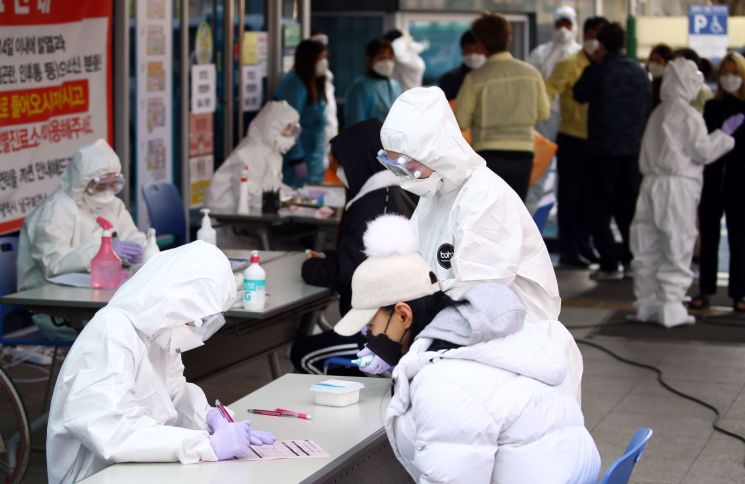 Suspected COVID-19 patients are flocking to the Nam-gu Public Health Center in Daegu.
 [Image source=Yonhap News]
[Asia Economy reporters Choi Dae-yeol and Kim Heung-soon] On the morning of the 24th, 161 new confirmed cases of the novel coronavirus infection (COVID-19) were added domestically, causing the speed of new patient occurrences in South Korea to spiral out of control. Among them, 129 new cases were related to the Shincheonji Church of Jesus Daegu branch, where a mass infection outbreak occurred overnight. The quarantine authorities stated, "COVID-19 is spreading mainly within a specific religious group," and are focusing diagnostic testing on about 9,500 believers and workers associated with the Shincheonji Daegu Church. Among them, as many as 1,300 reported symptoms, making it highly likely that the cumulative number of confirmed cases this week will exceed 1,000. Additionally, the number of patients linked to the Shincheonji Daegu Church who reside outside Daegu is steadily increasing, indicating a rapid nationwide spread originating from Shincheonji. Among the newly confirmed patients from the previous day, 20 were related to Shincheonji but did not reside in Daegu, and 14 more were confirmed just this morning, showing that this is not a problem confined to Daegu alone. There is also a possibility of additional cases emerging among patients currently under epidemiological investigation in other regions, so it is expected that patients will continue to appear across the country.
458 cases in 7 days, 60% of total
According to the Central Disaster and Safety Countermeasures Headquarters for COVID-19, as of 9 a.m. today, out of the total 763 confirmed cases domestically, 458 are linked to the Shincheonji Daegu Church, accounting for over 60% of the total. The number of patients related to this religious group has been rapidly increasing since last week.
On the 18th, patient number 31 (born 1959, Korean female), a member of the Shincheonji Daegu Church, was the first to be confirmed positive. The next day, 14 additional cases were confirmed, and by the 22nd, the cumulative number had surged to 231. On the 23rd, 98 more cases were added, and overnight, 129 more were confirmed. More related cases are expected to be identified during the day.
"Critical turning point this week... peak in 2-3 days"
Clinical experts estimate the incubation period of COVID-19 to be up to 7-8 days. The authorities estimate that patient number 31 began showing symptoms around the 7th of this month. Although the exact infection route of this patient has not yet been identified, based on the symptom onset date, exposure to the virus likely occurred between January 31 and February 1. Epidemiological investigations have found that other Shincheonji Daegu Church members exhibited symptoms around the same time as patient 31. These patients attended Shincheonji Daegu Church services on the 9th and 16th of this month, respectively.
Considering the incubation period, the recent surge in confirmed cases among Shincheonji Daegu Church members likely resulted from exposure to the virus during the service on the 9th, from patient 31 and other previously symptomatic individuals. If many additional infections occurred during the service on the 16th, another large-scale confirmation of cases is expected starting this week, after the incubation period has passed.
The Shincheonji Church of Jesus stated, "Since the 18th, all church activities including worship, evangelism, and meetings have been suspended for approximately 245,000 believers nationwide, and we are cooperating with the quarantine authorities' requests to prevent the spread of COVID-19." Based on this, the authorities believe that minimizing the spread of infection among symptomatic individuals related to the Shincheonji Daegu Church is essential to slowing the increase in confirmed cases. Park Neung-hoo, head of the Central Disaster and Safety Countermeasures Headquarters (Minister of Health and Welfare), emphasized, "Within the next 2-3 days, the number of patients will peak, and whether or not these patients cause secondary transmission, and how much that transmission is minimized, will determine the occurrence of future cases."
© The Asia Business Daily(www.asiae.co.kr). All rights reserved.

















