Israel Followed by Jordan Lockdown... Entry Ban on Foreigners Visiting Korea
Travel Restrictions Imposed on 15 Countries Including Macau
US, Taiwan, Australia Raise Travel Alerts
Philippines Considering Travel Ban
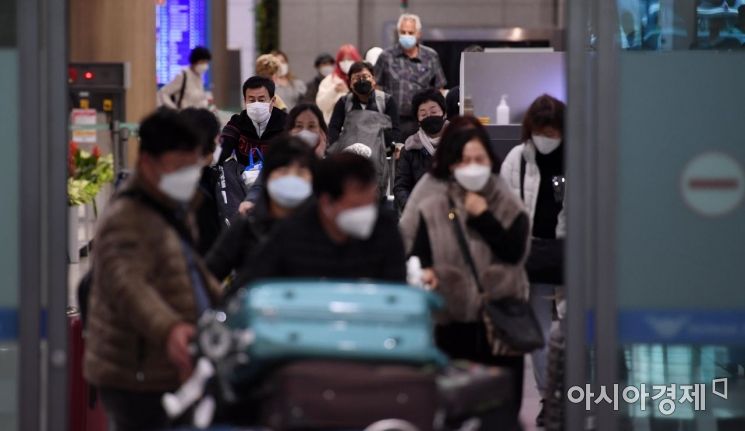 On the 4th, passengers arriving on flights from China are entering through a dedicated immigration area at Incheon International Airport Terminal 1, wearing masks. / Yeongjongdo - Photo by Kim Hyunmin kimhyun81@
[Asia Economy Reporter Lim Cheol-young] As President Moon Jae-in raised the crisis alert level for the novel coronavirus infection (COVID-19) to the highest 'serious' level, the number of countries proactively strengthening measures against South Korea, such as entry bans and travel advisory upgrades, is rapidly increasing.
According to the Ministry of Foreign Affairs on the 24th, as of midnight, 15 countries have implemented entry bans, self-quarantine, and strengthened entry procedures related to the spread of COVID-19 in South Korea. Jordan and Israel have banned entry of South Koreans and all foreigners who have passed through South Korea, while Macau and Qatar have implemented self-quarantine and strengthened entry procedures.
In the case of Israel, it unusually banned the entry of South Koreans without prior consultation. As a result, 177 South Koreans who arrived at Ben Gurion International Airport in Tel Aviv, Israel, at 7:55 p.m. local time on the 22nd were denied entry. They returned on the same flight and arrived at Incheon International Airport on the afternoon of the 23rd. Although the Ministry of Foreign Affairs contacted the Israeli government and the Israeli Embassy in Korea to strongly protest, the response was that it was an unavoidable decision.
On the late afternoon of the 23rd, Israel officially announced a ban on foreigners who have visited South Korea and Japan and advised Israelis residing in South Korea to leave the country. It also requested that unnecessary travel be refrained from in Japan. Israel is currently blocking entry of foreigners who have passed through China, Singapore, Thailand, Hong Kong, Macau, and other places within 14 days.
The Korean Embassy in Israel also stated, "Israel announced that from the 24th, it will officially implement entry bans on all foreigners who have visited South Korea, Japan, and other countries within the last 14 days," and advised, "Please refrain from visiting Israel until the entry ban is lifted."
Following Israel, Jordan also imposed lockdown measures including South Korea. Jordan announced that foreigners who have not passed 14 days since departing from South Korea, China, and Iran will be banned from entry. Amjad Adaileh, Jordan's Minister of Media, stated, "This is a preventive measure due to the spread of COVID-19 infections in China, Iran, South Korea, and others." Previously, Bahrain, Kiribati, Samoa, and American Samoa have either banned entry of foreigners who have passed through South Korea, China, and Japan or imposed 14-day self-quarantine measures, effectively controlling entry directly or indirectly.
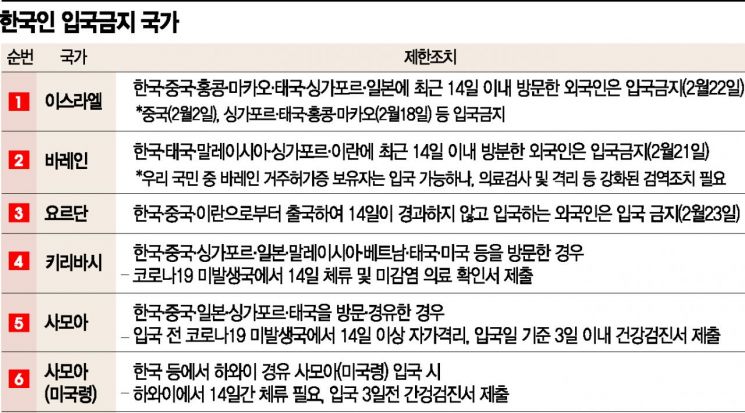
Besides entry bans, the number of countries strengthening self-quarantine and entry procedures has increased to nine. Following Brunei, the United Kingdom, Turkmenistan, Kazakhstan, Oman, Ethiopia, and Uganda, Macau and Qatar have started imposing movement restrictions on South Korea.
Macau classified South Korea as a high-risk area for COVID-19 infection and requires all visitors who have been to South Korea within the last 14 days to undergo enhanced quarantine at designated locations such as certified gyms. Qatar enforces self or facility quarantine for 14 days after entry if the traveler has a history of visiting COVID-19 infected countries.
Following movement restrictions, cases of upgrading travel advisories are also being confirmed one after another. After the U.S. Department of State and the Centers for Disease Control and Prevention (CDC) raised travel advisories for South Korea and Japan by one level, Taiwan made the same decision. The U.S. Department of State raised the travel advisory level for South Korea, where COVID-19 cases are increasing, to Level 2, and the CDC also upgraded the travel notice for South Korea to Level 2, the 'Alert Level,' related to COVID-19.
Taiwan elevated South Korea and Japan to Level 2 travel alert, the 'Alert Area,' due to the spread of COVID-19 and increasing infections, and stated that whether to raise it to Level 3 will be decided based on clear community transmission and whether the cumulative confirmed cases in the country exceed 1,000. Earlier, Vietnam recommended refraining from travel on the 21st, and Brazil strengthened quarantine for travelers arriving from seven Asian countries including South Korea, North Korea, Japan, Singapore, Vietnam, Thailand, and Cambodia.
Meanwhile, although not officially listed among countries imposing movement restrictions, the Thai government is also requiring teachers and students who have traveled to six countries including South Korea, China, Japan, Hong Kong, Taiwan, and Singapore to stay home for 14 days due to concerns about COVID-19 spread. Additionally, the Australian Department of Foreign Affairs and Trade announced it upgraded travel levels for South Korea and Japan from Level 1 to Level 2. Philippine authorities are also reportedly considering a travel ban on South Korea.
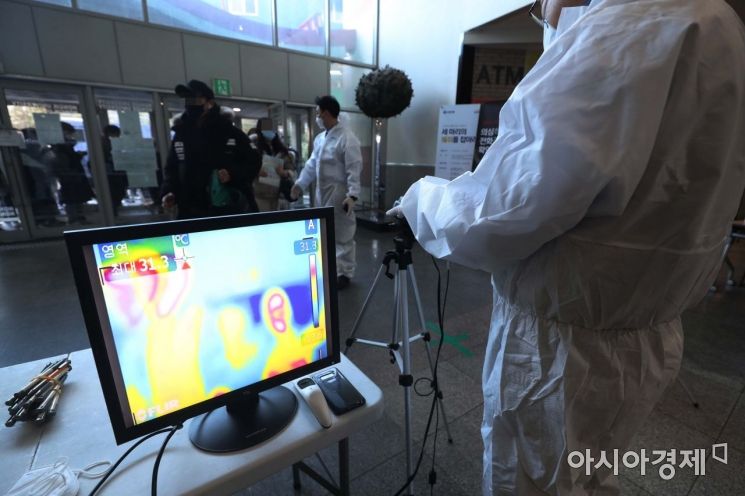 On the 23rd, amid concerns over the spread of the novel coronavirus infection (COVID-19), the 55th Certified Public Accountant exam was held at Hongik University in Mapo-gu, Seoul, where officials checked examinees for fever using thermal cameras. Photo by Moon Honam munonam@
© The Asia Business Daily(www.asiae.co.kr). All rights reserved.
![User Who Sold Erroneously Deposited Bitcoins to Repay Debt and Fund Entertainment... What Did the Supreme Court Decide in 2021? [Legal Issue Check]](https://cwcontent.asiae.co.kr/asiaresize/183/2026020910431234020_1770601391.png)


















