Legislative Possibility Uncertain, Moved Up by 2 Months Compared to Previous Years
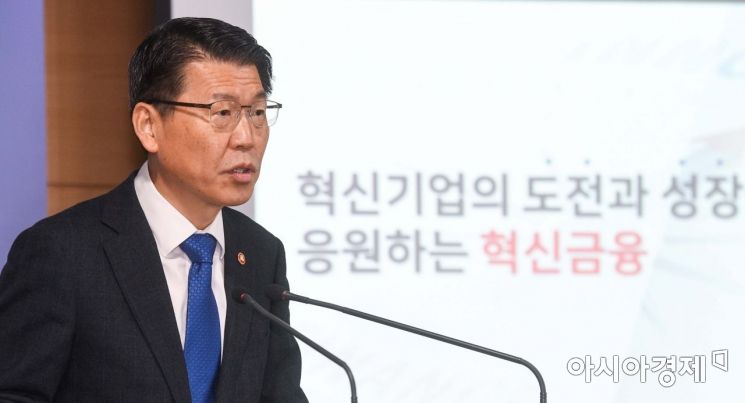 Eun Sung-soo, Chairman of the Financial Services Commission, is announcing the '2020 Financial Services Commission Work Plan' on the 19th at the Government Seoul Office in Jongno-gu, Seoul. Photo by Kang Jin-hyung aymsdream@
[Asia Economy Reporter Kangwook Cho] The model guidelines for financial group supervision for six major conglomerate financial groups, including Samsung, Hyundai Motor, Hanwha, and Mirae Asset, will be extended from May. This is a follow-up measure reflecting the future directions discussed at a seminar held at the end of last month, including improvements to the capital adequacy evaluation system and the establishment of internal control systems within groups. The reason for implementing it two months earlier than usual is interpreted as due to the uncertainty of legislation in May.
According to financial authorities and the financial sector on the 24th, the Financial Services Commission will hold a meeting in the afternoon attended by Financial Services Commission Chairman Eun Sung-soo, Financial Supervisory Service Senior Deputy Governor Yoo Kwang-yeol, CEOs of financial groups, and private experts to discuss the risk management performance of the financial group supervision system piloted over the past two years and the future direction of its implementation.
The "financial group supervision system" is a system that manages and supervises financial groups with assets exceeding 5 trillion won that operate financial companies in two or more sectors among deposit-taking, financial investment, and insurance. It is being promoted as one of the Moon Jae-in administration's national tasks to prevent repeating past mistakes where not only the financial companies but also consumers suffered damage due to the simultaneous insolvency of affiliated financial companies. It has been piloted based on model guidelines since July 2018, targeting six companies: Samsung, Hanwha, Hyundai Motor, DB, Mirae Asset, and Kyobo.
Earlier, on the 29th of last month, the financial authorities held a seminar attended by Min Byung-doo, Chairman of the National Assembly's Political Affairs Committee, and Kim Sang-jo, Policy Chief of the Presidential Secretariat, to discuss the results of a research project on improvements to the financial group supervision system that started last year and concluded earlier this year. At the seminar, improvement plans to prevent risks in advance were announced, including the preparation of a comprehensive group risk evaluation plan, establishment of group self-management systems, and the establishment of a voluntary monitoring system through disclosure of major risk factors.
At the meeting held on this day, discussions on the future direction of the financial group supervision system between the financial authorities and the supervised financial groups are expected based on the results of this research project. The financial authorities plan to improve the capital adequacy evaluation system. Currently, regulations have been criticized for focusing too much on capital adequacy management of financial groups and needing supplementation. Accordingly, the evaluation system will be reorganized into a single system that comprehensively considers various group risks by integrating concentration and contagion risk assessments.
Additionally, going forward, disclosure items scattered across individual companies will be integrated to provide the market and investors with an easy-to-understand form of the group's financial status, governance, and risk conditions. This is to establish a voluntary monitoring system for the market and investors through disclosure of major risk factors at the financial group level. The establishment of a group internal control system centered on the representative company will also be promoted. This is to enable financial groups to have systems to measure and manage risks themselves, while supervisory authorities inspect those systems, applying the so-called "Pillar II" system. Pillar II is one of the Basel regulatory standards (Pillars I to III) set by the Basel Committee, composed of central bank and banking supervisory authority representatives from major countries.
© The Asia Business Daily(www.asiae.co.kr). All rights reserved.
![User Who Sold Erroneously Deposited Bitcoins to Repay Debt and Fund Entertainment... What Did the Supreme Court Decide in 2021? [Legal Issue Check]](https://cwcontent.asiae.co.kr/asiaresize/183/2026020910431234020_1770601391.png)















