[Asia Economy Reporter Jeong Hyunjin] As the novel coronavirus infection (COVID-19) rapidly spreads worldwide, finance ministers and central bank governors of the Group of Twenty (G20) publicly expressed concerns about downward pressure on the economy. On the 23rd (local time), they agreed to consider various measures such as easing trade tensions and monetary policies if necessary. However, since it is difficult to immediately confirm the economic impact, they placed more emphasis on monitoring the situation rather than intervening right away.
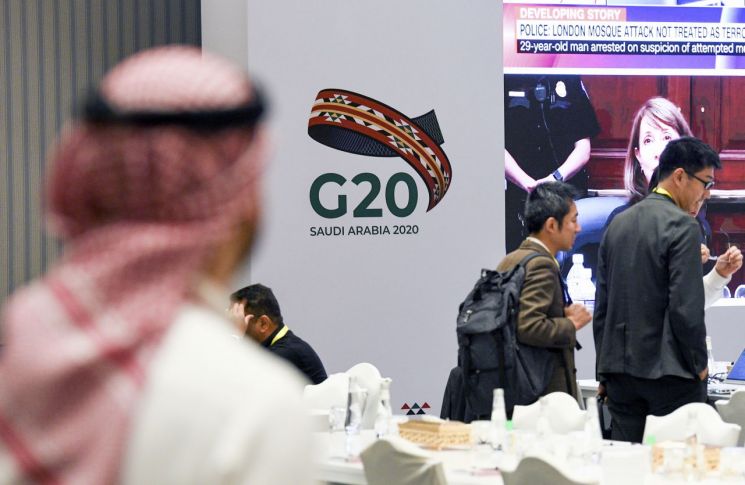
According to CNN and others, the G20 finance ministers and central bank governors concluded their meeting in Riyadh, Saudi Arabia, on the same day and stated in a joint declaration, "We agreed to closely monitor the risks facing the international economy due to the COVID-19 outbreak" and "We will take more proactive measures to address these risks." They pointed out that "global economic growth remains sluggish, and there are downside risks including persistent trade tensions and policy uncertainties." However, they mentioned that the economy is "expected to grow moderately in 2020-2021."
Global economic leaders expressed concerns about the possibility of an economic downturn due to COVID-19 during the meeting. Saudi Finance Minister Mohammed Al-Jadaan, who chaired the meeting, said in his closing remarks, "G20 member countries have decided to intervene using necessary policy tools regarding various risks," and forecasted, "The global economy will continue to grow, but downside pressures remain." Haruhiko Kuroda, Governor of the Bank of Japan (BOJ), also stated, "If the spread of COVID-19 continues, it could cause significant damage to the Japanese and global economies," emphasizing, "We are fully prepared to take necessary measures to mitigate the economic impact of COVID-19 and will cooperate with international organizations."
Kristalina Georgieva, Managing Director of the International Monetary Fund (IMF), said, "(Due to the spread of COVID-19) the expected global economic recovery is uncertain," adding, "COVID-19 has already disrupted economic activities in China, which could put the global economic recovery at risk." She urged G20 member countries to cooperate to overcome this crisis. In a panel discussion the previous day, Georgieva revised down the forecast for China's economic growth rate this year by 0.4 percentage points from January to 5.6%, and lowered the global economic growth rate forecast by 0.1 percentage points to 3.2%.
Although countries expressed concerns, they refrained from taking immediate action because it is difficult to gauge the extent of damage at this point. U.S. Treasury Secretary Steven Mnuchin said, "The virus is spreading rapidly, but the fatality rate is quite low. It is too early to say whether this is a very worrisome situation or not," adding, "We need another 3 to 4 weeks." He emphasized, "It seems manageable now, but that could change," and said, "I don't want to comment on monetary policy, but certainly central banks will look at various options if COVID-19 impacts the economy."
In the U.S., considering that COVID-19 originated in China, concerns were raised about the procurement of pharmaceuticals. Peter Navarro, Director of Trade and Manufacturing Policy at the White House, said, "Not only COVID-19 but also the supply chain for essential medicines has been excessively relocated overseas," emphasizing, "Part of my role is to ensure our supply chains are secure and that we can obtain what is necessary." Bruno Le Maire, French Minister of Economy and Finance, also stressed in a foreign media interview that France needs to produce more items such as pharmaceuticals and electric batteries from a strategic perspective. He said, "This is not protectionism but responsibility," adding, "Since the initial costs are high, public support is necessary. Both China and the U.S. are doing this. I don't understand why only Europe is not doing so."
© The Asia Business Daily(www.asiae.co.kr). All rights reserved.