Korean Air to Suspend Flights to Israel Banning Korean Entry Until Next Month 28
"Inbound Share Around 30% for FSC, 15% for LCC... Will Be Affected by Travel Warnings from Various Countries"
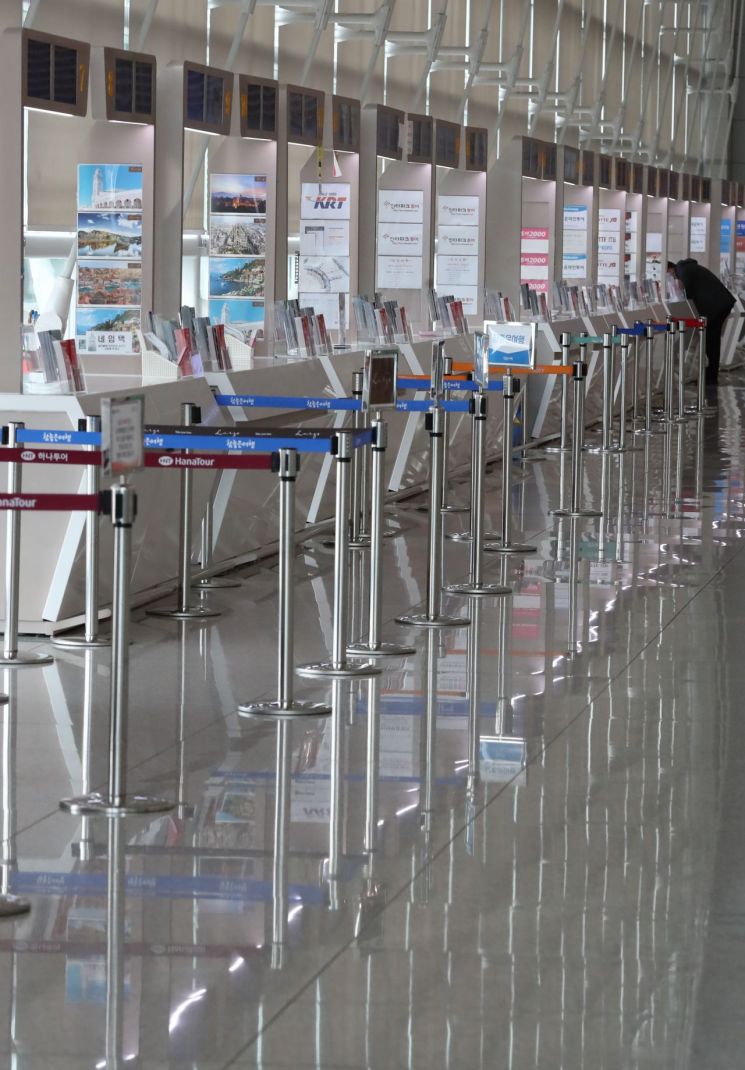
[Asia Economy Reporter Yu Je-hoon] The aviation industry is facing a double burden as some overseas countries have issued or raised travel alerts against Korea amid the novel coronavirus disease (COVID-19) outbreak. This is because the outbound demand to China and Southeast Asia has sharply declined due to the spread of COVID-19 in China, and there is an increasing possibility that inbound demand will also be adversely affected.
According to the industry on the 24th, Korean carriers such as Korean Air, Asiana Airlines, and Jeju Air held separate meetings in the morning to urgently check the reservation status of routes related to countries issuing travel alerts against Korea and banning Korean nationals from entry, as well as the overall inbound routes. This measure comes as some countries including the United States, Taiwan, and Vietnam have urged caution regarding travel to Korea due to the domestic spread of COVID-19 and have announced bans on Korean nationals entering their countries.
Earlier, on the 22nd, Korean Air flight KE957 bound for Tel Aviv Ben Gurion Airport returned to Incheon after only allowing local passengers to disembark due to an entry ban notification from the Israeli government during the flight. A Korean Air official explained, "We received the entry ban notification three hours before arrival in Tel Aviv," adding, "The Incheon-Tel Aviv route is scheduled to be suspended from today until the 28th of next month."
The industry is concerned that inbound demand from foreigners visiting Korea may shrink further due to this situation. Although Korean carriers generally have a significantly higher proportion of outbound passengers, the simultaneous decline in both inbound and outbound demand due to the spread of COVID-19 could exacerbate difficulties in the aviation sector.
Professor Lee Hwi-young of Inha Technical College said, "Typically, the inbound proportion of passengers is estimated to be around 30% for major airlines and about 15% for low-cost carriers (LCCs), which is relatively low. However, recently, as outbound demand has decreased due to COVID-19, the relative importance of inbound demand has increased," adding, "If travel alerts spread, inbound demand is likely to decrease further following the decline in outbound demand."
This trend was also observed during previous infectious disease outbreaks, notably the 2015 Middle East Respiratory Syndrome (MERS) outbreak. According to the Korea Tourism Organization, the number of foreign visitors to Korea in June and July 2015, when MERS spread rapidly, was 750,925 and 629,737 respectively, representing decreases of 41.0% and 53.5% compared to the same period the previous year. Korea ranked second worldwide in MERS cases, and countries such as the United States, Taiwan, and Hong Kong had issued various levels of travel alerts at that time.
The Korea Economic Research Institute also predicted that if the current COVID-19 outbreak spreads to the level of the 2003 Severe Acute Respiratory Syndrome (SARS) or the 2015 MERS, the number of foreign visitors to Korea could decrease by 1.25 million and 1.65 million respectively.
Meanwhile, foreign airlines such as Vietnam Airlines, Philippine Airlines, Thai Airways, Singapore Airlines, Thai Airways, and Thai AirAsia X have recently suspended or reduced flights to Korea. This is interpreted as reflecting concerns over the decline in inbound demand due to COVID-19 and the spread of the infection.
© The Asia Business Daily(www.asiae.co.kr). All rights reserved.
![User Who Sold Erroneously Deposited Bitcoins to Repay Debt and Fund Entertainment... What Did the Supreme Court Decide in 2021? [Legal Issue Check]](https://cwcontent.asiae.co.kr/asiaresize/183/2026020910431234020_1770601391.png)















