"Enhanced Caution Measures... US State Department Adjusts Alerts Frequently"
Number of Countries with Elevated Travel Warnings Increases
Israel Bans Entry of Koreans Starting from the 22nd
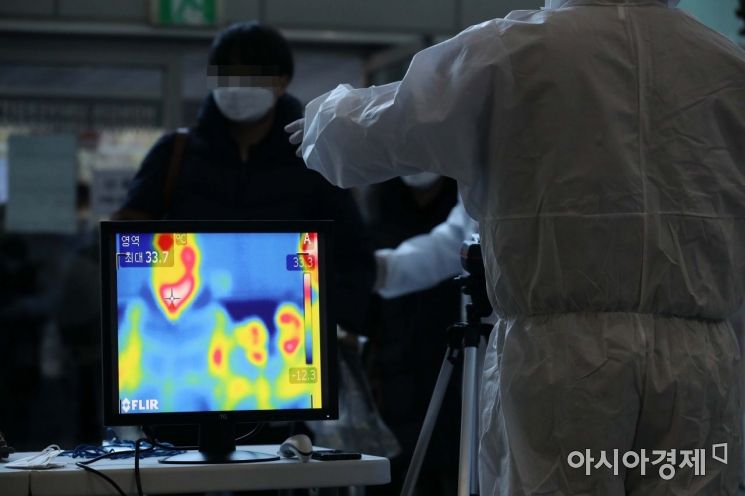 On the 23rd, amid concerns over the spread of the novel coronavirus disease (COVID-19), the 55th Certified Public Accountant exam was held at Hongik University in Mapo-gu, Seoul. Officials are checking examinees for fever using thermal cameras at the testing site. Photo by Mun Ho-nam munonam@
[Asia Economy Reporter Lim Cheol-young] The Ministry of Foreign Affairs clarified on the 23rd that although the U.S. Department of State and the Centers for Disease Control and Prevention (CDC) have raised travel alerts for South Korea and Japan, this does not constitute a ban on Americans traveling to South Korea or on South Koreans entering the United States.
The U.S. Department of State raised the travel advisory level to Level 2 for South Korea, where confirmed cases of the novel coronavirus infection (COVID-19) are increasing. The Department of State stated that while many confirmed cases had been linked to travel to mainland China or contact with travelers, continuous community spread has now been reported, prompting the upgrade of the travel advisory level. Countries classified under Level 2 travel advisories related to COVID-19 now include Hong Kong, Macau, South Korea, and Japan. Over 70 countries, including the United Kingdom, Germany, France, Mexico, and the Philippines, are also listed at this level. China was classified as Level 4, the travel ban level, on the 2nd of this month.
The U.S. CDC also raised the travel notice level for South Korea to Level 2, the "Alert" level, which is one step higher than the Level 1 "Watch" level assigned to Hong Kong. The Alert level signifies "enhanced precautions," and South Korea and Japan were simultaneously designated at this level. China was classified as a Level 3 "Warning" level country on the 4th, indicating that unnecessary travel should be avoided.
An official from the Ministry of Foreign Affairs explained, "The U.S. government is requesting that its citizens exercise greater caution when traveling to South Korea and Japan. This does not mean a ban on travel to these countries, and especially, it has no impact on our citizens entering the United States."
The official also emphasized that adjustments to the U.S. Department of State's travel advisories and CDC notices are information that is updated frequently based on regional situations. "The U.S. Department of State regularly adjusts travel advisories based on the conditions in each country," the official said, adding, "Currently, over 70 countries including the United Kingdom, Germany, and France are classified under Level 2 travel advisories according to various criteria."
Furthermore, the official noted, "The CDC issues travel notices based on disease outbreaks, natural disasters, and other factors that may affect travelers' health in various countries and regions," adding, "Level 2 travel notices have been implemented for countries with occurrences of diseases such as polio and yellow fever."
Meanwhile, the number of countries raising the travel alert level for South Korea due to COVID-19 is increasing. Earlier, Vietnam recommended refraining from travel on the 21st, and Taiwan designated South Korea as a Level 1 infectious disease travel alert area. Brazil has strengthened quarantine measures for travelers arriving from seven Asian countries including South Korea, North Korea, Japan, Singapore, Vietnam, Thailand, and Cambodia.
Israel has banned entry for South Koreans. The Israeli government prohibited entry of South Korean tourists starting from the 22nd (local time). As a result, about 130 South Koreans who arrived at Ben Gurion International Airport in Tel Aviv at 7:55 p.m. on the 22nd were denied entry. They departed for South Korea on the same flight at around 9:50 p.m. This measure by Israel came after it was confirmed that South Koreans who participated in a pilgrimage to Israeli holy sites were infected with COVID-19.
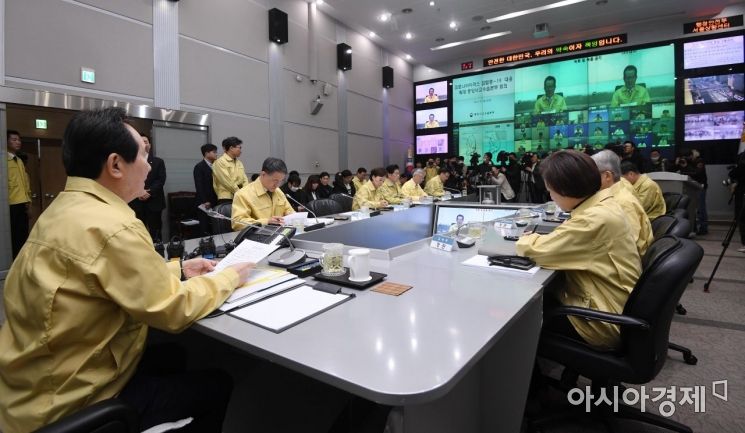 Prime Minister Chung Sye-kyun is presiding over the Expanded Central Disaster and Safety Countermeasures Headquarters meeting for COVID-19 response at the Seoul Situation Center in the Central Disaster and Safety Situation Room of the Government Seoul Office Building, Jongno-gu, Seoul, on the 21st. Photo by Kim Hyun-min kimhyun81@
© The Asia Business Daily(www.asiae.co.kr). All rights reserved.


















