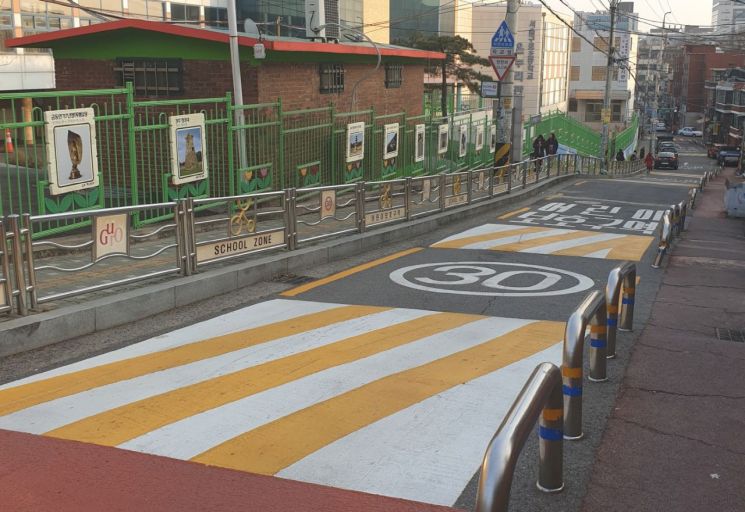
[Asia Economy Reporter Oh Hyung-gil] Starting from the 25th of next month, the traffic safety reinforcement measures for school zones, commonly known as the 'Min-sik Law,' will be enforced. Drivers who violate the law while driving in school zones will face severe penalties. As automobile and auto insurance-related systems change, the related insurance market is also expected to undergo transformations. Non-life insurance companies are busy formulating strategies, such as expanding coverage for driver insurance that guarantees fines or settlement payments and launching promotional activities.
According to the insurance industry on the 21st, the government has decided to raise the deductible for drunk driving accidents by the end of next month. Currently, drunk drivers can be exempted from civil liability for traffic accidents by paying a deductible of up to 4 million KRW (3 million KRW for bodily injury, 1 million KRW for property damage). This has been criticized for the relatively low economic burden on offenders compared to the severity of accidents caused by drunk driving.
In particular, automobile insurance payouts for drunk driving accidents have approached 300 billion KRW annually, contributing to an increase in the loss ratio of automobile insurance. According to the Korea Insurance Development Institute, automobile insurance payouts for drunk driving accidents from 2015 to 2018 amounted to 1.2055 trillion KRW. This means that premiums paid by conscientious drivers are used to compensate for damages caused by drunk drivers.
The Financial Services Commission and the Ministry of Land, Infrastructure and Transport are considering raising the accident deductible to a maximum of 10 million KRW for bodily injury and 5 million KRW for property damage to raise awareness about drunk driving and prevent insurance payout leakage. This measure is expected to prevent an annual insurance payout leakage of approximately 55 billion KRW.
The government will also strengthen premium surcharges for vehicles with high repair costs. The average repair cost for imported cars is 2.85 million KRW, which is 2.6 times higher than the average repair cost for domestic cars (1.08 million KRW). This aims to prevent deterioration of the loss ratio due to the increase in imported car purchases and to increase the driver's deductible.
The Ministry of Land, Infrastructure and Transport recently amended the Enforcement Decree of the Automobile Damage Compensation Guarantee Act to provide personal information related to traffic law violations such as principal driver status or driver's license validity to non-life insurance companies.
Insurance companies will be able to determine whether an accident for which a claim was made involved drunk or unlicensed driving. The industry expects this to enable risk management against fraudulent claims where such facts are concealed and claims are made as general accidents.
Interest in driver insurance is also expected to increase with the enforcement of the Min-sik Law. From now on, in cases of accidents exceeding 30 km/h speed limit or accidents neglecting child safety within school zones, offenders will face imprisonment from 1 year to 15 years or fines ranging from 5 million KRW to 30 million KRW for injuries. In case of death, imprisonment from 3 years without fines up to life imprisonment is possible. Driver insurance consists of key coverages such as 100 million KRW for traffic accident support funds, 20 million KRW for attorney fees, and fines coverage of 20 million KRW for bodily injury and 5 million KRW for property damage.
Meanwhile, the extension of the employment eligibility age is expected to be a long-term factor increasing automobile insurance loss ratios. The recently passed amendment to the 'Special Act on Improving the Quality of Life for Farmers and Fishermen and Promoting Development of Farming and Fishing Villages' raises the employment eligibility age for farmers and fishermen, which is the basis for calculating automobile insurance payouts, from 65 to 70 years. An insurance industry official said, "Since it only applies to farmers and fishermen, insurance payouts will not increase sharply," but added, "Along with discussions on retirement age extension, it could be a burden on loss ratios in the long term."
© The Asia Business Daily(www.asiae.co.kr). All rights reserved.

















