COVID-19 Patients, 106 in Two Days...Nationwide Pandemic Phase
"Asymptomatic and Early-Stage Infectivity ↑, Spread May Accelerate"
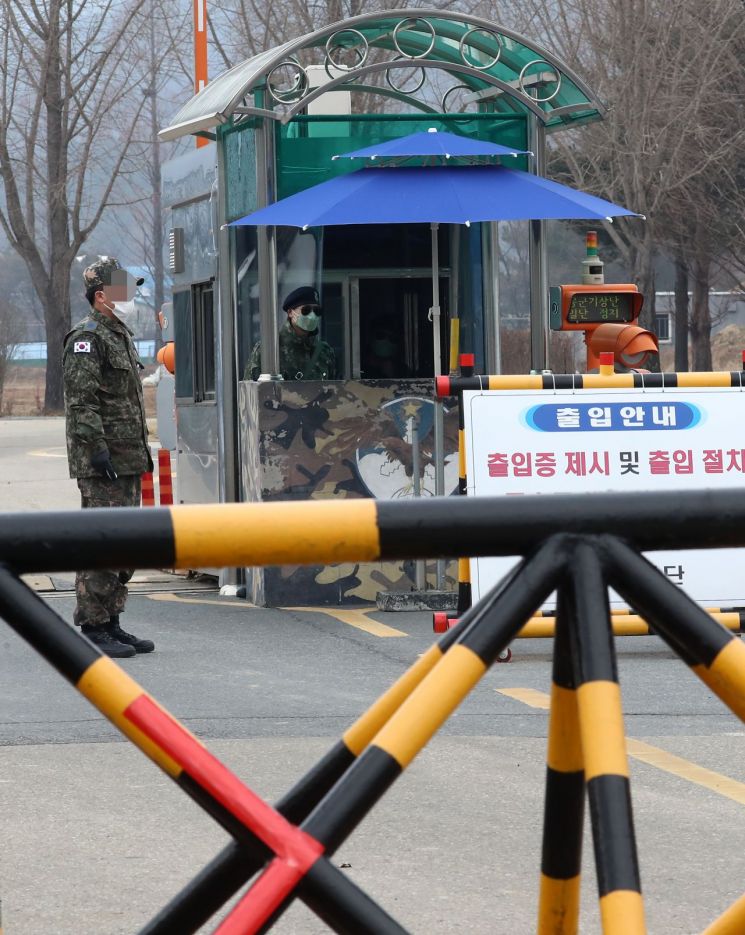 On the morning of the 21st, officials are on duty at the main gate of the Air Force Weather Unit at Gyeryongdae in Gyeryong City, Chungnam. In the early hours of the day, Air Force Lieutenant A, who was dispatched to the Air Force Weather Unit, tested positive for the novel coronavirus (COVID-19) and was transferred to the Armed Forces Capital Hospital.
 [Asia Economy Reporters Choi Dae-yeol, Kim Heung-soon, Lee Jung-yoon] Following the cluster outbreak of the novel coronavirus infection (COVID-19) centered in the Daegu and Gyeongbuk regions, patients have been continuously reported across the country, effectively entering the 'nationwide pandemic' phase. Experts warn that considering COVID-19’s characteristic of strong transmissibility from the early stages of infection, the spread could accelerate further. With patients emerging consecutively in group facilities such as churches and military units, and even hospital-acquired infections?most feared by health authorities?becoming a reality, the government is also introducing additional measures, but it is expected to face criticism for its delayed response.
Nationwide Spread Following Cluster Outbreak
Among the 52 newly confirmed patients on this day, most were found to be related to the Shincheonji Daegu Church. According to the Central Disaster and Safety Countermeasures Headquarters for COVID-19, 39 were confirmed to have connections such as visiting this church. The problem is that after visiting the church for worship, patients spread to various parts of the country. Of the 39, six patients reside outside Daegu.
In the case of Daenam Hospital in Cheongdo, Gyeongbuk, where a patient was confirmed positive post-mortem, 15 patients (including the deceased) were confirmed the previous day, and one more was diagnosed positive on this day. It is reported that five nurses are among them, marking the first occurrence of a healthcare worker cluster infection. Health authorities conducted infection control readiness inspections at all nursing hospitals nationwide on the 17th and 18th, but this hospital was not included.
This hospital is connected via corridors to the Cheongdo County Public Health Center, the County-Run Cheongdo Elderly Nursing Hospital, and Edenwon (a nursing home). While the connection between facilities offers advantages for patient care, it is vulnerable to infectious disease spread, raising concerns about additional infections among long-term hospitalized patients and elderly individuals with weakened immunity. Authorities have currently closed the facility and are conducting comprehensive testing on approximately 600 staff and patients.
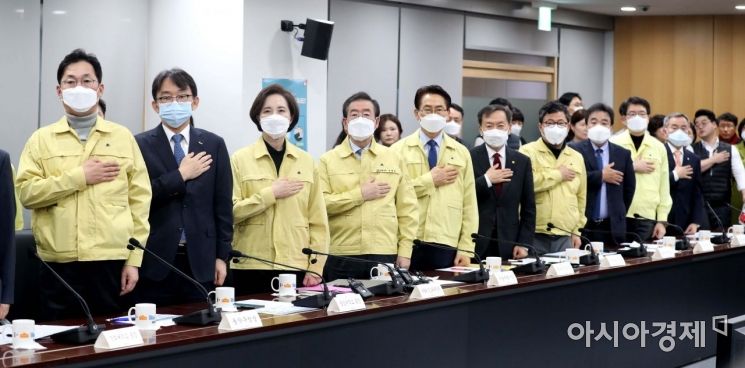 On the 21st, at the Seoul City Hall Planning Situation Room, participants including Yoo Eun-hye, Deputy Prime Minister for Social Affairs and Minister of Education, and Mayor Park Won-soon attended the Ministry of Education-Seoul City countermeasure meeting to protect and support Chinese international students entering the country. They are saluting the national flag while wearing masks to prevent the spread of COVID-19. Photo by Moon Ho-nam munonam@
"Increased Infectivity from Early Stage"
Medical staff treating COVID-19 patients report that compared to other respiratory infectious diseases, the viral shedding is high from the early stages of the illness. This underpins the view that infectivity is high from the outset. Along with cluster outbreaks in churches and hospitals, patients with unclear infection routes continue to emerge, raising the possibility of new clusters forming. Early symptoms are mild, making it likely that patients themselves may not recognize their infection, and asymptomatic transmission?controversial from the start?is currently considered highly probable.
Oh Myung-don, chairman of the Central Clinical Committee composed of attending physicians and hospital officials (Professor of Infectious Diseases at Seoul National University Hospital), stated at a briefing the previous day, "In a study of 114 individuals transferred from Wuhan, China to Germany, there were cases where the virus was detected despite no symptoms," indicating a high possibility of asymptomatic infection. Bang Ji-hwan, director of the Central Infectious Disease Center at the National Medical Center, pointed out, "COVID-19 has a high viral load from the early symptomatic stage and is released from the upper respiratory tract, making it easily transmissible through coughing. (In the early stage) symptoms may be mild or absent, allowing community infection and spread before diagnosis."
 On the 21st, as the possibility of community spread of the novel coronavirus (COVID-19) increases, Tongin Market in Jongno-gu, Seoul, is seen quiet. Photo by Hyunmin Kim kimhyun81@
Negative Pressure Rooms Should Be Used Mainly for Severe Patients
As patient numbers surge, overloading the community healthcare system, calls for a comprehensive overhaul are emerging. Negative pressure rooms, which prevent air inside the room from escaping outside, are necessary for treating COVID-19 patients or isolating suspected cases. However, with the likelihood of hundreds or thousands of patients in the future, the current treatment system needs adjustment, such as treating mild cases outside negative pressure rooms.
According to the Central Disaster and Safety Countermeasures Headquarters, there are a total of 161 designated isolation rooms and 198 beds nationwide. Including other public medical centers and private hospitals, there are 755 rooms and 1,027 beds. The utilization rate of nationally designated negative pressure beds is about one-third nationwide, but Daegu (87.5%) and Gyeongbuk (100%) are already fully occupied.
Jeon Byung-yul, dean of the Graduate School of Health Industry at CHA University, said, "When patients occur nationwide, the most important issue is how medical institutions provide treatment, isolate, and hospitalize patients, but confusion may arise there." He emphasized, "The treatment system needs to be adjusted so that negative pressure rooms are used mainly for severe patients without overlapping movement paths with other general patients." Chairman Oh added, "We have entered a stage where social distancing measures such as refraining from gatherings, school closures, and telecommuting are necessary to slow the spread of COVID-19. Slowing the increase in patient numbers allows medical institutions to prepare beds and reagents."
© The Asia Business Daily(www.asiae.co.kr). All rights reserved.



















