Apartment Smoking Conflicts... Secretly Smoking in Front of Others' Homes and Running Away
Secondhand Smoke Disputes Escalate to Violence with Weapons
Difficulty Obtaining Household Head Consent for Designating Smoke-Free Apartments
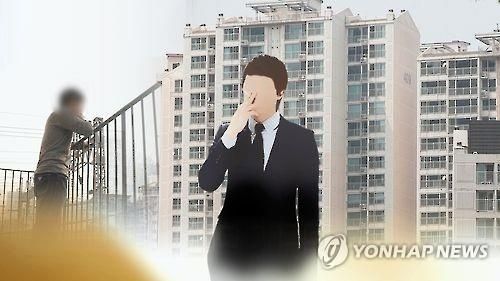
[Asia Economy Reporter Han Seung-gon] # A man in his 30s, Mr. A, recently experienced a frustrating incident. Smoke from a cigarette drifted into his home, and when he went outside, he found only cigarette butts but could not find the person who had smoked. Mr. A said, "Recently, there have been shameless neighbors who smoke in front of other people's homes and then disappear, which is very stressful," adding, "The apartment's closed-circuit television (CCTV) is only around the elevator area, so I can't find the inconsiderate neighbor."
Smoking bans in apartment complexes and other multi-family housing apply only to outdoor spaces. Because of this, residents who smoke do so inside their balconies or bathrooms. This has led to conflicts over secondhand smoke between floors. However, some even smoke in apartment hallways, intensifying conflicts among neighbors.
Some residents, worried that cigarette smoke will enter their homes if someone smokes in front of their door, change floors and smoke in front of other people's homes, leaving cigarette butts behind and fleeing?so-called "secret smokers"?causing extreme stress among residents.
Mr. B, another office worker in his 30s who recently experienced a similar case, said, "I don't smoke, but I smelled cigarette smoke in my home. When I went outside, someone had smoked in front of my house," adding, "I want to confront them, but I don't know where they live, so I just inquired at the security office."
Conflicts over smoking in multi-family housing have been increasing every year. According to the Anti-Corruption and Civil Rights Commission, conflicts over secondhand smoke in apartments investigated since 2014 increased from 260 cases in 2015 to 265 in 2016 and 353 in 2017. The total number of related disputes reached 1,215.

Given this situation, various disputes over smoking conflicts have arisen. In August 2016, in Seoul, a man in his 50s was arrested by the police for stabbing his neighbor with a weapon over a conflict about secondhand smoke.
Also, in December 2018, in Gwangju Metropolitan City, a man in his 70s who smoked in a non-smoking area and a security guard in his 60s who told him "You shouldn't smoke in public places" got into a fistfight and were both booked.
Residents suffering from secondhand smoke expressed their frustration. Mr. C, an office worker in his 40s, said, "I don't smoke at all, but because my neighbor smokes, the smell comes into my home, so I am effectively exposed to secondhand smoke," adding, "My health is deteriorating, and I am angry at neighbors who only think of themselves."
Another resident in his 30s, Mr. D, raised his voice, saying, "Residents who cannot even follow the minimum rules in shared living areas should be dealt with according to the law," adding, "Those who don't smoke don't know how painful it is."
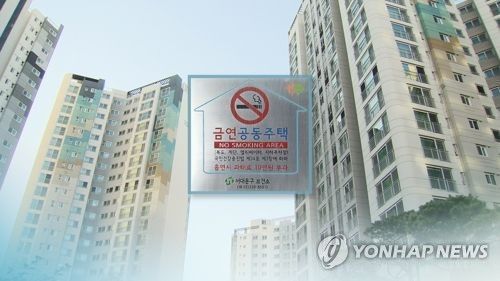
As conflicts over secondhand smoke between floors grow, local governments are enacting smoking bans and designating non-smoking apartments as alternatives. After designation as a non-smoking apartment, smoking in non-smoking areas results in a fine of up to 100,000 won.
The problem is effectiveness. The designation of a non-smoking apartment requires the consent of more than half of the residents. However, it is not easy to obtain consent from all household heads, and in some areas, signatures were submitted by proxy members of households but were rejected due to not meeting the majority consent criteria. Ultimately, since it is a shared living space, conflicts can be reduced through mutual consideration.
An official from an apartment management office explained, "Conflicts over secondhand smoke between floors occur in other apartments as well," adding, "It is practically impossible to monitor smoking in bathrooms or balconies." He continued, "When someone secretly smokes in front of another person's home and disappears, we warn them through CCTV analysis or guide them with official notices to observe mutual courtesy."
© The Asia Business Daily(www.asiae.co.kr). All rights reserved.
![Clutching a Stolen Dior Bag, Saying "I Hate Being Poor but Real"... The Grotesque Con of a "Human Knockoff" [Slate]](https://cwcontent.asiae.co.kr/asiaresize/183/2026021902243444107_1771435474.jpg)


















