Five New Areas Subject to Regulation
Mostly Mid-to-Low Priced Housing
Almost No Apartments Priced Around 900 Million Won
[Asia Economy Reporter Donghyun Choi] Concerns are rising that the groups most adversely affected by the government's expansion of regulated areas and tightening of loan regulations will be low-income households owning old, low-priced homes. This is because the median apartment prices in the newly designated regulated areas are only around 300 to 400 million KRW, and there are almost no apartments exceeding 900 million KRW where the loan-to-value ratio (LTV) is restricted to 30%, except for some new apartments, meaning most will not be significantly impacted. Critics argue that this policy may have been a showy measure aimed at swaying voters ahead of the general election.
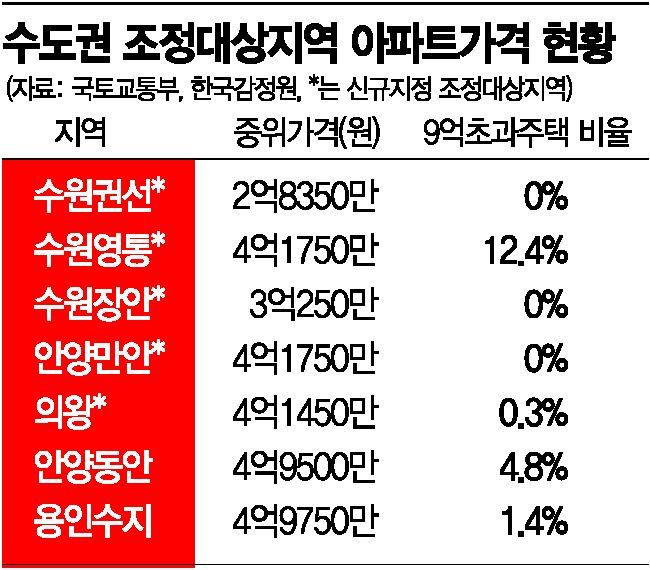
According to the Korea Real Estate Board on the 21st, as of January, the median apartment sale price in Gyeonggi Province was 358.49 million KRW. Among the five newly designated regulated areas, only Suwon Yeongtong-gu, Anyang Manan-gu, and Uiwang-si have median prices exceeding the Gyeonggi average. Even these median prices range from 414.5 million to 417.5 million KRW, falling short of 500 million KRW. Suwon Jangan-gu is only 302.5 million KRW, and Gwonseon-gu is 283.5 million KRW. The median price refers to the price positioned exactly in the middle when all surveyed homes are arranged in order of price. This means that in all five areas, more than half of the apartments have prices barely above the low 400 million KRW range.
The government adjusted the LTV in regulated areas from 60% to 50% through this regulation and further lowered it to 30% for the portion of home prices exceeding 900 million KRW. This applies the '900 million KRW' high-priced apartment standard, previously used for speculative overheated districts like Seoul under the December 16 measures, to regulated areas as well. In Seoul, according to KB Kookmin Bank statistics last month, the median apartment price exceeded 900 million KRW, placing the majority under loan regulation. After the policy implementation, demand suppression effects appeared, and price declines have continued mainly in the Gangnam 3 districts (Seocho, Gangnam, Songpa), where high-priced apartments are concentrated.
However, applying a uniform 900 million KRW standard to areas where the median apartment price is less than half that of Seoul raises questions about whether suppressing high-priced apartments will effectively control prices in surrounding complexes. According to data released by the Ministry of Land, Infrastructure and Transport, the five newly designated regulated areas in the metropolitan area generally had a '0' proportion of apartments priced around 900 million KRW. In Suwon, Yeongtong-gu, which includes Gwanggyo New Town, had the highest proportion at 12.4%, while Gwonseon-gu and Jangan-gu had 0%. Anyang Manan-gu also had 0%, and Uiwang-si had only 0.3%. Except for some parts of Gwanggyo New Town, the 'LTV 30% regulation for apartments exceeding 900 million KRW' is effectively a negligible policy. A Ministry of Land official explained, "Stronger regulations are applied to high-priced apartments, while mid- to low-priced apartments are somewhat more protected compared to speculative overheated districts."
This showy 'pinpoint' approach by the government is expected to cause greater damage to existing regulated areas. The proportion of apartments exceeding 900 million KRW in existing regulated areas is 4.8% in Anyang Dongan, 1.4% in Yongin Suji, and 1.1% in Guri-si. In non-regulated areas like Hwaseong (including Dongtan 2, which is a regulated area), the proportion is 1.5%, significantly higher than the newly designated regulated areas. Ham Young-jin, head of Zigbang Big Data Lab, said, "Since the December 16 measures were announced not long ago and with the April 15 general election approaching, it was probably difficult to introduce a strong comprehensive real estate policy. It seems the policy level was adjusted by strengthening regulated areas while responding with pinpoint measures to localized balloon effects."
© The Asia Business Daily(www.asiae.co.kr). All rights reserved.
![Clutching a Stolen Dior Bag, Saying "I Hate Being Poor but Real"... The Grotesque Con of a "Human Knockoff" [Slate]](https://cwcontent.asiae.co.kr/asiaresize/183/2026021902243444107_1771435474.jpg)
















