Won-Dollar Exchange Rate Hits 4-Month High
KOSPI and KOSDAQ Decline for Second Consecutive Day
1-Year Treasury Bond Yield at 5-Month Low
Concerns Over Foreign Investment Outflow Further Weakening Won Value
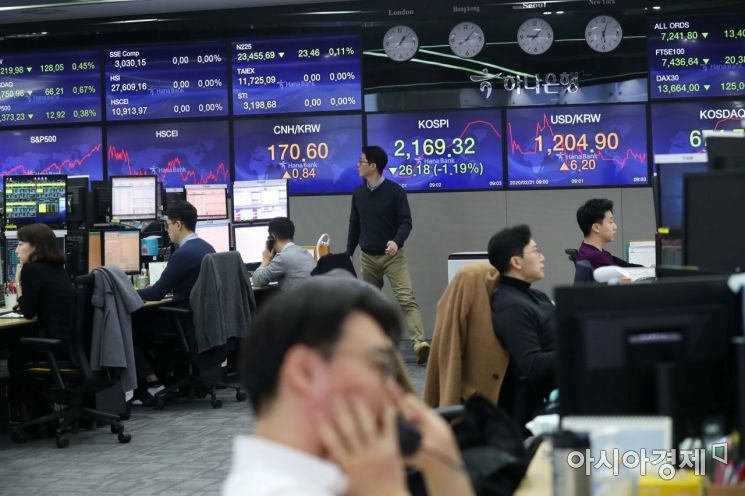 On the 21st, as the possibility of community spread of the novel coronavirus (COVID-19) increases, the KOSPI index opened lower at 2,165.65, down 29.85 points (1.36%) from the previous trading day. The won-dollar exchange rate started the session at 1,205.7 won, up 7.0 won. Dealers are working in the dealing room of Hana Bank in Euljiro, Seoul on this day. Photo by Moon Honam munonam@
[Asia Economy Reporters Song Hwajeong and Kim Eunbyeol] As confirmed cases of the novel coronavirus infection (COVID-19) surge rapidly, anxiety is spreading in the financial markets. The won-dollar exchange rate soared to its highest level in four months, while government bond yields fell across the board. As the financial markets shake, concerns over foreign capital outflows are also growing.
On the 21st, the KOSPI opened at 2,165.65 points, down 1.36% (29.85 points) from the previous day, and the KOSDAQ fell 1.19% (8.09 points) to 673.57, continuing a two-day losing streak. The won-dollar exchange rate continued its upward trend. At 10:14 a.m. in the Seoul foreign exchange market, the won-dollar exchange rate stood at 1,205.45 won. The previous day, the won-dollar exchange rate rose to 1,201.9 won during trading hours, surpassing 1,200 won for the first time since October last year.
Government bond yields continue to decline. According to the Korea Financial Investment Association, the 3-year government bond yield, a benchmark market rate in the Seoul bond market, was 1.222% as of 10:12 a.m. that day. The previous day, the 3-year bond yield closed at 1.234%, down 5.0 basis points from the previous trading day, and the 1-year government bond yield ended at 1.209%, down 2.8 basis points. Both the 3-year and 1-year yields fell below the base rate (1.25%), with the 3-year yield at its lowest since October 7 last year (1.232%) and the 1-year yield at its lowest since September 11 last year (1.202%).
Due to the impact of COVID-19, the preference for safe assets has expanded, leading to continued weakness in the stock market, a stronger dollar, and falling bond yields.
It is expected that the won will inevitably weaken for the time being due to the spread of COVID-19. Researcher Heo Jinwook of Samsung Securities said, "With Korea's exports to China sharply declining and concerns over a reduction in foreign tourists, the rapid increase in new domestic cases has negatively affected the won-dollar exchange rate," adding, "In the short term, the won-dollar exchange rate is expected to fluctuate depending on the spread of the epidemic not only in China but also domestically." He forecasted that exchange rate stabilization would be possible only in the second quarter. Heo explained, "The won-dollar exchange rate will be influenced by the strength of China's economic recovery. It is expected that China's economy will normalize in the second quarter and domestic epidemic concerns will subside. Accordingly, negative perceptions of the Korean economy will improve, leading to a downward stabilization of the won-dollar exchange rate."
It is also expected that it will take time for the stock market to recover from COVID-19. Researcher Park Seokhyun of KTB Investment & Securities said, "After the initial shock of COVID-19 caused a sharp drop in stock prices, advanced markets have recovered their previous index levels, but emerging markets have been slower to recover returns," adding, "This is due to differences in risk exposure to the Chinese economy, which is facing economic shocks." Park added, "In a situation where concerns about the Chinese economy coexist with expectations for Chinese government stimulus measures, the uncertainty of the Chinese economy due to COVID-19 needs to improve, and it may take more time for emerging markets, including the KOSPI, to recover to pre-COVID-19 index levels."
In particular, the indicator linked to the recovery of emerging market stock prices, including the domestic stock market, is the dollar exchange rate. Park said, "The dollar index rose 3.4% this year, and during the same period, emerging markets underperformed advanced markets in stock returns," explaining, "The economic fundamental differentiation and widening monetary policy gap, which were the background for the dollar's strength, have caused the relative underperformance of emerging market stocks, and the COVID-19 situation is further fueling the dollar's strength." Park added, "Until these factors driving the dollar's strength subside, the recovery of emerging market stock price peaks may be delayed, so an investment strategy of phased buying during corrections rather than chasing purchases is necessary."
There is an analysis that the rapid increase in domestic confirmed cases is weighing on risk asset investment sentiment. Researcher Noh Donggil of NH Investment & Securities said, "While the spread of COVID-19 in China is slowing, the increase in new confirmed cases in Asian regions outside China, including Korea, Japan, and Singapore, is burdening risk asset investment sentiment," adding, "When foreign media such as Bloomberg reported Korea's new confirmed cases on the 20th as major news, foreigners sold nearly 600 billion won worth of KOSPI 200 futures on the same day, leading to a decline in the index."
The Bank of Korea's concerns have also grown. As the COVID-19 outbreak prolongs, expectations for a rate cut by the Bank of Korea are forming in the bond market. Researcher Gong Dongrak of Daishin Securities said, "Initially, the number of COVID-19 cases was stabilizing, but recently, with the emergence of a new infection route through local transmission, many factors causing economic downturn, including consumption, have increased," forecasting, "The Bank of Korea's Monetary Policy Committee will cut the base rate to 1.00% in February."
However, if the rapid rise in the exchange rate continues, the Bank of Korea will have no choice but to worry. A rate cut could further fuel the exchange rate increase, causing foreign investors to withdraw funds. When foreign investors pull out, demand for dollars rises and demand for won falls in the foreign exchange market, generally causing the won's value to decline further. There is also a view that the decline in government bond yields should not be seen solely as expectations for a rate cut. A Bank of Korea official explained, "As anxiety grows overall, preference for safe assets has increased, leading to a general decline in government bond yields."
Concerns over foreign investor outflows are also growing in the stock market. Foreigners sold 774.2 billion won worth of domestic stocks just this week. However, the trend of foreign net selling is expected to be limited. Researcher Kim Daejun of Korea Investment & Securities said, "Although the won-dollar exchange rate may temporarily exceed 1,200 won, it is unlikely to become a trend," adding, "Accordingly, foreign demand may experience minor short-term adjustments, but long-term trend net selling is expected to be limited."
© The Asia Business Daily(www.asiae.co.kr). All rights reserved.

















