'2020 LNG Outlook Report' Released
Global LNG Demand in 2019
Increased 12.5% YoY to 359 million tons
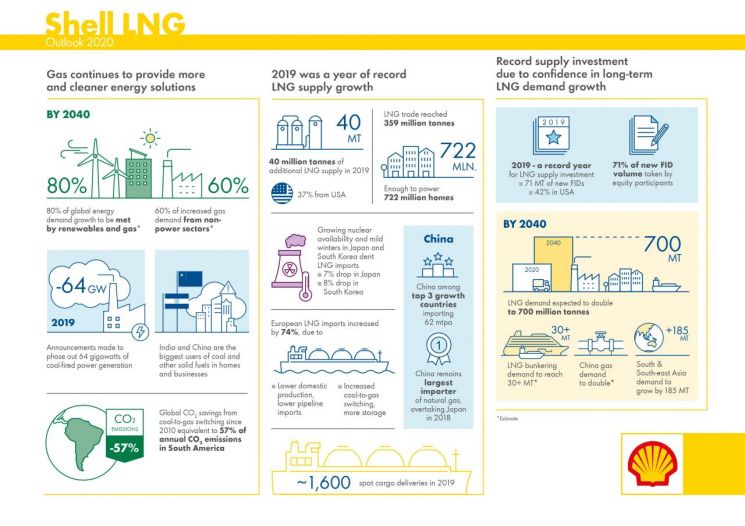
Expected to reach 700 million tons by 2040
"Smooth LNG Supply Contributes to Clean Energy Demand Creation"
[Asia Economy Reporter Moon Chae-seok] An analysis has emerged that global liquefied natural gas (LNG) demand will approximately double in 20 years.
On the 20th (local time), British energy company Royal Dutch Shell (Shell) announced through its 'LNG Outlook Report' that last year, global LNG demand increased by 12.5% compared to the previous year, reaching 359 million tons.
Last year, a record high of about 40 million tons of new LNG supply was introduced to the market and consumed. The largest annual new LNG investment decision of 71 million tons was also made.
According to Shell, recently, contract structures between buyers and sellers in the LNG market have diversified.
In the power generation and industrial sectors, the role of gas has increased as fuel switching from coal to gas has accelerated to improve air quality. Announcements of the phased shutdown of coal power plants have also increased more than threefold.
Natural gas emits about 45-55% less greenhouse gases (GHG) and about 10% or less air pollutants compared to coal during power generation.
Shell expects that natural gas will play a key role in establishing a low-carbon energy system, and global LNG demand will increase to about 700 million tons by 2040, roughly double the current level.
Martin Vesela, Vice President of Integrated Gas and New Energies, said, "With the increase in demand for LNG and natural gas, the global LNG market grew last year across both power generation and non-power sectors. The record-breaking new LNG investments last year will help meet consumers' demand for cleaner and more flexible fossil fuels."
He added, "Although the market conditions have worsened due to two recent warm winters, the spread of COVID-19, and the large-scale introduction of new supply, LNG demand continues to rise. New supply volumes will decrease until mid-year, and the global LNG market will gradually stabilize."
Meanwhile, last year, Asia's LNG imports showed a moderate increase compared to the previous two years. Shell explained that this was because Korea and Japan, two of the world's top three LNG importers, experienced mild weather and increased their share of power generation from nuclear energy.
China increased LNG imports by 14% year-on-year as it sought to improve urban air quality. Bangladesh, India, and Pakistan imported 36 million tons of LNG, a 19% increase compared to the previous year.
Shell stated that Asia is expected to play a leading role in LNG imports for more than a decade going forward. It is anticipated that demand from South Asia and Southeast Asia will account for more than half of the LNG demand increase.
© The Asia Business Daily(www.asiae.co.kr). All rights reserved.

















