Support for 4.5 Trillion KRW Facility Investment by Returning Companies
Establishment of Export Vitality Promotion Team
Granting Special Provisions for Air Transport
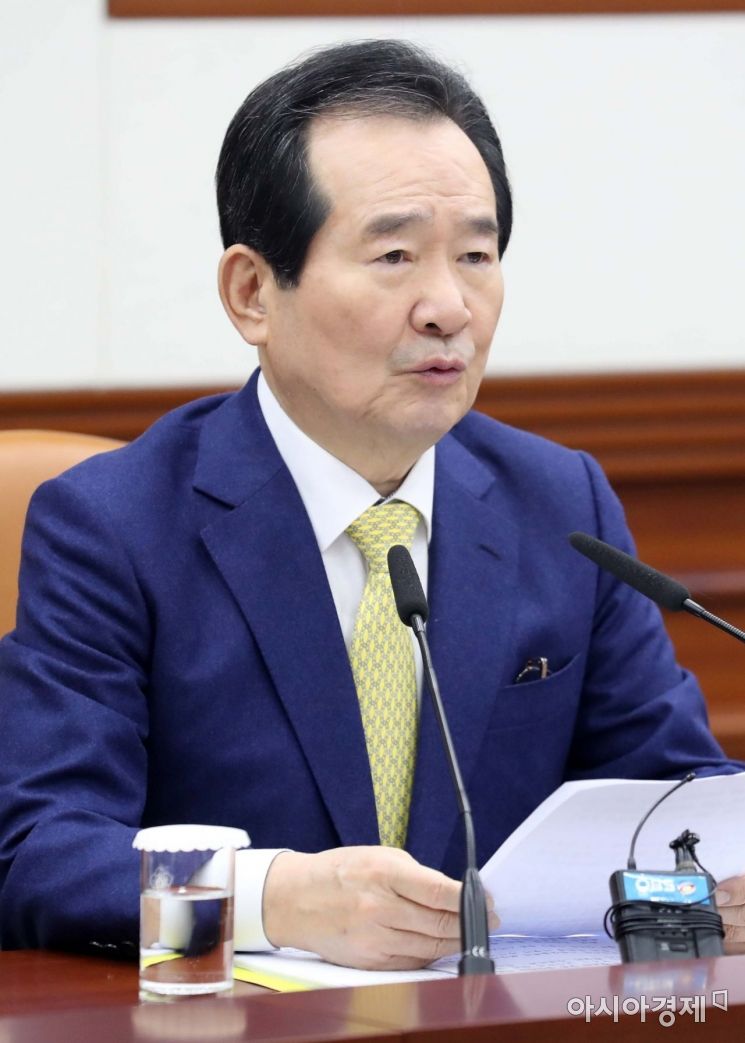 Prime Minister Chung Sye-kyun delivering opening remarks at the Government Policy Coordination Meeting held at the Government Seoul Office in Jongno-gu, Seoul on the 20th. Photo by Moon Ho-nam munonam@
[Asia Economy Reporter Moon Chae-seok] The government will provide an additional 3.1 trillion KRW in trade finance to support exports. It plans to establish the 'Export Vitality Promotion Team' to fully focus on securing export opportunities, while expanding incentives such as supporting facility investments worth 4.5 trillion KRW for U-turn companies.
On the 20th, Prime Minister Chung Sye-kyun held an 'Expanded Trade Strategy Coordination Meeting' at the Korea International Trade Association in Seoul and announced measures to resolve difficulties caused by the novel coronavirus disease (COVID-19) and support exports.
Prime Minister Chung said, "At the beginning of this year, we expected the economic situation to improve based on the outlook for global economic recovery. However, due to the spread of COVID-19, investment as well as domestic demand has contracted, and exports are particularly difficult."
He emphasized, "We have experience in wisely overcoming external risks and creating new growth momentum. This time as well, we must turn the crisis into an opportunity with a 'let's do it' mindset."
First, to minimize liquidity constraints on corporate financing in response to COVID-19 risks, the government will support trade finance totaling 260.3 trillion KRW, an increase of 3.1 trillion KRW from before. It will promptly support affected companies by disbursing 156 trillion KRW in the first half of the year and supply a record-high 105 trillion KRW in trade finance to small and medium-sized enterprises (SMEs) and mid-sized companies.
Logistics and customs clearance support will also be strengthened, including operating a 24-hour customs clearance support system. When urgently procuring items by air, special exceptions will be granted to impose customs duties based on sea freight rates. Currently, customs duties on air freight are more than 15 times higher than those on sea freight.
Export marketing support will increase by 14.4% from last year to 511.2 billion KRW. In particular, an exclusive 'Cyber Consultation Zone for the Greater China Region' will be expanded to hold online video consultation meetings. Next month, the 'Export Vitality Promotion Team 2020' will be newly launched. Starting in Busan, it will tour nationwide focusing on preventing export stoppages, diversification, and capacity building.
The government will actively promote corporate domestic return activation, global supply chain diversification, and overseas investment attraction in response to this situation. This reflects acceptance of the criticism that a comprehensive review of the global value chain (GVC) of domestic industries overly dependent on China is necessary.
The scope of corporate tax reductions for U-turn companies will be expanded. Previously, this applied only when establishing new business sites, but it will now also apply when expanding existing business sites. Additionally, considering corporate deliveries and cost reductions, a cooperative model linked with demand companies will be newly established to provide a 'package support plan.' The criteria for entering port hinterland complexes will be relaxed to allow U-turn companies to move in, and a facility investment support program worth 4.5 trillion KRW will be newly established. Preferential support will also be planned for U-turn companies participating in industrial technology research and development (R&D).
Trade support programs will also be reorganized. Specifically, new trade finance support programs such as ▲Global Supply Chain Transition Guarantee ▲Domestic Supply Chain Utilization Guarantee ▲Special Guarantee for U-turn Export Companies will be launched. When dependence on specific countries and companies is high, the 'Milk Run' method, which involves supply chain diversification to third countries, industry joint purchasing, and joint logistics, will be introduced.
Prime Minister Chung urged, "The public and private sectors must unite and do their best to ensure that exports turn positive this year."
However, the government does not plan to present a customized reshoring plan for the metropolitan area. On the 5th, the Ministry of Trade, Industry and Energy held discussions with the industry regarding policies such as creating exclusive rental complexes for small and medium-sized U-turn companies in industrial complexes including the metropolitan area. The timing of applying related policies has not yet been determined. Academia still insists that additional measures are urgently needed to induce reshoring of large corporations that can support employment and domestic demand, including deregulation, labor-management cooperation, risks from minimum wage increases, and employment burdens due to the introduction of the 52-hour workweek system.
Professor Kim Tae-gi of Dankook University’s Department of Economics said, "President Moon Jae-in said the national economy is in an 'emergency,' and to induce reshoring of large corporations, it is necessary to implement 'emergency fiscal and economic measures' stipulated in Article 76 of the Constitution to deregulate and reform labor."
Professor Jeong In-kyo of Inha University’s Department of International Trade emphasized, "The essence of corporate reshoring policy is not cost reduction in labor but discovering investment value, so lifting regulations in the metropolitan area is most important."
© The Asia Business Daily(www.asiae.co.kr). All rights reserved.
![User Who Sold Erroneously Deposited Bitcoins to Repay Debt and Fund Entertainment... What Did the Supreme Court Decide in 2021? [Legal Issue Check]](https://cwcontent.asiae.co.kr/asiaresize/183/2026020910431234020_1770601391.png)















