Pre-orders start today... Mobile carrier subsidies up to 240,000 KRW
Concerns continue over "inevitable price war" despite gentlemen's agreement
[Asia Economy Reporter Joeslgina] "Although the carriers have signed a gentlemen's agreement, the competition on the ground is intense."
On the 20th, as the three domestic mobile carriers began accepting pre-orders for Samsung Electronics' 'Galaxy S20,' the 'customer acquisition battle' ignited. To prevent a cutthroat competition, they entered into a gentlemen's agreement for one week, but on the ground, competition among dealerships to secure even one more subscriber is fierce. A dealership official said, "It's a tense situation like the calm before the storm," adding, "If one side launches an offensive, a marketing war could erupt immediately." Amid the impact of the novel coronavirus (COVID-19) that has stopped customers from visiting, dealerships nationwide have no choice but to stake their lives on the Galaxy S20, the big catch of the first half of the year.

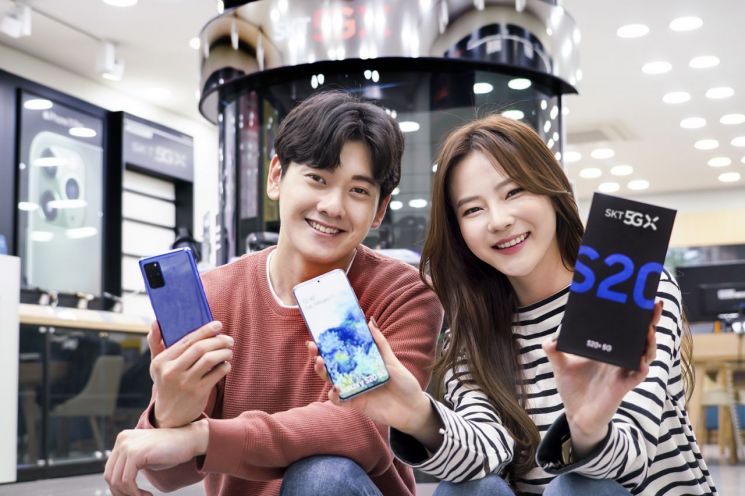
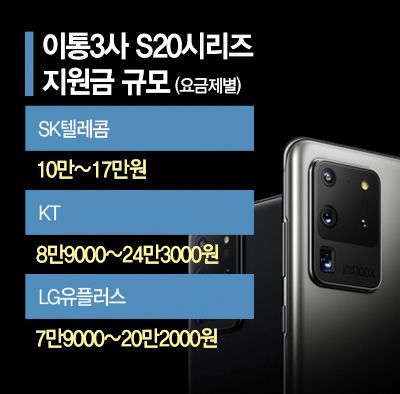
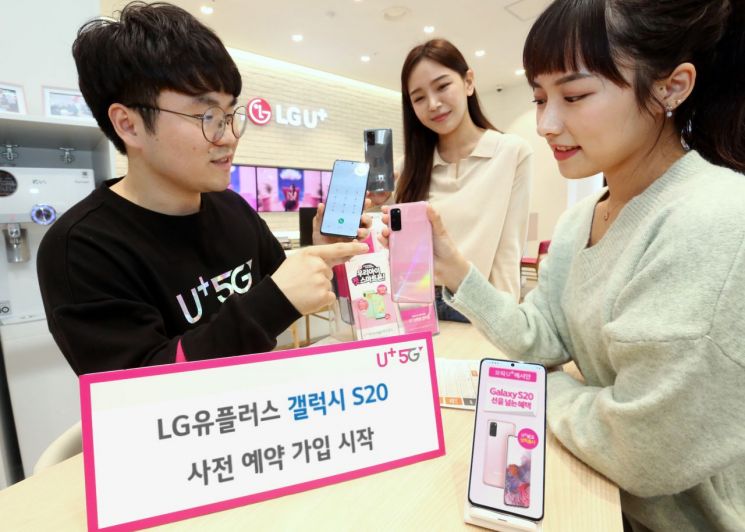
◆Pre-orders followed by preliminary contracts= The three carriers, SK Telecom, KT, and LG Uplus, are conducting pre-orders for the Galaxy S20 from this day until the 26th. SK Telecom offers subsidies ranging from 100,000 to 170,000 KRW depending on the plan, while KT provides 89,000 to 243,000 KRW. LG Uplus, which significantly increased subsidies during the Galaxy S10 launch last year, set theirs at 79,000 to 202,000 KRW. The three carriers have each promoted exclusive colors?Aura Blue, Aura Red, and Pink?and launched extensive online marketing campaigns. KT featured Jennie, a member of the idol group BLACKPINK.
At the frontline dealerships, preliminary contracts were conducted early with prospective customers even before the pre-order period. This means the customer acquisition battle started before the official subsidies were confirmed. Despite the carriers' gentlemen's agreement to shorten the pre-order period to one week and prohibit changes to official subsidies, the atmosphere on the ground heated up. A KT store official located in downtown Seoul hinted, "The S20 is the only 5G flagship model launching in the first half of this year," adding, "There will definitely be a push (in subsidies)." A representative from a nearby competing store also questioned, "The gentlemen's agreement lasts only one week," and added, "Who knows what will happen with subsidy amounts afterward?"
Some stores independently prepared gifts separate from the headquarters. An industry insider lamented, "Although the headquarters is cautious about preliminary contract practices and excessive giveaways that undermine the spirit of the gentlemen's agreement, it is practically impossible to manage the situation of all dealerships in real time across online and offline channels." The Galaxy S20 series' retail prices are 1,248,500 KRW for the S20, 1,353,000 KRW for the S20+, and 1,595,000 KRW for the S20 Ultra.
◆5G subscriber competition continues... sparks of cutthroat competition= In the market, considering the 5G subscriber targets of the three carriers this year, cutthroat competition is seen as an inevitable step. SK Telecom, which attracted the most 5G subscribers (2,084,328) among the three carriers in the first year of 5G commercialization last year, aims for 6 to 7 million subscribers by the end of this year. KT also plans to raise the proportion of 5G subscribers to 25-30% of its total subscribers, which is about 4.5 million people. LG Uplus has set a target of 4.5 to 5 million subscribers.
Combined, the three carriers aim for 16.5 million subscribers, which is 3.5 times the cumulative subscribers (4,668,057) at the end of last year. Ultimately, carriers have no choice but to promote flagship models to secure more subscribers, which is expected to ignite a subsidy war for devices.
Even before the new smartphone launch, subsidies for old devices based on number portability are rampant. Numerous cases have been posted on major online communities where the Galaxy S10 5G model, priced at 1,248,500 KRW, was purchased for around 100,000 KRW under number portability conditions. This effectively means illegal subsidies of about 700,000 KRW. As competition heats up, the three carriers and the Korea Association for ICT Promotion (KAIT) have warned that phone sales scams using illegal subsidies as bait at frontline dealerships are a concern.
The key issue is ammunition. The three carriers, all of which posted negative results last year, agree that customer acquisition battles like in previous years are difficult amid the heavy burden of 5G investments. The marketing expenses spent by the three carriers during last year's 5G competition amounted to 8.054 trillion KRW, nearly matching the total CAPEX of 8.7807 trillion KRW.
© The Asia Business Daily(www.asiae.co.kr). All rights reserved.



















