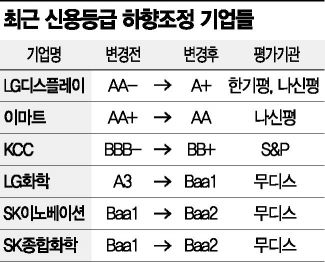
[Asia Economy Reporters Koh Hyung-kwang and Oh Ju-yeon] Warnings that credit rating downgrades of domestic companies will become widespread are emerging from various quarters. As key economic indicators such as employment, consumption, exports, and investment continue to deteriorate, coupled with uncertainties in the global trade environment and the ripple effects of the novel coronavirus disease (COVID-19) pandemic, domestic companies' credit risks are increasing. Companies with lowered credit ratings face difficulties in finding creditors willing to lend money or must raise funds at higher interest rates. Concerns are growing that this year, too, dark clouds hang over the credit outlook of domestic companies, potentially spreading a vicious cycle of "increased financing costs → deterioration of financial soundness."
◆Economic downturn compounded by COVID-19 impact this year = According to industry sources on the 19th, global credit rating agency Moody's views the outlook for 14 out of 24 domestic non-financial companies as 'negative' this year, forecasting a bleak credit environment for companies. Korea Ratings also expects that pressure for credit rating downgrades among domestic companies will intensify further this year compared to last year. In particular, the retail distribution, apparel, dining, and alcoholic beverage industries, as well as export-dependent sectors such as automobiles, semiconductors, displays, and chemicals, were assessed as 'negative.' There was not a single sector rated as 'positive.'
The three major domestic credit rating agencies also did not foresee any sector with a 'positive' credit rating outlook this year. On the contrary, all three agencies rated the outlook for the display and retail distribution sectors as 'negative.' This indicates that credit rating downgrades are likely for companies in these sectors due to deteriorating performance this year. The outlook was also bleak for automobile parts, steel, and aviation industries.
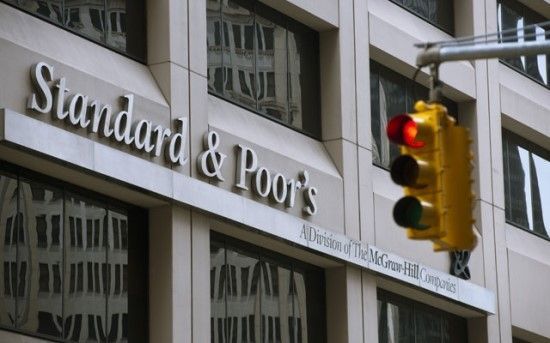
In particular, international credit rating agency Standard & Poor's (S&P) warned that the COVID-19 pandemic has emerged as a risk factor for credit rating downgrades in the Asia-Pacific region. In a recent report, S&P stated, "The negative impact of COVID-19 across the Asia-Pacific region will peak by June," and warned, "If the situation prolongs, it could directly affect credit ratings in the automobile and banking sectors." Following a sharp increase in the number of companies with downgraded credit ratings due to last year's economic recession?the first significant rise in four years?this year, the COVID-19 impact is expected to adversely affect all domestic industries, potentially triggering a 'domino effect' of rating downgrades.
◆Poor earnings but pressured to increase dividends... ultimately credit ratings ↓ = The burden is not only on earnings. With a significant increase in institutions participating in the 'Stewardship Code' (principles of fiduciary responsibility) to strengthen shareholder rights, shareholders' voices are expected to grow louder. According to the Korea Corporate Governance Service, as of the end of last year, 116 institutions participated in the domestic Stewardship Code. In the first year of its introduction in 2017, there were only 18 participants, but with the National Pension Service at the center, along with the Teachers' Pension, asset management companies, and insurance companies joining, the number increased by nearly 100 within three years. However, ahead of the recent shareholder meeting season, demands for active shareholder returns through dividend increases are rising, causing companies to feel pressured.
S&T Group affiliates plan to propose the introduction of quarterly dividends at this year's shareholder meetings. This follows last year's criticism from the National Pension Service that dividends were insufficient. S&T Motive, S&T Heavy Industries, and S&T Holdings announced through disclosures that they would introduce quarterly dividends. Some companies are increasing dividend payout ratios despite reduced net profits to appease shareholders. However, excessive dividends unsupported by earnings negatively affect credit ratings. For example, domestic and international rating agencies evaluated SK E&S's recent announcement to pay dividends up to twice the market expectation as potentially negative for creditworthiness. S&P warned, "SK E&S's aggressive financial and shareholder return policies will increase its debt ratio to between 3.9 and 4.3 times over the next two years," adding, "If the company's debt ratio remains above 4 times for a considerable period, a credit rating downgrade may occur." Kim Mi-hee, a senior researcher at Korea Ratings, also pointed out, "Shareholder-friendly dividend policies are significantly negative factors for cash flow forecasts," adding, "Such high dividend payout ratios stem from the parent company SK's aggressive investment policies, and dividend sizes exceeding expectations and additional capital injections inevitably have very negative effects on the company's creditworthiness." S&P assigned SK E&S a corporate credit rating of 'BBB' with a 'negative' outlook, and Korea Ratings also assessed SK E&S's rating outlook as 'negative.'
◆Credit rating downgrade warnings for financial firms amid Lime Asset Management scandal = The recent Lime Asset Management redemption suspension scandal has also affected financial firms. The Lime incident is expected to negatively impact the business risks of banks and securities firms and may affect profitability depending on the scale of compensation payments, leading to a series of credit rating downgrades. Kim Ki-pil, head of the Financial Evaluation Division at NICE Credit Rating, explained, "We plan to conduct detailed monitoring of securities firms with large compensation amounts related to Lime Asset Management's redemption suspension relative to their annual profit generation and reflect the results in credit ratings. We will also review credit ratings for securities firms experiencing business base weakening due to reputational damage following prosecution investigations."
At the end of last year, the securities industry was one of the sectors expected to see credit rating upgrades. If credit ratings fall in the securities sector due to this incident, combined with companies facing downgrades due to declining performance this year, a large number of downgrades are expected. Park Se-young, head of the Evaluation Policy Office at NICE Credit Rating, said, "As of the end of last year, the upgrade-to-downgrade ratio (the number of upgrades divided by the number of downgrades) was 0.61, down from 1.14 in 2018," indicating that the credit rating environment is challenging. He added, "In the medium to short term, the number of companies facing downgrades is expected to exceed those with upgrades."
© The Asia Business Daily(www.asiae.co.kr). All rights reserved.
![User Who Sold Erroneously Deposited Bitcoins to Repay Debt and Fund Entertainment... What Did the Supreme Court Decide in 2021? [Legal Issue Check]](https://cwcontent.asiae.co.kr/asiaresize/183/2026020910431234020_1770601391.png)