Nationwide First Installation of 'Fine Dust Simple Measuring Device' Using Private IoT Network, Rated Grade 1 in Ministry of Environment Performance Evaluation; Fine Dust and Four Major Information Accessible via Internet and Mobile Apps... ▲ Displayed on 300 Bus Information Terminals (BIT) and Parking Enforcement Electronic Boards ▲ Web Service at 270 Locations Including Senior Welfare Centers and Elementary, Middle, and High Schools to Launch in First Half of This Year
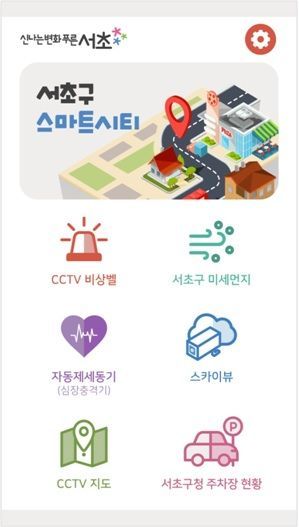 Notification App
[Asia Economy Reporter Jongil Park] “As soon as the children arrive at the daycare, the first thing they ask is whether they can play outside today. It’s heartbreaking to see that the growing children are already physically feeling the damage caused by fine dust,” said a teacher at a daycare in Banpo-dong.
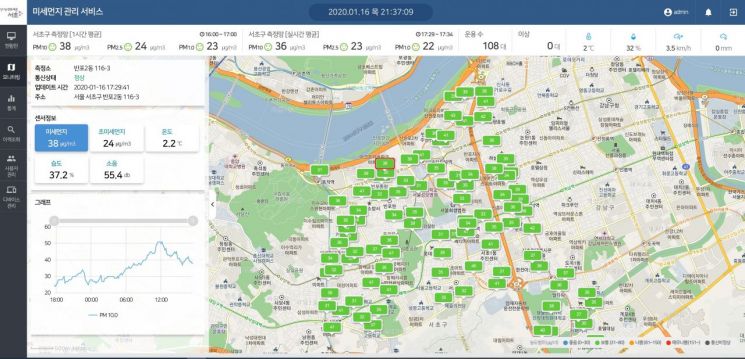
Seocho-gu (Mayor Cho Eun-hee) is operating the nation’s first ‘Fine Dust Detailed Measurement System’ using a self-operated Internet of Things network (LoRa) to cope with the increasingly serious future environmental threats.
The district developed the ‘Fine Dust Detailed Measurement System,’ which received the highest grade, Grade 1, after two performance evaluations by the Ministry of Environment (first indoor, second outdoor), and completed installation at the end of December last year.
While there were only two fine dust measuring devices in Yangjae Station and Banpo 2-dong, the district significantly increased the number to about 6 to 7 per neighborhood, establishing a total of 108 locations.
This effort is part of the district’s meticulous care for residents’ health, especially installing the devices densely around crowded subway stations, elementary, middle, and high schools, and daycare centers.
Currently, the district has conducted a comprehensive two-week test of the fine dust sensors certified as Grade 1 by the Ministry of Environment and is operating them stably.
Going forward, the system will be linked to 300 bus information terminals (BIT) and parking violation electronic boards for display, and web services for 270 locations including senior welfare centers and schools will be launched in the first half of the year.
With this system, residents can immediately check the fine dust levels around their homes and decide whether outdoor activities are possible or if windows should be opened. The responsible departments can also use the data for fire detection using temperature and humidity status, preemptively resolve noise complaints by monitoring noise levels around construction sites, and develop various policies using big data.
In particular, a district official stated that by utilizing the self-operated IoT network during system construction, budget savings were achieved, and a ‘mobile fine dust measuring device’ service will be provided to measure fine dust anytime and anywhere upon residents’ requests.
In the future, the district plans to expand the system’s functions to include not only fine dust but also five types of harmful air pollutants (SO2, NO2, CO, O3, UV), wind direction, and wind speed, and use it for policy-making on future environmental threats such as air quality forecasting, pollutant analysis, and vulnerable area analysis.
Residents who need information can access it through the internet homepage (https://bluesky.seocho.go.kr/public/monitoring) and the mobile app (Seocho Smart City app, opening in March), where they can check four major real-time data points: fine dust, temperature and humidity, and noise by region.
On the ‘Seocho Smart City app,’ users can also check the locations of 600 CCTVs and emergency bells, 125 AEDs (automated external defibrillators), and simple fine dust measurement guidance along with the locations of 108 measurement sites.
Additionally, the district is uniquely utilizing its advantage of possessing various self-communication networks (Self-LoRa Network) nationwide to implement IoT services.
In six unauthorized clustered villages including Narumauel in Jamwon-dong and Jeonwonmaeul in Bangbae 2-dong, 300 fire monitoring sensors were installed in 238 households, and by linking the announcement system and fire station, a process was created to shorten initial response time during fires and minimize casualties.
Mayor Cho Eun-hee said, “We will continue to promote the realization of a smart city so that the quality of life directly felt by residents improves through various administrative data advancement projects.”
© The Asia Business Daily(www.asiae.co.kr). All rights reserved.

















