Launch from South America's Guiana Space Centre on the morning of the 19th
Marine information available from October, atmospheric data from next year
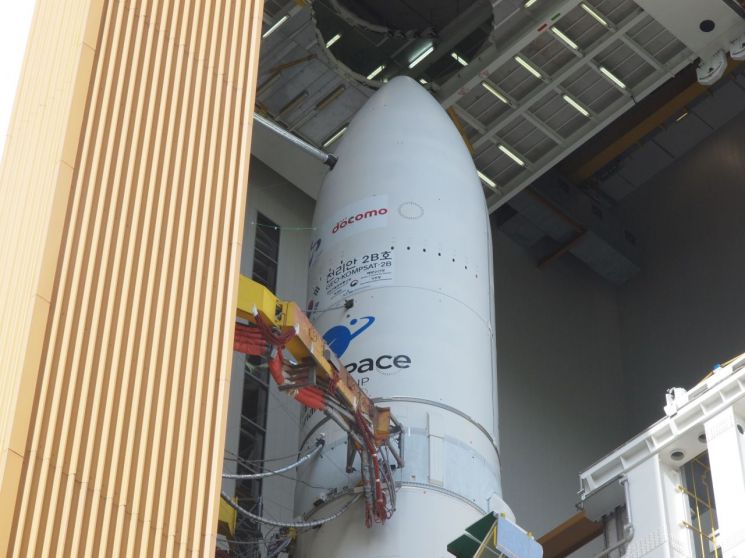 Cheollian 2B is loaded on the Ariane launch vehicle and awaiting transfer. Cheollian 2B, the world's first geostationary meteorological observation satellite, will be launched at 7:18 PM on the 18th (local time, 7:18 AM on the 19th Korean time) from the Kourou Space Center in French Guiana. (Kourou Space Center = Joint Press Corps)
At 8:27 a.m. on the 17th (8:27 p.m. on the 17th Korean time), the front of the assembly building at the Guiana Space Centre in French Guiana, South America, began to open.
Inside, the launch vehicle Ariane 5ECA, marked with the Korean flag and the Hangul inscription "Cheollian 2B," was revealed. This launch vehicle was set to send the world's first geostationary orbit atmospheric observation satellite, Cheollian 2B, into space at 7:18 p.m. on the 18th (7:18 a.m. on the 19th Korean time). The launch vehicle was slowly moved from the assembly building to the launch pad about 3.5 km away.
Countdown, Korean time 7:18 a.m. on the 19th
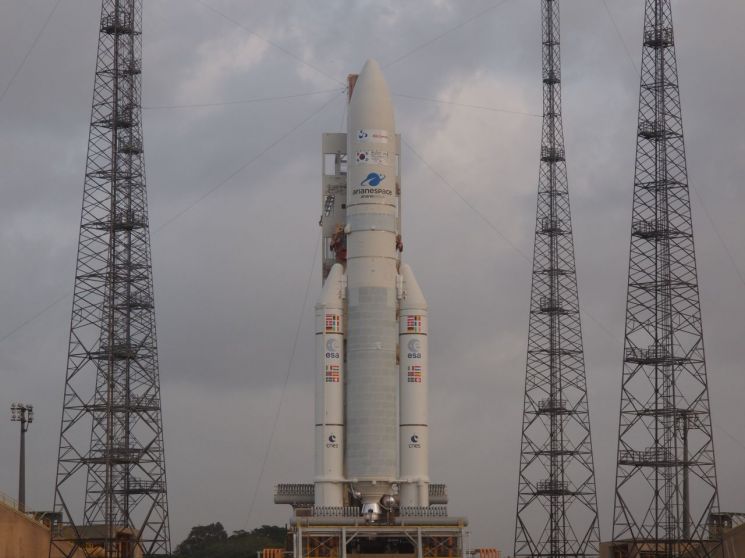
The countdown begins at 7:55 a.m. local time on the 18th, 11 hours and 23 minutes before launch. As the countdown starts, final preparations for launch, including fueling, are carried out. First, at 4 hours and 38 minutes before launch, the injection of launch vehicle propellants such as liquid oxygen begins. Fifteen minutes before launch, the satellite switches to internal power mode using its battery. From 7 minutes before launch, an automatic sequence starts, and one second after the launch command is given, the first stage engine of the launch vehicle ignites. Seven seconds later, the launch vehicle lifts off. If any anomalies are detected in the satellite up to 9 seconds before launch, the countdown is halted.
It takes 25 minutes and 29 seconds for the launch vehicle to reach the target orbit. About 6 minutes later, Cheollian 2B separates. The first communication is expected about 31 minutes after launch. The success of the launch will be confirmed through the first communication between the control center in Yasara, Australia, and the satellite. The Ariane 5ECA has a launch success rate of 98.6%. Choi Jae-dong, head of the Geostationary Orbit Complex Satellite Project Group at KARI, stated, "After tomorrow's launch, we plan to confirm initial success by checking the first communication and the deployment of the solar panels."
It will take about two weeks for Cheollian 2B to reach an altitude of 128.2 degrees east longitude. Choi said, "This is a very important operation that consumes 70% of the satellite's fuel," adding, "we cannot afford to let our guard down during this period."
World's First Geostationary Orbit Atmospheric Observation Satellite
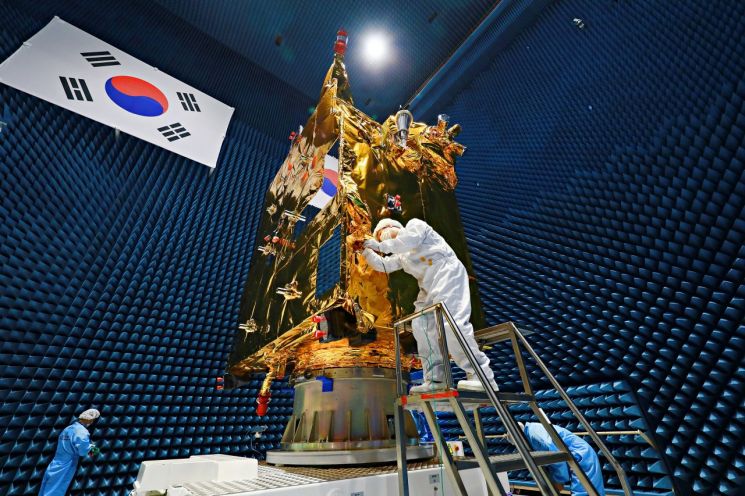
Once Cheollian 2B settles at an altitude of 36,000 km, it will begin preparations for its mission. Cheollian 2B is a geostationary satellite that orbits the Earth at the same rotational speed as the Earth, observing Asia, including South Korea.
Cheollian 2B is equipped with the world's first environmental payload capable of real-time monitoring of fine dust concentration changes. It can observe the transboundary movement of fine dust, a matter of national concern, in real time. It can monitor fine dust and pollutants such as nitrogen dioxide, sulfur dioxide, and formaldehyde up to eight times a day. It can also detect the movement of more than 20 types of air pollutants. The observation range covers 13 East Asian countries, from eastern Japan to northern Indonesia in the west and southern Mongolia. Atmospheric environment information sent by Cheollian 2B is expected to be provided starting next year.
Additionally, the satellite is equipped with an ocean payload to monitor disasters such as red tides, brown tides, and sea fog, providing useful information for fisheries and contributing to research in the fisheries and marine sectors. Marine environmental information such as red and green tides will be available from October.
Choi said, "Cheollian 2B is a satellite developed and equipped with various systems using our own technology after nine years of challenges," adding, "It is equipped with the world's highest-spec payloads that even the United States and Europe have not yet installed, and launching it into space will be an opportunity to showcase our space technology to the world."
© The Asia Business Daily(www.asiae.co.kr). All rights reserved.

![User Who Sold Erroneously Deposited Bitcoins to Repay Debt and Fund Entertainment... What Did the Supreme Court Decide in 2021? [Legal Issue Check]](https://cwcontent.asiae.co.kr/asiaresize/183/2026020910431234020_1770601391.png)
















