[Asia Economy Reporter Kwangho Lee] "We will create a newly advancing Korean economy through economic rebound and innovative inclusive growth."
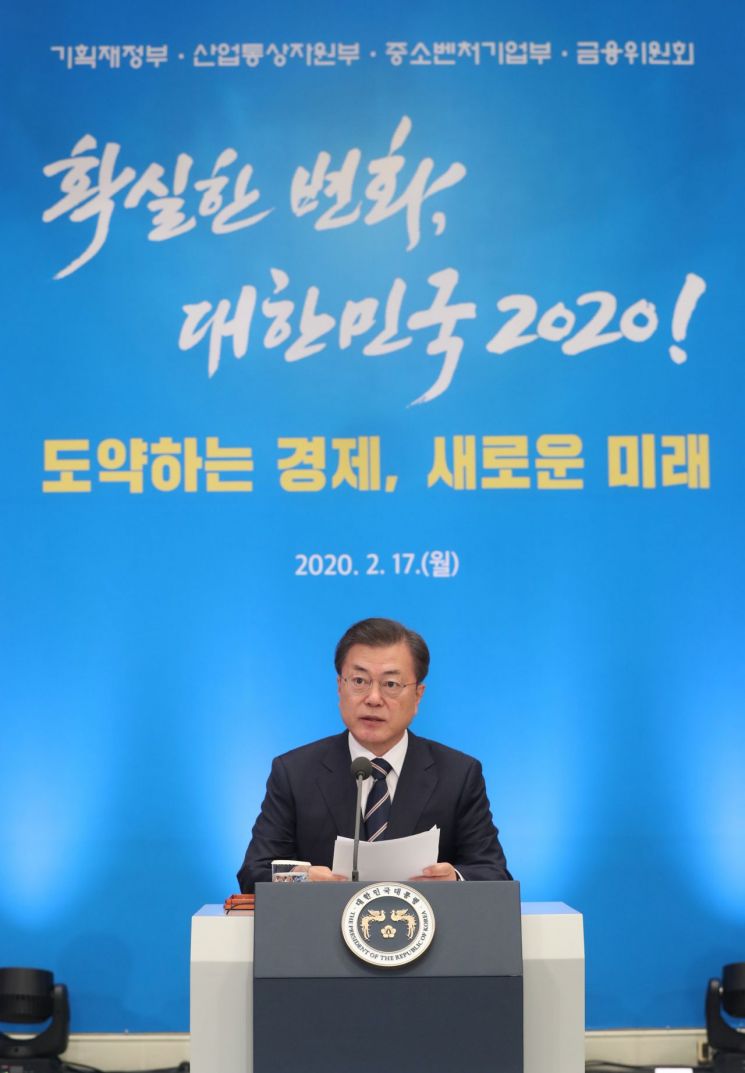
On the 17th, four ministries?the Ministry of Economy and Finance, the Ministry of Trade, Industry and Energy, the Ministry of SMEs and Startups, and the Financial Services Commission?held the 2020 political affairs briefing under the theme of innovation growth titled "Advancing Economy, New Future" at the Blue House State Guest House.
The briefing was attended by about 180 people including the Prime Minister, vice ministers of the four ministries, ruling party and government officials, and private sector representatives. It began with President Moon Jae-in’s opening remarks, followed by live broadcasts of direct reports to the public by Deputy Prime Minister and Minister of Economy and Finance Hong Nam-ki, Minister of Trade, Industry and Energy Sung Yun-mo, Minister of SMEs and Startups Park Young-sun, and Financial Services Commission Chairman Eun Sung-soo, presenting achievements and policy visions for innovation growth by sector.
This briefing was characterized by a town hall meeting format where the president, economic officials, and experts from various fields sat face-to-face to overcome psychological stagnation caused by the COVID-19 pandemic and promote economic revitalization.
In his opening remarks, President Moon said, "Ministries’ briefings are not for reporting to the president but for reporting to the people and pledging to take action," adding, "I hope the prepared policy measures are well implemented so that we can surely achieve our goals, and I ask everyone to do their best until the end."
The Ministry of Economy and Finance plans to strengthen efforts to secure new industries and new markets this year, boldly reform regulations, and support infrastructure to deliver innovation growth results that the public can feel. To this end, innovation growth will be promoted based on the 4+1 strategic framework: the second venture boom, manufacturing and service innovation, future growth engines, innovative talent, and regulatory innovation.
The ministry stated, "Innovation growth has accelerated and spread private sector innovation, steadily increasing economic performance," and added, "Building on this, we will focus on a breakthrough leap and a clear improvement in public perception this year." It emphasized, "We are pushing forward policies with a sense of speed through inter-ministerial coordination and collaboration systems using innovation growth strategy meetings and green meetings."
First, there is a plan to strategically foster new industries. A plan to activate the data economy will be established by next month, and follow-up work on the amendment of the three data-related laws will be carried out without delay. In addition, public data disclosure and utilization will be promoted, and infrastructure for data transactions such as data exchanges and the activation of convergence between heterogeneous data will be encouraged.
Furthermore, the bio-industry will be nurtured as the next-generation growth industry following semiconductors. The ten core tasks for the bio-industry include ▲a strategy for building big data on life research resources ▲innovation strategy for bio R&D ▲master plan for bio-industry workforce development ▲comprehensive innovation strategy for K-Beauty, among others.
The Ministry of Trade, Industry and Energy announced plans to promote four core themes to realize an "unshakable industrial powerhouse": achieving solid self-reliance in materials, parts, and equipment (SoBuJang), fostering post-semiconductor new industries, leaping to become the global No. 1 hydrogen economy nation, and turning exports positive.
First, within this year, supply concerns over the three major export-restricted items from Japan will be completely resolved, and 2.1 trillion won will be invested in self-reliance for 100 key items. In particular, technological self-reliance will be achieved for nine materials and parts in fields such as semiconductors, displays, secondary batteries, and robots. Following the recently passed "SoBuJang Special Act" in the National Assembly, thorough measures will be taken to ensure supply stability.
Efforts will also continue in the mid-to-long term to minimize supply disruptions related to COVID-19 by activating domestic return of companies operating in China, diversifying supply chains, and expanding domestic companies’ global market shares.
As part of this year’s new industry measures, efforts will be accelerated to expand the supply and production of eco-friendly vehicles. The goal is to lead the global eco-friendly vehicle market by achieving production of 440,000 eco-friendly vehicles and exports of 300,000 units. By cumulative standards this year, 195 hydrogen buses, 1,478 electric buses, and 7,430 electric vehicle charging stations will be supplied.
A record 1 trillion won budget will be invested over 10 years in next-generation semiconductor technology development to induce large-scale investment and win-win cooperation. A win-win fab tailored to fabless (semiconductor design companies) demand will be promoted, and a 100 billion won scale win-win fund will be operated to establish a growth base for fabless companies.
This year, semiconductor exports are targeted at 100 billion dollars, and bio-health exports at 10 billion dollars. Plans include operating a cutting-edge microprocess new line in Hwaseong, Gyeonggi-do this month and mass-producing 5-nanometer processes in the first half of this year to achieve a 20% share of the global foundry market.
Alongside this, the slogan to leap to become the "global No. 1 hydrogen economy nation" was also announced. The plan is to rapidly expand the hydrogen utilization base by supplying 10,000 hydrogen vehicles and installing 100 new hydrogen charging stations. By producing by-product hydrogen, wholesale hydrogen prices will be reduced by 25%, lowering charging station operating costs, and support will be provided for the spread of privately operated hydrogen charging stations.
The Ministry of SMEs and Startups announced its 2020 work plan under the title "Great Transition to a Digital Economy, Smart Korea." The plan is divided into three major areas: ▲Smart Korea ▲Innovative Enterprise Scale-up ▲Coexistence and Win-win.
First, in the Smart Korea area, policy tasks are divided into data sharing and utilization necessary for smart factory advancement (SMEs), management innovation and smart services using big data (startups and venture companies), connection of 4th industrial revolution technologies with small merchants and smart stores (small merchants), and introduction of digital technology into manufacturing processes and smart workshops (small manufacturers).
Advancement will be promoted through expanding smart factories for manufacturing process smartization and implementing optimal production systems using manufacturing data. The plan is to supply 30,000 smart factories by 2022. As of last year, 12,660 smart factories have been supplied.
To strengthen the competitiveness of small merchants, smart store technologies utilizing 4th industrial revolution technologies such as smart orders, smart mirrors, and smart maps will be specialized and supplied by industry. Additionally, digital technology will be introduced into the manual manufacturing processes of small manufacturers to improve productivity through smart manufacturing environments.
Policy tasks in the innovative enterprise scale-up area include promoting the K-Unicorn project to foster global startups, nurturing global "Brand K" such as K-Beauty, K-Food, and K-Pop, and bold regulatory innovation through the world’s first regulatory free zones. These are key tasks for the core of the digital economy.
The K-Unicorn project will be carried out jointly by the public and private sectors. Potential unicorn companies will be intensively discovered and nurtured, and a systematic scale-up system will be established to promote their leap. Systems to attract large-scale investments such as leap-stage fund formation, special guarantees for prospective unicorns, and differential voting rights will be prepared. Unicorn companies refer to unlisted startups with a corporate value of over 1 trillion won.
The Financial Services Commission plans to innovate the entire financial system, including credit and venture capital, so that funds currently concentrated in unproductive sectors such as households and real estate can be redirected to SMEs and venture companies.
It will also support the financial industry to gain global competitiveness through competition, innovation, and fintech activation.
Alongside this, a supply base for venture capital will be established by fostering institutional investors and expanding the investor base, and policy finance functions will be strengthened to expand supply to innovative companies.
In particular, to enhance the competitiveness of the financial industry, entry and business regulations will be reformed, and active support will be provided for overseas expansion.
© The Asia Business Daily(www.asiae.co.kr). All rights reserved.
![User Who Sold Erroneously Deposited Bitcoins to Repay Debt and Fund Entertainment... What Did the Supreme Court Decide in 2021? [Legal Issue Check]](https://cwcontent.asiae.co.kr/asiaresize/183/2026020910431234020_1770601391.png)
















