Hong Kong Political Unrest and Boycott Movement
Worst Crisis Worsened by COVID-19 Situation
Support for Business Stabilization Funds and Special Loans
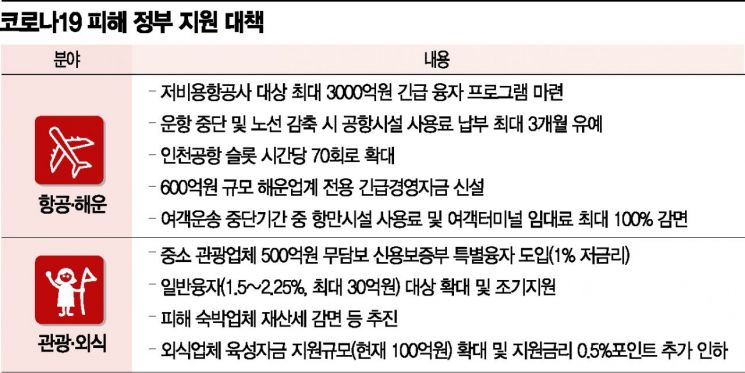
[Asia Economy Reporters Kwangho Lee, Heungsun Kim, Sehee Jang, Jehun Yoo, Chunhee Lee] The government announced emergency support measures on the 17th for aviation, shipping, tourism, and dining industries because these sectors have been pushed to the brink of collapse due to the novel coronavirus disease (COVID-19) crisis. In fact, the aviation industry is experiencing an unprecedented level of damage with flight reductions and cancellations followed by a surge in reservation cancellations and refunds. The tourism and dining sectors are also voicing their difficulties.
◆ "Impact greater than 9/11"... Emergency funding for LCCs = The shock to the low-cost carrier (LCC) industry caused by COVID-19 is significant. The government previously injected 250 billion KRW into the two major national airlines during the 2001 9/11 terrorist attacks. However, no separate financial support was provided during the 2003 Severe Acute Respiratory Syndrome (SARS) or the 2015 Middle East Respiratory Syndrome (MERS) outbreaks. Unlike those one-off incidents, this COVID-19 crisis is intertwined with last year's Japan travel boycott due to Korea-Japan tensions, instability in Hong Kong, and an overall 'supply-demand imbalance' in the industry. A representative from a national airline stated, "Some flights have load factors (L/F) below 10%, resulting in losses of over 100 million KRW per flight," adding, "The intangible losses from reduced aircraft utilization will be even greater."
The government expects the impact of COVID-19 to be greater than during the 2001 9/11 attacks, considering that the aviation market has grown more than fourfold since then. International passengers numbered 21.81 million during 9/11, but reached 90.3 million last year. At that time, only two national airlines?Korean Air and Asiana Airlines?operated, but now there are 10 airlines including LCCs.
Especially, LCCs focusing on short-haul routes are facing severe financial pressure after posting losses in the hundreds of billions of KRW last year. Last year's deficits for LCCs were 32.9 billion KRW for Jeju Air, 49.1 billion KRW for Jin Air, 19.2 billion KRW for T’way Air, and 50.5 billion KRW for Air Busan. Some airlines are even at risk of partial capital erosion. To make matters worse, the surge in refund requests due to COVID-19 is tightening the cash flow of LCCs.
Experts say this support will be a much-needed relief for LCCs but advise that diversified support measures should be prepared to minimize future risks. Professor Yongshik Hwang of Sejong University said, "The government's decision to provide 'liquidity support' shows how seriously it views this crisis," adding, "Efforts at the government level to reduce uncertain external risks should be intensified." Professor Heeyoung Heo of Korea Aerospace University also noted, "Issues such as exemption from aircraft acquisition and registration taxes and waivers of tariffs on aircraft parts, which are important for the mid- to long-term development of the aviation industry, should be discussed during this opportunity."
◆ Shipping and tourism also hit hard = Since the full suspension of passenger transport between Korea and China from the 30th of last month due to the spread of COVID-19, passenger ferry companies on the Korea-China route and businesses operating in international passenger terminals have seen a sharp decline in sales. The reduction in cargo volume to China due to the contraction of the Chinese domestic economy and delays in ship repairs caused by reduced operations at Chinese repair yards are also expected to disrupt cargo shipping operations. Accordingly, the government will first provide a total of 30 billion KRW in emergency management stabilization funds to passenger ferry companies struggling due to the suspension of passenger transport. This will be done by depositing funds from the Korea Ocean Business Corporation with financial institutions under the condition that these institutions use the funds to provide operating loans to the ferry companies.
Emergency financial support will also be provided to the tourism industry, which has been directly hit by massive travel reservation cancellations and a decline in tourists. First, a total of 50 billion KRW from the Tourism Promotion Development Fund will be used to offer special loans to small and medium-sized tourism businesses. These loans will be provided without collateral through public institution credit guarantees and will apply a preferential interest rate of 1%. The maximum support limit will be raised to 200 million KRW.
◆ Government to announce additional domestic and export measures soon = The government plans to introduce additional measures to stimulate domestic demand following this initial package. It is reported that domestic consumption promotion measures will be prepared about three times this year. A Ministry of Economy and Finance official explained, "We will announce domestic consumption promotion measures as soon as possible," adding, "It could be as early as the end of this month." Export support measures are scheduled to be announced on the 19th.
The government's successive announcements of economic measures reflect a sense of crisis that the economy, which showed signs of recovery this year, could be derailed again by the COVID-19 crisis. There is a strong determination to respond thoroughly to quarantine measures while not missing the opportunity for economic rebound. Hong Nam-ki, Deputy Prime Minister and Minister of Economy and Finance, emphasized, "I earnestly ask everyone to unite once again to minimize the economic impact and ensure that normal economic activities such as private investment, consumption, and exports proceed alongside thorough quarantine responses until the end."
© The Asia Business Daily(www.asiae.co.kr). All rights reserved.

















