[2020 New Year Project - Generational Coexistence, Building Society Together]
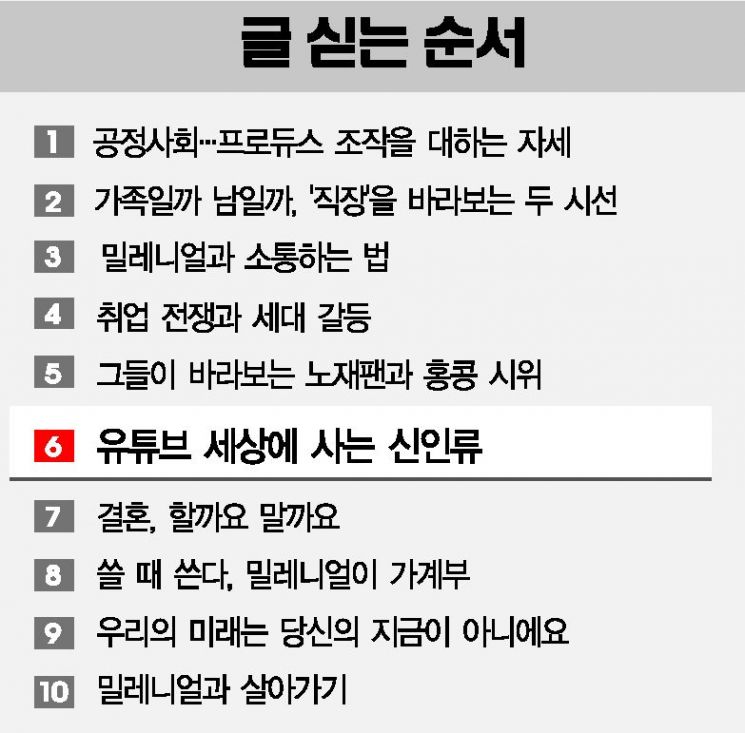
<6>The New Generation Living in the YouTube World
No Grand or Serious Topics
Comfortable Content Consumption Psychology
Exploring Better Leisure
Not Just Wasteful
Clear Distinction Between Hobby and Job
Rational Pursuit of 'Carpe Diem'
The Temptation of Sensational Thumbnails and Titles
Obvious but the Solution Lies in Social Consensus
[Asia Economy Reporter Lee Jung-yoon] "These days, kids don’t watch TV much because they have YouTube."
"Watching YouTube after work is my only pleasure."
Indeed, it is the golden age of YouTube, where people of all ages watch the world through YouTube. According to Nielsen Korea's survey last year, the YouTube penetration rate among millennial men and women was 85.8% and 90.8%, respectively. The younger Z generation has an even higher rate, with over 93% for both men and women. In contrast, the X generation and baby boomers living under the same roof as their parents have rates in the high 70s to low 80s percentile. So why are kids these days even more enthusiastic about YouTube? Is it because they are a generation accustomed to videos? Of course, compared to older generations familiar with text and photos, the MZ generation (a collective term for millennials and Gen Z) is more familiar with and responsive to videos. They also have the characteristic of using smartphones comfortably and freely. However, young people’s immersion in YouTube is not solely due to these apparent reasons. YouTube has something that captivates them. Understanding that something might naturally lead to understanding their emotions, needs, and the situations they face.
"Fascinated by the ordinary and everyday"
When thinking of YouTube content favored by young people, the first things that come to mind are content featuring ordinary people showing their daily lives, such as mukbangs or vlogs. Thomas (30, pseudonym), an office worker, watches YouTube for over two hours daily. The content he frequently watches involves YouTubers doing mukbangs while talking about their daily lives and listening to viewers’ concerns. Thomas said, "I relate to and enjoy content that discusses things I might experience in daily life," adding, "I mainly look for YouTube content that is not sensational but captures small, ordinary moments." Kim Seonsaeng (28) also often watches content featuring unknown comedians acting out everyday episodes and hidden camera pranks.
There are no glamorous celebrities appearing, nor well-scripted dialogues?just plain and simple. That’s how adults might see it. Yet why do young people find such content entertaining? Professor Lim Myung-ho of Dankook University’s Department of Psychology offers a persuasive explanation through the concept of "normal crush." "Normal crush" is a compound of "normal," meaning ordinary, and "crush," meaning to fall for, which can be interpreted as falling for the ordinary or seeking the everyday. Professor Lim said, "On YouTube, you can watch content from ordinary people similar to yourself, which has the advantage of being light and easy to approach," adding, "Since working and competing is exhausting, it seems that people want to consume content connected to a comfortable daily life during their rest time."
This also implies a sad self-portrait behind the youth’s indulgence in YouTube. They dive into YouTube as a reaction to a harsh reality. Therefore, serious content with grand themes is not welcomed. They just want a break from adults’ nagging about 'no-effort' and 'self-development.' YouTube has tapped into this point. Videos featuring people who look like friends or neighbors providing small pleasures. Young people feel "small but certain happiness" (sohwakhaeng) while watching YouTube.
"They do get information. But only about what interests them."
Adults often scold the younger generation for watching YouTube thoughtlessly, telling them not to waste their lives. However, kids these days are not that indiscriminate. YouTube also serves as a place for information searching. Of course, the information they seek does not satisfy the older generation because it is limited to leisure and hobbies. Telling them to study foreign languages or certifications instead of watching YouTube is dismissed as nagging. No matter how hard they try, it is difficult to meet the expectations of their elders. They still need something to release the pent-up frustrations from a harsh reality. That something is spending freer time watching YouTube videos related to hobbies.
Hwagog Reboron (32), who works in accounting at a mid-sized company, said, "I often watch YouTube channels about basketball, soccer, and recently, science," adding, "They explain deep content in an easy-to-understand way." Dakgaseumsal Salad (34) also said, "I’m interested in cooking, so I often watch Baek Jong-won's YouTube videos," adding, "I even try cooking according to the recipes shown in the videos." Their reasons for watching YouTube are far from improving work skills or self-development. The common word appearing in their statements is "interest."
"I like YouTube. But I don’t want to be a YouTuber."
There was news that YouTuber ranked high among the desired jobs of kids these days. Since they live with YouTube, do MZ generation really admire YouTubers? College student Myeongryang Cheongnyeon (22) said, "I sometimes envy YouTubers because I hear they make a lot of money," but added, "I don’t have the confidence to develop content that attracts others’ attention, and there are tedious tasks like video editing and adding subtitles." He also said, "Isn’t YouTube already a red ocean? Success on YouTube these days is not easier than success in society." Not all MZ generation confuse 'hobby' and 'job.'
For today’s youth, YouTubers with hundreds of thousands of subscribers are like 'stars' or 'heroes' in the past. In the past, people dreamed of becoming like the heroes they admired. It was common sense to have at least one such role model. "Who is your role model?" is a common question in job interviews. If thought simplistically, people’s heroes might have shifted from Yi Sun-sin, King Sejong, and Kim Gu to Steve Jobs and famous YouTubers, but that is not always the case. "Do I really have to become a hero by working that hard?" and the phrase "Carpe diem (seize the day)" are commonly used. The realistic MZ generation is not foolish enough to stare at unattainable fruit. "The social ladder hasn’t worked for a long time." They don’t waste energy on YouTube success either, saying it’s not easy. Analyzing the essence of the YouTube golden age to understand MZ generation’s characteristics and values might be a meaningless task. They might just say, "Why take this so seriously about just playing? Are you a 'Jinjichung' (someone who takes everything too seriously)?"
"Then, what about a YouTube user manual?"
YouTube is the most suitable playground for youth living in the present. For YouTube to be a healthy playground, issues like fake news, confirmation bias, and sensationalism?which have been repeatedly criticized?must be managed. Otherwise, it could become a time bomb that seduces young people anytime, anywhere. Office worker Huroesiman (29) shares this concern. He said, "When using YouTube, it’s easy to come across videos with baseless stories and sensational content," adding, "It seems these videos are made for money or views, but when I see the thumbnails and titles, I can’t help but check them once." Professor Park Jong-min of Kyung Hee University’s Department of Media and Communication explains, "Especially young people are more likely to fall into these dark sides of YouTube," meaning that due to lack of social or political experience, they are easily influenced and tempted.
The solution to these problems is clich? and boring. Yet often the answer lies in the obvious. Everyone knows it but it’s hard to practice, and only by overcoming this difficulty can the fundamental problem be resolved. Professor Park points out that these current YouTube issues must be solved through social consensus, ethics, and cultural movements. Enforcing laws or regulations might conflict with individual rights like freedom of expression and cause bigger repercussions. It is also difficult to establish criteria on who, how, and what to restrict. "Human freedom and rights cannot be taken away. We must strive to become more mature users of YouTube." A homework assignment has been given.
Every phenomenon carries social meaning. Young people immersed in YouTube should not be finger-pointed or lectured but examined with the question "why" to look deeper inside. Then, we might get closer to understanding them. Fortunately and certainly, the MZ generation immersed in YouTube is not so pathetic as to let their playground deteriorate, and if that happens, they are always ready to leave YouTube.
© The Asia Business Daily(www.asiae.co.kr). All rights reserved.


















