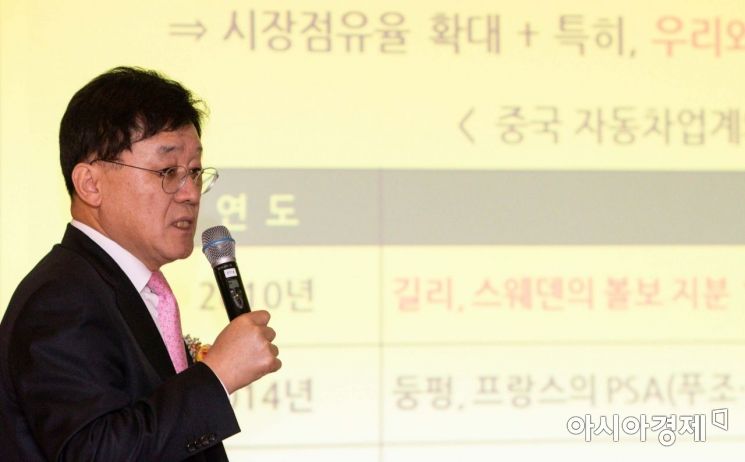
 Jung Manki, Chairman of the Korea Automobile Manufacturers Association. / Photo by Kang Jinhyung aymsdream@
[Asia Economy Reporter Kiho Sung] South Korea ranked 7th in the list of automobile manufacturing countries last year, the same position as in 2018. The gap with Mexico, which ranked just above, was only 20,000 units, leading to criticism that ongoing labor-management conflicts last year caused South Korea to miss the chance to reclaim 6th place.
According to the "2019 Top 10 Automobile Manufacturing Countries Status" report released on the 17th by the Korea Automobile Manufacturers Association (KAMA), the ranking of the top 10 automobile manufacturing countries last year was China, the United States, Japan, Germany, India, Mexico, South Korea, Brazil, Spain, and France, with no changes compared to 2018. However, production decreased in 8 of the top 10 countries. As a result, global automobile production also declined by 4.9% compared to the previous year.
China, the world's largest automobile producer, recorded negative growth for the second consecutive year by producing 25.71 million units, a 7.5% decrease from the previous year.
The United States ranked 2nd with a 3.7% decrease, Japan 3rd with a 0.5% decrease, Germany 4th with an 8.1% decrease, India 5th with a 12.7% decrease, Mexico 6th with a 3.1% decrease, and South Korea 7th with a 1.9% decrease. Brazil ranked 8th with a 2.3% increase, Spain 9th with a 1.0% increase, and France 10th with a 1.8% decrease. Among the top 10 producers, only Brazil and Spain showed an increase in production, while all other countries experienced declines.
Among the top 10 producers, South Korea, the United States, Japan, and Mexico showed a lower decrease rate than the global production decline rate of 4.9%, resulting in an increased share of global production.
In particular, South Korea's production was 3.95 million units, a 1.9% decrease from the previous year, but due to the relatively small decline rate, its global production share increased from 4.1% in 2018 to 4.2% in 2019. Mexico, ranked 6th, produced 3.97 million units, and the production gap between Mexico and South Korea narrowed from about 72,000 units in 2018 to about 22,000 units in 2019.
Regarding this, Chung Manki, chairman of KAMA, pointed out, "Despite improved production conditions such as no-dispute wage and collective bargaining agreements at Hyundai Motor and Ssangyong Motor in 2019, some companies continuously showed conflicts and prolonged wage and collective bargaining negotiations with strikes, causing production disruptions and reduced volume allocations, resulting in missing the opportunity to reclaim the 6th place in global production."
He added, "Especially as Chinese companies are actively expanding into overseas markets, global competition with us is expected to intensify. It is necessary to enhance labor flexibility by quickly expanding the unit period of flexible working hours (6 months or 1 year), allowing dispatch and substitute labor, and extending the labor-management negotiation cycle (from the current 1 year to 3-4 years). Labor and management should also work together to improve productivity while stabilizing wages."
© The Asia Business Daily(www.asiae.co.kr). All rights reserved.

![User Who Sold Erroneously Deposited Bitcoins to Repay Debt and Fund Entertainment... What Did the Supreme Court Decide in 2021? [Legal Issue Check]](https://cwcontent.asiae.co.kr/asiaresize/183/2026020910431234020_1770601391.png)