Export from 1st to 10th Surges 69.4% YoY Thanks to Lunar New Year Holiday Working Days
Daily Average Actually Down 3.2% YoY
February, Marked by Government as Turning Point, Faces Increased Uncertainty Due to COVID-19 Unexpected Variables
DRAM Export Prices Also Decline
Focus on Results from 1st to 20th and Entire February
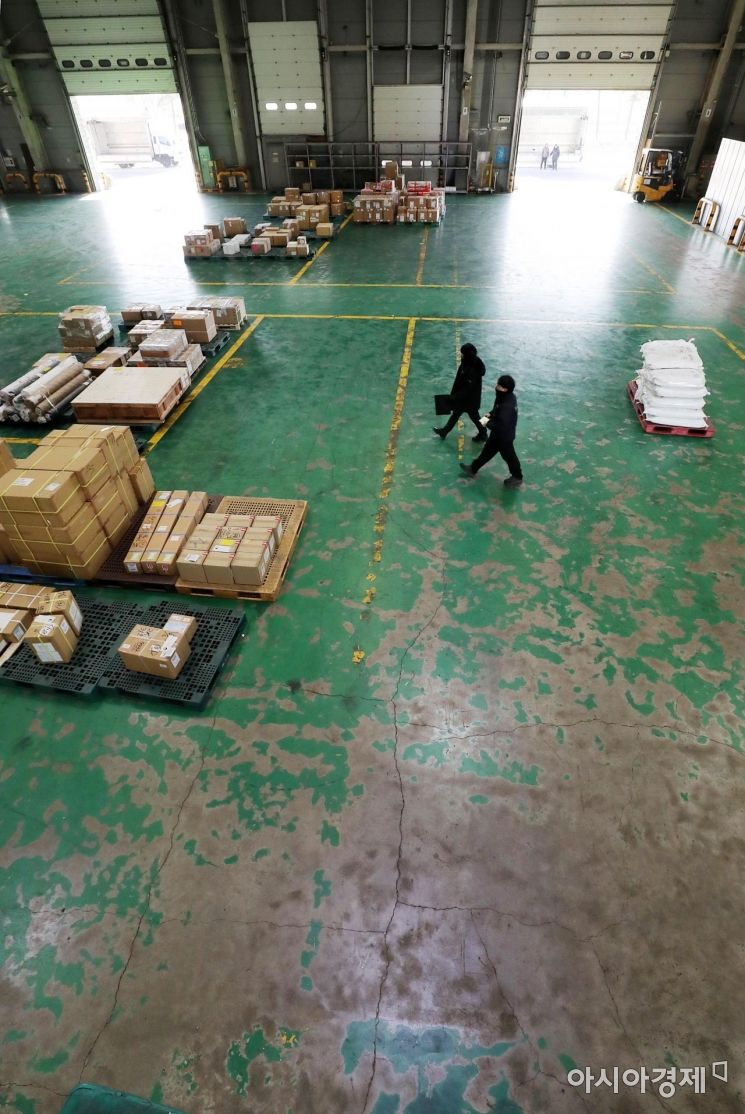 Amid a sharp decline in cargo imports from China due to the recent novel coronavirus impact, the designated warehouse at Incheon Airport Customs in Yeongjongdo, Jung-gu, Incheon, appeared unusually empty on the 6th, unlike its usual state filled with cargo./Yeongjongdo=Photo by Kim Hyun-min kimhyun81@
[Asia Economy Reporter Moon Chae-seok] "February has many working days and several favorable conditions. The key is to make the entire first quarter 'positive'." (Sung Yun-mo, Minister of Trade, Industry and Energy)
Can South Korea's exports meet the government's declared "promised February" announced at the year-end press briefing on December 26 last year? The government's positive export outlook for February did not include predictions regarding unexpected variables such as the early-year Iran missile incident and the novel coronavirus disease (COVID-19) in China.
To minimize the adverse effects of COVID-19 on the real economy, the government is deploying various support measures. However, with declines in semiconductor export prices, which were the basis for the expected export rebound, attention is focused on the export figures from the 1st to the 20th, the entire month of February, and the final first-quarter results to be announced in March.
According to the Korea Customs Service on the 11th, the export amount from February 1 to 10 (provisional customs clearance basis) was $10.7 billion, an increase of 69.4% ($4.38 billion) compared to the same period last year. There were 7 working days out of the 10 days, which was three more than the same period last year that included the Lunar New Year holiday.
What is noteworthy is that the average daily export amount was $1.53 billion, a 3.2% decrease from $1.58 billion during the same period last year. Although the export indicators from the 1st to the 10th do not necessarily lead to the end-of-month figures, the government's declaration that exports will turn positive in February seems to have lost its weight.
Considering that the first export report of the new year last month showed an average daily export amount of $1.77 billion, a 5.3% increase year-on-year, raising expectations for recovery, the mood now appears somewhat dampened.
It is true that semiconductors led the export rebound with a 37.8% increase compared to the same period last year, but it remains to be seen whether the semiconductor unit prices, which rose last month, will continue to increase.
According to market research firm DRAMeXchange, as of the 10th, the spot price for PC DRAM (DDR4 8Gb standard) was $3.41 per unit, down from the peak of $3.48 on the 4th.
Export prices also declined due to exchange rate effects. According to the "January 2020 Export and Import Price Index" released by the Bank of Korea on the 14th, the export price of DRAM in January fell 2.5% month-on-month and plunged 41.4% year-on-year.
Kang Hwan-gu, head of the Price Statistics Team at the Bank of Korea's Economic Statistics Bureau, explained, "The export price of DRAM has continued a negative trend for 13 consecutive months since January last year compared to the same month of the previous year," but added, "The magnitude of the decline is gradually decreasing."
The overall semiconductor export price is showing a similar trend to DRAM. When viewed in contract currency terms, semiconductor export prices actually rose 0.2% month-on-month.
An official from the Ministry of Trade, Industry and Energy said, "We are carefully monitoring key semiconductor-related indicators such as the Philadelphia Semiconductor Index."
© The Asia Business Daily(www.asiae.co.kr). All rights reserved.

















