Pilates Popular Among Office Workers
Lower Barriers to Instructor Certification... Controversy Over Unqualified Instructors
Some Students Injured Their Backs During Training
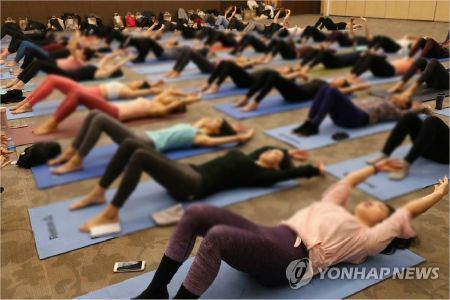 Women are learning Pilates at a cultural center. The photo is not related to any specific expression in the article. [Image source=Yonhap News]
[Asia Economy Reporter Han Seung-gon, Intern Reporter Kim Seul-gi] # A female office worker in her 20s, Ms. A, feels frustrated whenever she thinks of Pilates. She injured her back while taking Pilates classes because the instructor at the Pilates academy, which she joined through an acquaintance’s recommendation, was practically unqualified.
Ms. A was bewildered and started to investigate whether there was a problem with how Pilates instructors obtain their certifications. This is because anyone can acquire a Pilates certificate by investing just a few months of their time. Ms. A expressed, "I wish the certification process for professions that handle the human body were at least a bit more stringent," adding, "If not, I hope the qualification standards are raised significantly."
With the introduction of the 52-hour workweek system, ensuring office workers have 'evenings to themselves,' the number of workers taking care of themselves through activities like Pilates is increasing. Pilates is a muscle-strengthening exercise designed to be performed with simple equipment such as beds and mattresses.
The problem lies in the fact that some Pilates instructors demonstrate skills that are far below what can be considered instructor-level.
Although Pilates is an exercise based on various sports science knowledge such as anatomy and exercise physiology, underqualified instructors cannot provide proper education, resulting in students suffering injuries to their shoulders, backs, and legs.
◆ Pilates Certifications: 20 cases in 2015 → 185 cases in 2019
Anyone can become a Pilates instructor even without a nationally certified license. According to the Korea Research Institute for Vocational Education & Training, the number of registered Pilates instructor certificates was only 20 in 2015 but surged to 185 in 2019, an approximately eightfold increase.
There were also various institutions issuing these certificates. Some of the issuing bodies registered with the Korea Research Institute for Vocational Education & Training had no relation to exercise or physical education at all.
The acquisition period was also short in some cases, ranging from 5-week courses to 3-month courses, allowing instructors to obtain certification quickly.
Given this situation, students are increasingly concerned about whether Pilates instructors have received proper training and whether there are safety issues, as the number of Pilates instructors is rapidly increasing.
B, a 24-year-old university student, said, "I saw advertisements saying that if you get a Pilates certificate, you can get a job as a Pilates instructor. Since it’s already hard to find a job, I was tempted by the ads that said you could become an instructor by getting a certificate in a short period."
◆ Underqualified Pilates Instructors... Some Students Suffer Back Pain and Other Safety Incidents
Complaints about the Pilates instructor qualification controversy continue in online communities. In 2017, a post titled "Your Pilates Class Might Be a Scam" was published on an online community.
The author wrote, "An intern who had been doing Pilates for less than six months was teaching members," and added, "Those who take Pilates know it’s not cheap. I think it’s ridiculous to pay a high price to attend classes taught by an intern without a certificate."
They continued, "From what I heard, the intern teaches members the content learned in the previous week’s intern class the following week," and confessed, "I was introduced as a new instructor, but I was someone who didn’t even know what Pilates was." The post has since been deleted.
In Pilates communities where information about Pilates instructor certificates is exchanged, voices of self-reflection have emerged, urging, "If you want to be a Pilates instructor, please receive proper training."
A member who identified themselves as a "current instructor" admitted, "Due to the nature of the job, the entry barrier is low, and if you’re good, you can make some money. But there really aren’t many instructors who have been properly trained."
The damage caused by unprofessional instructors falls directly on consumers. C, a 28-year-old office worker, said, "I visited a Pilates center for posture correction and back pain, but my back pain worsened, and I had to receive hospital treatment. When I told the hospital I was injured doing Pilates, they said many patients come in injured from Pilates," adding, "I think it was a mistake to believe the instructor who said, ‘You have to hurt for the exercise to work.’"
As a result, the number of damage relief cases related to Pilates reported to the Korea Consumer Agency increased steadily from 237 cases in 2016 to 258 cases in 2019.
However, the Korea Consumer Agency can only provide relief for cases where the damage is clearly evident, such as excessive penalty clauses, which has led to growing calls for revising laws related to certification to prevent the training of underqualified instructors.
An official from the Ministry of Education, responsible for the Basic Qualifications Act, explained in a phone interview with Asia Economy, "We are preparing to introduce a 'registration renewal system' through amendments to the Basic Qualifications Act. Once the 'registration renewal system' is implemented, the government can periodically, every three years or so, clean up ghost certificates that are not actually in use and certificates with prohibited or disqualifying reasons."
© The Asia Business Daily(www.asiae.co.kr). All rights reserved.
![User Who Sold Erroneously Deposited Bitcoins to Repay Debt and Fund Entertainment... What Did the Supreme Court Decide in 2021? [Legal Issue Check]](https://cwcontent.asiae.co.kr/asiaresize/183/2026020910431234020_1770601391.png)