Second National Scholarship Application by the 10th of Next Month
Annual Maximum of 5.2 Million KRW for Basic to 3rd Income Brackets
Scholarship Support of 675,000 KRW Annually for 8th Bracket and Below
No Grade Requirement for First Semester of New, Transfer, and Re-enrolled Students
Re-enrolled Students Who Missed First Application Can Apply with Relief Request Form
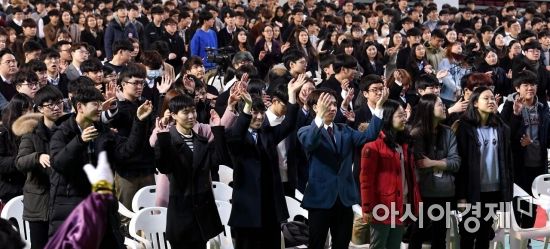 At the 2018 Korea University Entrance Ceremony held at Hwajeong Gymnasium, Korea University, Anam-ro, Seongbuk-gu, Seoul, freshmen are learning the school song and cheer songs from senior cheerleaders. Photo by Hyunmin Kim kimhyun81@
[Asia Economy Reporter Jo In-kyung] Due to concerns over the spread of COVID-19, graduation and entrance ceremonies have been canceled, and the start of the semester has been delayed at universities, resulting in a relatively calm atmosphere as the new semester begins. Although various gatherings and orientations (OT) have been canceled, making it difficult for freshmen to fully enjoy the joy of acceptance, one thing that should not be forgotten is the application for the 'National Scholarship.' Most universities have abolished entrance fees and frozen tuition fees, but receiving tuition bills amounting to several million won per semester is still burdensome for both students and parents. In addition to the National Scholarship, which is provided based on household income, there are government-supported scholarships such as the National Work-Study Scholarship, Donation Scholarship, and National Excellence Scholarship. It is advisable to apply in advance by entering your information to receive these scholarships, so do not forget to apply.
◆Tuition Bills Vary According to Monthly Recognized Income= Currently, scholarships operated by the Korea Student Aid Foundation include ▲Income-Linked National Scholarship ▲National Education Work-Study and Small and Medium Enterprise Employment-Linked Scholarship (Hope Ladder) ▲Donation Scholarship ▲National Excellence Scholarship, among others.
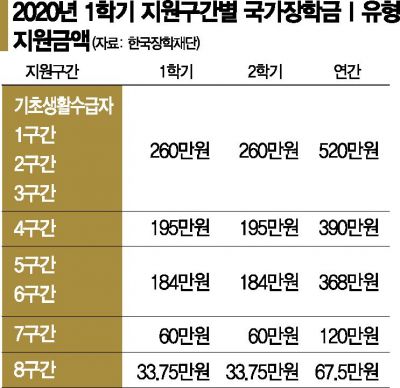
A representative example of the income-linked National Scholarship, commonly called 'Gukjang,' is the 'National Scholarship Type I,' which provides differential support according to the income level of the student's household. This scholarship supports tuition fees within the range that does not exceed the tuition for the semester, varying by the student's income bracket. Students in the basic livelihood security recipient category through income brackets 1 to 3 can receive up to 2.6 million KRW per semester and up to 5.2 million KRW annually. Bracket 4 receives up to 1.95 million KRW per semester and 3.9 million KRW annually; brackets 5 and 6 receive up to 1.84 million KRW per semester and 3.68 million KRW annually. Bracket 7 receives up to 600,000 KRW per semester and 1.2 million KRW annually, and bracket 8 receives up to 337,500 KRW per semester and 675,000 KRW annually. However, the most economically well-off households in brackets 9 and 10 are not eligible for support.
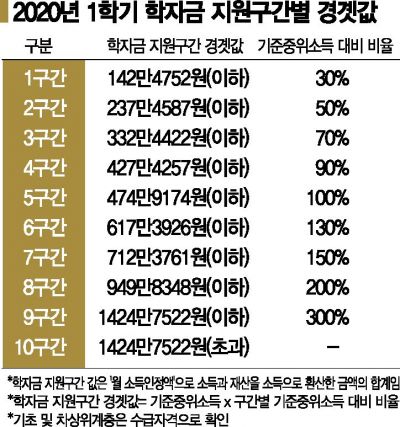
The economic situation of each household is divided by calculating the 'income quintile.' Based on public data surveyed through the Social Security Information System, household members' income, assets, financial assets, and debts are assessed to calculate the recognized income amount, which is then divided into 10 brackets according to the amount of financial aid. The Ministry of Health and Welfare set this year's median income (for a family of four) at 4,749,174 KRW, a 2.94% increase from the previous year, adjusting the thresholds for financial aid brackets accordingly. For bracket 8, which receives the smallest scholarship, the income and asset conversion amount must be 9,498,348 KRW or less.
If you have properly applied for the scholarship and completed the income review and consent to provide household member information, enrolled students will automatically receive tuition bills reflecting the National Scholarship deduction. Freshmen who have not yet applied for the National Scholarship can pay tuition first and later receive a refund for the scholarship amount.
◆Enrolled Students Must Meet Academic Standards Each Semester= The National Scholarship is available to any university student with Korean nationality enrolled in a domestic university, provided they meet certain academic standards. However, freshmen and transfer students admitted to universities under Financial Support Restriction Type II are not eligible.
For freshmen, transfer students, and re-enrolled students, academic standards do not apply for the first semester. However, enrolled students must complete 12 credits in the previous semester and achieve a B grade (80 points out of 100) or higher. Basic livelihood and near-poverty class students need only achieve a C grade (70 points) or higher, and students with disabilities have no restrictions on grades or credits. Additionally, students in income brackets 1 to 3 can receive the National Scholarship for the next semester even if they receive a C grade twice.
It is also important to check cases where support is restricted, such as students who have received overlapping scholarships in past semesters, those whose total scholarship benefits exceed the regular semesters of their department, and those who took a leave of absence after receiving the National Scholarship and then returned. If a student who received the National Scholarship withdraws, is expelled, or otherwise loses their enrollment status, or receives a tuition refund due to leave of absence, the scholarship must be returned. Also, if the scholarship amount exceeds the tuition due to overlapping benefits, the excess amount must be repaid.
Students admitted through the Overseas Korean Special Admission must report overseas income and assets if any household member is registered as an overseas Korean in the resident registration to be eligible for the National Scholarship, so caution is required.
◆Carefully Review University-Specific Scholarships and Multi-Child Benefits= The 'National Scholarship Type II (University-Linked Support Type)' is a scholarship provided to encourage universities to reduce tuition burdens on their own. Since scholarships are provided based on each university's criteria, it is important to carefully review and apply accordingly. However, freshmen and transfer students admitted to universities under Financial Support Restriction Types I and II based on university basic competency diagnosis and university structure reform evaluation are excluded from eligibility.
There is also a 'Multi-Child National Scholarship' to reduce tuition burdens for families with multiple children. Families with three or more children in income brackets from basic livelihood to 3 can receive up to 2.6 million KRW per semester and 5.2 million KRW annually. Brackets 4 to 8 can receive up to 2.25 million KRW per semester and 4.5 million KRW annually. This applies to all university-enrolled children in families with three or more children, regardless of whether other children are university students.
Additionally, there are scholarships such as the 'Regional Talent Scholarship,' which supports the recruitment of outstanding talents and future talent development in regional universities, and the 'Entrance Fee Support Scholarship,' which provides partial entrance fee support to students at universities that have implemented entrance fee reduction plans. It is necessary to check whether you qualify for these.
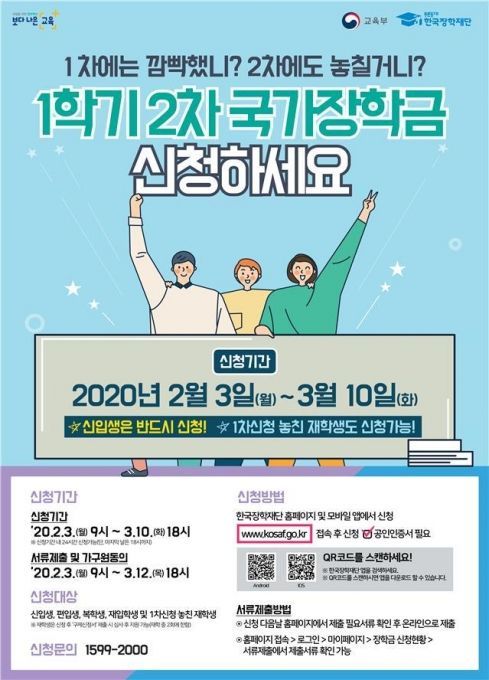
The Korea Student Aid Foundation is accepting the second round of National Scholarship applications for freshmen, transfer students, re-enrolled students, and returning students until 6 p.m. on the 10th of next month. Enrolled students who missed the first application can submit a relief application up to twice during their enrollment period and apply additionally. After applying for the National Scholarship, submission of documents for income review and consent to provide household member information must be completed by 6 p.m. on the 12th of next month. Detailed information related to National Scholarship support can be found on the Korea Student Aid Foundation website (www.kosaf.go.kr) and through the call center (1599-2000).
© The Asia Business Daily(www.asiae.co.kr). All rights reserved.
![User Who Sold Erroneously Deposited Bitcoins to Repay Debt and Fund Entertainment... What Did the Supreme Court Decide in 2021? [Legal Issue Check]](https://cwcontent.asiae.co.kr/asiaresize/183/2026020910431234020_1770601391.png)