[Asia Economy Reporter Park So-yeon] Heads of major conglomerates have voiced a unified call to "save small business owners." Domestic conglomerate leaders have steered their groups through numerous crises, from the foreign exchange crisis to recent US-China trade disputes and Japan's export restrictions. Although the scale of their businesses differs, as heads of families responsible for their households' livelihoods, they deeply understand the struggles of small business owners who are fighting to survive in global competition.
According to industry sources on the 14th, SK Group has decided to suspend the operation of its in-house cafeterias once a week starting next week to support domestic small and medium-sized merchants struggling due to the COVID-19 pandemic and to boost domestic consumption. Instead, SK employees will use nearby local restaurants.
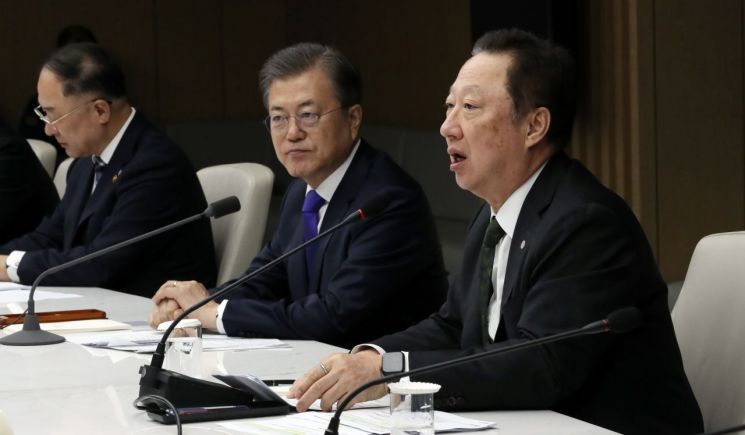
This was first proposed by Chairman Chey Tae-won during a morning meeting at the Korea Chamber of Commerce and Industry with President Moon Jae-in and key economic figures to respond to the COVID-19 situation. An SK Group official said, "Specific implementation plans will be established by comprehensively considering the surrounding conditions of each business site." SK plans to conduct an internal campaign targeting its employees and explore additional measures to revitalize local commercial districts.
Regarding this, Park Yong-man, chairman of the Korea Chamber of Commerce and Industry, also mentioned on Facebook, "The president said it was a good idea, and I also felt it was a good idea." Chairman Park added, "So I went to a local restaurant for lunch, ate rice soaked in steaming hot soup with kimchi, and felt my stomach was full and the world was happily colorful like a rainbow."
During the 1998 foreign exchange crisis, Chairman Park experienced a heart-wrenching situation where, while trying to save his group by selling additional affiliates, the other party offered ridiculously low prices, making him even think of his children's faces. He is a chairman who understands better than anyone the feelings of small business 'bosses' whose families' livelihoods depend on their work.
Not to be outdone, Samsung Electronics Vice Chairman Lee Jae-yong also proposed to the Blue House, "I hope not only lunch but also evening company dinners can be revitalized," and requested, "I hope concerns about violating the 52-hour workweek can be resolved."
Samsung Group also purchased 30 billion won worth of Onnuri gift certificates to revitalize traditional markets. Additionally, Samsung decided to actively participate in increasing flower consumption to support flower farmers facing difficulties due to cancellations and postponements of various events such as graduation and entrance ceremonies. They plan to increase the placement of flowers in offices and meeting rooms across all business sites to create a softer working atmosphere while boosting flower consumption.
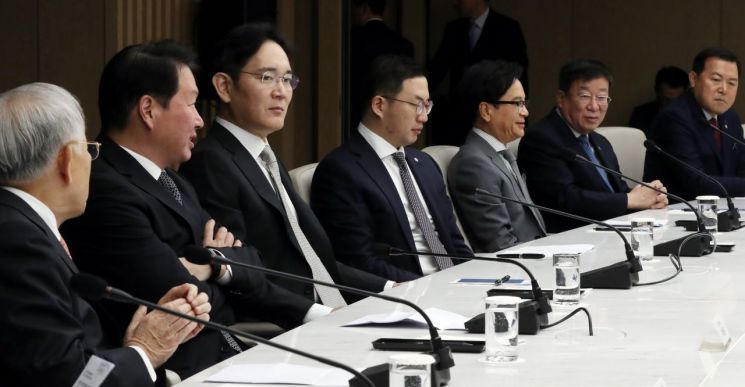
Furthermore, the business community proposed active support and regulatory improvements related to COVID-19 to President Moon.
Park Yong-man, chairman of the Korea Chamber of Commerce and Industry, said, "The government is moving quickly to prepare countermeasures, and with the president encouraging economic activities, it is expected to greatly help economic sentiment," adding, "I ask the government to focus support throughout February so that normal operations in China can resume quickly."
The government announced that it will introduce a system exempting administrative penalties such as responsibility for public officials to actively develop and implement policies related to COVID-19.
Chairman Park mentioned this and said, "If, furthermore, policy audits are suspended exceptionally for this incident, policy development and implementation will become more active and greatly help early resolution of the situation."
He added, "After the COVID-19 situation is resolved, mid- to long-term policy efforts such as regulatory innovation and fostering the service industry must continue."
Son Kyung-sik, chairman of the Korea Employers Federation (KEF), expressed gratitude for the government's allowance of special extended work hours for companies affected by COVID-19, saying, "I appreciate the expansion of permissible reasons, which eases the burden on companies," and emphasized, "There is a need to expand policy support more actively for affected companies to revitalize corporate activities."
Chairman Son also suggested legislative supplementation for flexible working hours to cope with various situations including COVID-19, proposing the prompt enactment of the flexible work system and raising the status of the Director of the Korea Disease Control and Prevention Agency.
Kim Ki-moon, chairman of the Korea Federation of SMEs, urged measures, stating, "It takes a long time for new policies to be applied on the front lines, and active administration is difficult due to concerns about audits by the Board of Audit and Inspection."
Each company also demanded "tailored measures."
Yoon Yeo-cheol, vice chairman of Hyundai Motor Company, requested a temporary reduction in tariffs related to air freight costs, which are 30 to 50 times higher than sea freight costs, as well as masks and other quarantine supplies for 120,000 workers at Chinese factories.
SK Group Chairman Chey Tae-won asked not to reduce or cancel Korea-China air cargo transportation, as it would disrupt the procurement of Chinese semiconductor wafers. Lotte Group Vice Chairman Hwang Kak-gyu requested measures for the distribution and tourism sectors, noting that cancellations of Lotte Hotel rooms have reached 28,000.
CJ Group Chairman Lee Jae-hyun also said, "Please recognize cultural content as an industry and provide substantial support," and requested more support in sectors such as aviation, tourism, and distribution.
In response, Deputy Prime Minister and Minister of Economy and Finance Hong Nam-ki said, "We are actively considering reducing tariff rates on air freight for urgent parts transportation," and added, "We will consult with the Minister of Land, Infrastructure and Transport to minimize reductions in Korea-China air routes."
He also added, "We will announce sector-specific measures for industries severely affected, such as tourism, distribution, and accommodation, starting next week."
© The Asia Business Daily(www.asiae.co.kr). All rights reserved.


















