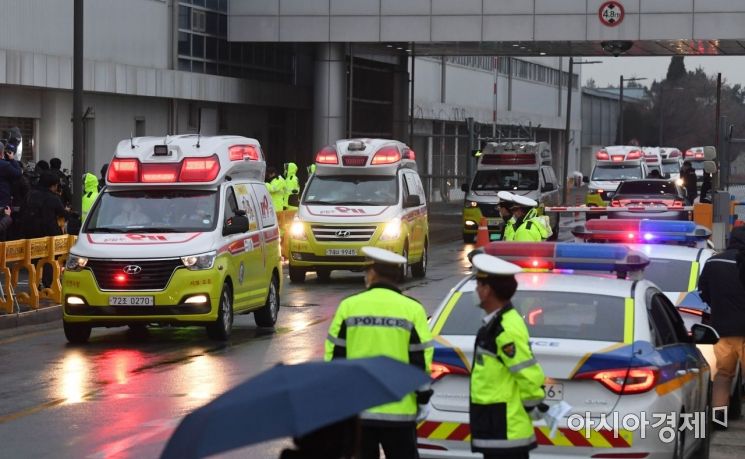
 An ambulance is leaving the airport as Korean residents from Wuhan, Hubei Province, China, where the novel coronavirus infection occurred, arrived at Gimpo International Airport in Gangseo-gu, Seoul on the 12th. Photo by Kim Hyun-min kimhyun81@
[Asia Economy Reporter Junho Hwang] The Korean Academy of Science and Technology, a leading scientific organization, pointed out that the government needs to change its response strategy to prevent COVID-19 from spreading in local communities. With community infection confirmed through the 6th confirmed case, it is suggested that the response level should be raised from managing imported cases to managing pneumonia patients.
Concerns of Community Infection from the 6th Confirmed Case
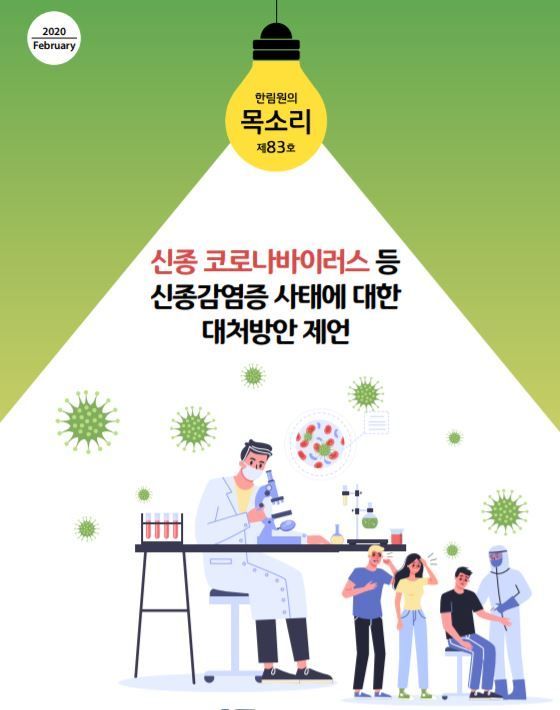
The Academy stated in its recently published 'Voice of the Academy No. 83' that South Korea had a notably high number of COVID-19 infection cases imported from countries other than China, and that the current goal is to prevent infection within the community. With community infection confirmed through the 6th confirmed case, the stage of blocking imported cases has passed.
According to the Central Disease Control Headquarters, the 6th confirmed case is a friend who dined with the 3rd confirmed case at Hanilkwan in Gangnam-gu, Seoul, and is considered the second domestic transmission case of COVID-19. Furthermore, the wife (10th case), son (11th case), and a friend from Myeongnyun Church (21st case) were infected from the 6th confirmed case.
The Academy viewed that to minimize the spread of COVID-19, it is necessary to confirm COVID-19 infection among pneumonia patients. The Academy proposed a community spread minimization strategy through a 'pneumonia full survey' to identify COVID-19 infected patients among those hospitalized with pneumonia, preemptive isolation of pneumonia patients in single rooms followed by release from isolation if tests are negative ('preemptive pneumonia isolation'), and collecting and testing specimens from patients with influenza-like symptoms to check for other patients in the community ('utilization of influenza laboratory surveillance system'). These measures should be implemented to minimize community spread.
The Biggest Obstacle in Responding to COVID-19 is 'Lack of Information on Reality'
Additionally, the Academy emphasized the need for proactive responses from scientists. Scientists should step forward to devise the best solutions through collective intelligence, accurately analyze the current situation, and discuss with the government which additional countermeasures should be incorporated into ongoing research.
Han Min-gu, President of the Korean Academy of Science and Technology, stated, "The biggest obstacle in resolving emerging infectious diseases is the lack of information about the actual situation." He added, "Because it is difficult to predict the spread routes of infections and to identify diagnosis and treatment methods, social confusion and anxiety intensify. Therefore, experts in science and technology must widely disseminate medical and scientific information to alleviate public anxiety and actively play a role in resolution and prevention."
Meanwhile, this 'Voice of the Academy' was prepared based on the discussion results of the joint roundtable held on the 5th by the Korean Academy of Science and Technology, the Korean Federation of Science and Technology Societies, and the National Science Advisory Group for Public Life, aiming to deliver the insights of top experts in related fields at a level accessible to the public.
© The Asia Business Daily(www.asiae.co.kr). All rights reserved.
![User Who Sold Erroneously Deposited Bitcoins to Repay Debt and Fund Entertainment... What Did the Supreme Court Decide in 2021? [Legal Issue Check]](https://cwcontent.asiae.co.kr/asiaresize/183/2026020910431234020_1770601391.png)

















