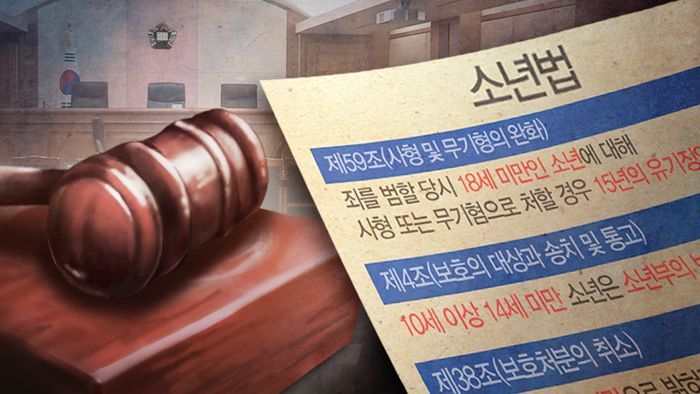
[Asia Economy Reporter Shinwon Yoon] Recently, an elementary school student fatally stabbed a friend with a weapon but was classified as a "Chokbeopsonyeon" (juvenile offender aged 10 or older but under 14) and thus did not face criminal punishment nor have a criminal record. The student was sent to a long-term juvenile detention center under disposition number 10. Although this is the heaviest juvenile protection disposition, considering the serious crime of deliberately killing a friend, the level of punishment is relatively light. Because of this, there is intense debate over whether society should treat juvenile offenders as individuals to be nurtured or punish them the same way as adult criminals.
Article 9 of the Criminal Act distinguishes young offenders based on age 14 into "beomjoe sonyeon" (juvenile offenders aged 14 or older but under 19) and "chokbeopsonyeon" (juvenile offenders aged 10 or older but under 14). Among these, chokbeopsonyeon only receive "protective dispositions" that do not leave a criminal record, based on the regulation that "juvenile protective dispositions shall not affect the future personal status of the juvenile."
However, violent crimes committed by chokbeopsonyeon have been increasingly severe. According to data received by Assemblyman Byeonghun So of the National Assembly’s Public Administration and Security Committee from the National Police Agency, 7,364 chokbeopsonyeon were sent to juvenile court in 2018, a 12.4% increase compared to 6,441 in 2015, three years earlier. During this period, an average of 7,006 juveniles were sent annually, about 19 daily. Among crime types, the four major violent crimes?murder, robbery, theft, and assault?accounted for 77% of the total.
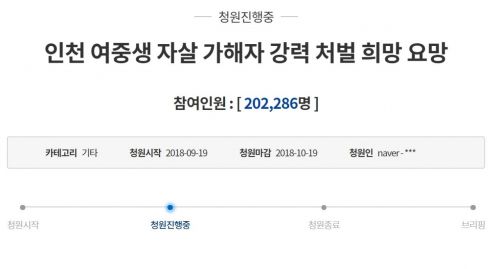
Some argue that the age threshold for chokbeopsonyeon should be lowered. This is because these crimes are by no means minor compared to adult crimes, yet offenders repeatedly evade legal consequences. On the Blue House’s public petition board, which serves as a barometer of public opinion, petitions demanding the abolition or revision of the Juvenile Act continue to be posted, with four petitions receiving over 200,000 signatures each.
Reflecting public opinion, the government is also discussing amendments to the Criminal Act and Juvenile Act. Last month, the Ministry of Education announced plans to lower the upper age limit for chokbeopsonyeon from 14 to 13 years old. The Ministry of Justice also released the "1st Basic Plan for Juvenile Delinquency Prevention (2019?2023)" in 2018, which contained the same proposal as the Ministry of Education, and during the 20th National Assembly, about 30 related Juvenile Act amendment bills were submitted.
However, there are criticisms that lowering the age of criminal responsibility is not a viable solution for preventing juvenile crime. The proportion of chokbeopsonyeon among all juvenile offenders is very low, under 1%, and many of these offenders come from socially marginalized backgrounds such as single-parent families or runaway youths.
Internationally, the United Nations (UN) Committee on the Rights of the Child urges member states not to lower the minimum age of criminal responsibility and even recommends raising it.
The National Human Rights Commission of Korea also states, "We cannot be certain that harsh punishment of juvenile offenders is effective in preventing juvenile crime," and explains, "What should be noted in juvenile crime is the recidivism rate, especially the increase in short-term recidivism. Juvenile crime prevention policies should be comprehensively improved to reduce the environments that expose youth to reoffending."
© The Asia Business Daily(www.asiae.co.kr). All rights reserved.


















