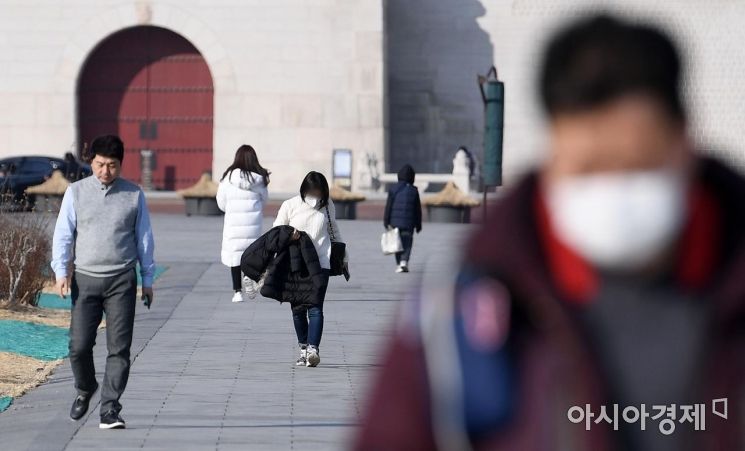
 On the 11th, when the weather was mild, citizens at Gwanghwamun Square in Seoul wore light clothing instead of heavy coats. Photo by Hyunmin Kim kimhyun81@
[Asia Economy Reporter Jo In-kyung] On the 11th, daytime temperatures rose to levels typical of late March, mainly in the central region.
According to the Korea Meteorological Administration on the 11th, the highest temperature in Seoul was 14.6°C, the highest so far this year. This is nearly 10 degrees higher than the average mid-February daytime high temperature (5°C) from 1981 to 2010, and even higher than the average late March daytime high temperature (12.4°C).
Not only Seoul but also Incheon (13°C), Suwon (14.5°C), Gangneung (16.6°C), Cheongju (15°C), and Daejeon (16°C) recorded their highest temperatures this year, showing weather comparable to late March.
In the southern region, temperatures rose to around 15 degrees in places such as Jeonju (15.4°C), Busan (14.5°C), Pohang (14.5°C), and Jeju (15.1°C).
The rise in daytime temperatures is due to a high-pressure system located over the East Sea. Because of the clockwise rotation of winds in the Northern Hemisphere's high-pressure system, warm winds are blowing from the southwest toward South Korea.
Especially unlike the cloudy southern region, the central region experienced relatively large temperature increases due to bright sunshine.
Rain is expected nationwide on the morning of the 12th, but warm weather is forecast to continue. Daytime temperatures on the 12th are predicted to be between 7 and 15 degrees Celsius, rising further to 9 to 17 degrees Celsius on the 13th.
© The Asia Business Daily(www.asiae.co.kr). All rights reserved.
![Clutching a Stolen Dior Bag, Saying "I Hate Being Poor but Real"... The Grotesque Con of a "Human Knockoff" [Slate]](https://cwcontent.asiae.co.kr/asiaresize/183/2026021902243444107_1771435474.jpg)
















