Minister Luhut "US Ignores Without Nuclear" Changes Attitude After Talks with US General
Attempted to Build Nuclear Power Plant in 1987 but Abandoned... Low Possibility This Time Too
Academia Also Negative "Shocking Remarks Like Frivolous Jokes"
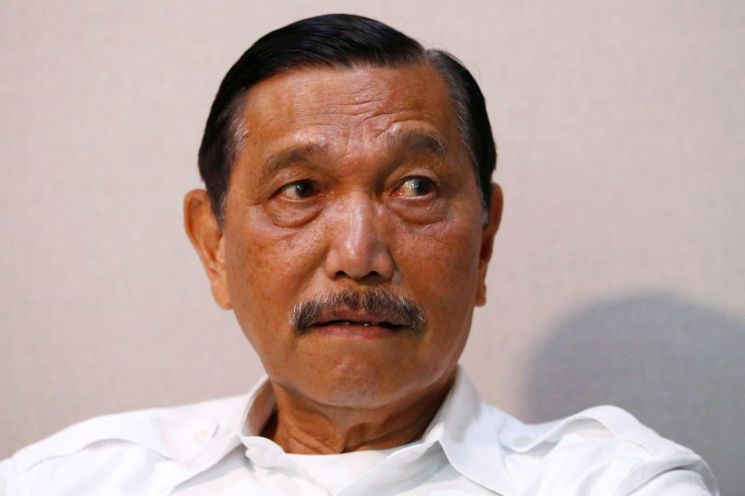
[Asia Economy Jakarta Correspondent Sujin Choi] In Indonesia, the "major power in Southeast Asia," a government official's remark that "nuclear development is necessary" has stirred unrest in the local atmosphere.
On the 10th (local time), according to Indonesian media such as The Jakarta Post, Luhut Panjaitan, Minister of Maritime Affairs and Investment Coordinating Ministry, recently introduced a conversation with President Joko Widodo at the launch event of the 'Agricultural Crisis Situation Room (War Room),' saying, "It is now time for Indonesia to develop nuclear technology." The conversation he referred to with President Jokowi took place at the World Economic Forum (Davos Forum) held in Switzerland last month. He introduced that he told President Jokowi, "Who causes global crises? It is the countries that possess nuclear weapons." He added, "This provided the starting point for discussions on nuclear development."
Initially, he was opposed to nuclear development. When Russia's Rosatom State Atomic Energy Corporation proposed the development of a nuclear power plant in 2017, he showed a lukewarm response, saying that public understanding was necessary.
His 180-degree turnaround was due to the attitude of a U.S. military general he met privately. According to Minister Luhut, the general only wanted dialogue with North Korea and China and did not care about Indonesia. In particular, the general reportedly told Luhut, "Don't even dream of nuclear energy." As a former military officer himself, this wounded his pride.
He revealed his inner thoughts at the time, saying, "The reason the U.S. only talks with North Korea and China and ignores Indonesia is precisely because we do not develop nuclear technology," and "I thought if we possessed nuclear weapons, we could instill fear." He also added that Indonesia has abundant eco-friendly energy resources and conditions suitable for building nuclear power plants, making development possible.
Indonesia is sensitive to Minister Luhut's remarks. Some have even started online polls to gauge public opinion on the matter. Diplomatically, Mohammad Azad, Iran's ambassador to Indonesia, expressed support for Indonesia developing nuclear technology as a non-threatening energy source. Ambassador Azad said, "The driving force behind advanced sciences, including nuclear energy, in Iran is the younger generation," and encouraged, "Indonesia is also ready to develop nuclear technology." He further emphasized the need to nurture young scientists and engineers, lending support to Minister Luhut's claims.
However, the local academic community holds a negative view, calling his remarks impulsive. Muhadi Sujiono, an international relations expert at Gadjah Mada University, pointed out that statements by high-ranking government officials have a significant impact on the public. He criticized Minister Luhut's attitude as shocking and likened it to an unserious joke. Sujiono, who is active in the International Campaign to Abolish Nuclear Weapons (ICAN), stated that Indonesia consistently adheres to non-nuclear principles and that the Foreign Minister prioritizes maintaining Indonesia as a nuclear-free country in diplomatic policy. He emphasized that Indonesia's negotiating power in the international community is unrelated to whether it possesses nuclear energy and that owning nuclear weapons, as seen in the cases of Iran and North Korea, can lead to international isolation.
Indonesia is also a signatory to the Treaty on the Non-Proliferation of Nuclear Weapons (NPT). The Ministry of International Security has expressed support for the Comprehensive Nuclear-Test-Ban Treaty (CTBT). This means Indonesia supports international efforts to curb nuclear weapons development and has no intention of conducting nuclear tests or development. The Jakarta Post reported that his remarks were "unclear whether they referred to nuclear weapons development or nuclear power plant development."
Indonesia has previously pursued nuclear power plant construction, even half a century ago. In 1958, it established a Nuclear Advisory Committee and enacted the Basic Atomic Energy Law in 1964. In 1965, a 1-gigawatt nuclear research reactor was operated in Bandung. Later, under the Suharto regime, a Nuclear Power Plant Construction Preparation Committee was established, and in 1987, the construction of a nuclear power plant was decided. However, continuous social opposition and religious and political environments prevented actual development.
Recently, Indonesia has resumed efforts to develop nuclear power plants. After a massive blackout lasting nine hours in Jakarta and nearby cities last August, which affected over 30 million people, nuclear power was reconsidered as part of stable power supply measures. In October last year, officials from Indonesia's National Economic Industry Committee, Ministry of Energy and Mineral Resources, and the state electricity company visited South Korea.
© The Asia Business Daily(www.asiae.co.kr). All rights reserved.
![User Who Sold Erroneously Deposited Bitcoins to Repay Debt and Fund Entertainment... What Did the Supreme Court Decide in 2021? [Legal Issue Check]](https://cwcontent.asiae.co.kr/asiaresize/183/2026020910431234020_1770601391.png)















