Site of Former US Ambassador's Residence in Songhyeon-dong, Jongno-gu
Hanjin Planned 7-Star Hanok Hotel but Development Failed Due to Proximity to Gyeongbokgung Palace and Schools
Sale Accelerates 13 Years After 2008 Purchase
Jongno-gu Proposes Park Development and Land Swap with District Office Site
Government Funding Key for Public Development
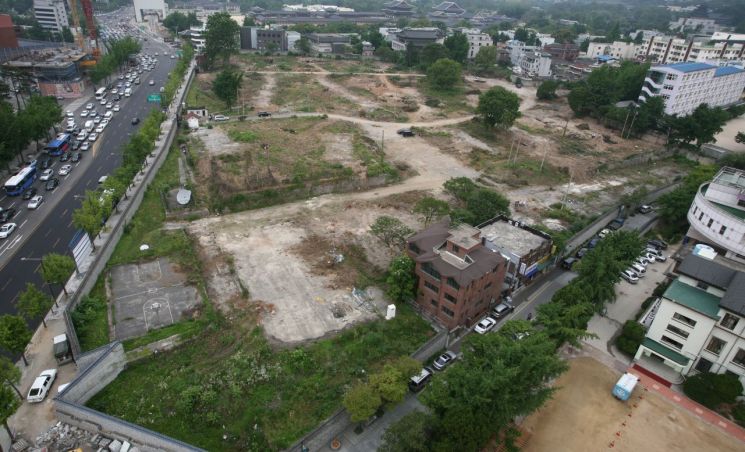 ▲ The site in Songhyeon-dong, Jongno-gu, Seoul, left unattended for 23 years. (Provided by Korean Air)
[Asia Economy Reporter Lee Chun-hee] As Hanjin Group has decided to sell the Songhyeon-dong site, known as the last prime land in Jongno, Seoul, attention is focused on the new buyer and development direction. Although this land is located in the heart of Seoul, development has repeatedly failed due to its proximity to Gyeongbokgung Palace and schools. Seoul City and Jongno-gu are advocating for turning it into a park, but since the market price is at least 500 billion KRW, it is expected to be difficult for the public sector to secure the enormous purchase cost, making it challenging to find a utilization plan.
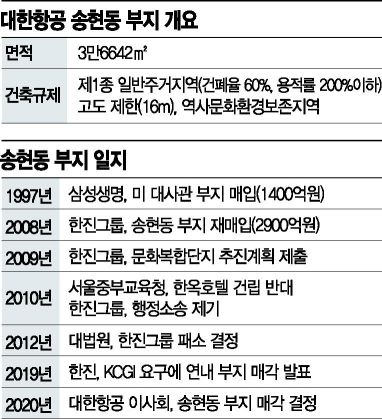
The land, which has changed owners several times, has come back on the market after Korean Air held a board meeting on the 6th and approved a management improvement plan that includes the sale of the 36,642㎡ Songhyeon-dong site. It has been 12 years since the site was purchased in 2008 for 290 billion KRW.
The Songhyeon-dong site is a historically significant land where Prince Anpyeong and Prince Bongnim’s residences were located during the Joseon Dynasty. During the Japanese colonial period, the Chosun Industrial Bank used it as staff housing, and after liberation, the U.S. government took ownership and built housing for embassy staff. In 1997, when the embassy housing was relocated, Samsung Life Insurance purchased the site for 140 billion KRW the same year to build a contemporary art museum. However, unable to find a suitable use, the ownership eventually changed to Korean Air in 2008.
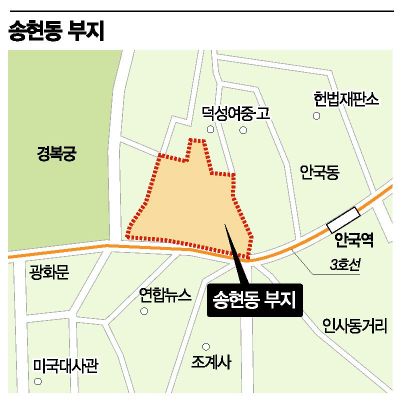
In 2010, Hanjin Group announced plans to build a '7-star' hanok hotel with 150 rooms, four basement floors, and four above-ground floors on this site. However, this plan also drifted for over 10 years without groundbreaking. Because Pungmoon Girls' High School (now Pungmoon High School) and Deoksung Girls' Middle and High Schools are adjacent, the education authorities and local residents opposed the plan, fearing that harmful facilities such as casinos might be included. Eventually, Hanjin filed a lawsuit against the Seoul Central Education Office, which blocked the hotel construction, but in 2012, the Supreme Court ruled against Hanjin, stating that "the three traditional schools existed before the land was purchased and the site was within a purification zone."
After losing the lawsuit, Hanjin proposed a complex cultural space focused on exhibition halls and performance venues, but this too remains at a standstill. Subsequently, KCGI, which demanded management intervention at Hanjin, requested the sale of various idle assets and sites including Songhyeon-dong, and Hanjin officially decided to proceed with the sale through this recent decision.
The current price of this site is estimated to be at least 500 billion KRW. Some speculate that if competition arises due to its prime location in the heart of Jongno, the price could soar up to 1 trillion KRW. In the business community, there is speculation that Bando Construction, which recently partnered with former Korean Air Vice President Cho Hyun-ah, purchased shares targeting idle sites like Songhyeon-dong that Hanjin Group must sell for management improvement. However, since it has been difficult to find utilization plans for over 20 years, it is not easy for a new owner to step forward.
Currently, the Songhyeon-dong site is subject to overlapping regulations such as Type 1 General Residential Area, height restriction zone under 16m, and Historic and Cultural Environment Preservation Area. In the Type 1 General Residential Area, building coverage ratio is limited to 60%, floor area ratio to 200%, and only detached houses, multi-family housing, and neighborhood living facilities up to four floors can be built. Commercial facilities are difficult to establish. Moreover, as it is a Historic and Cultural Environment Preservation Area, related reviews by the Cultural Heritage Administration must also be passed.
However, regarding the school adjacency regulation, it is analyzed that many obstacles to site development have been removed since related regulations were significantly relaxed by the 2016 revision of the Tourism Promotion Act, which lifted restrictions on building tourist accommodation facilities with 100 or more rooms without harmful facilities beyond 75 meters from school gates.
Jongno-gu is advocating for turning the site into a park. In June last year, Jongno-gu held the 'Songhyeon-dong Forest and Cultural Park Creation Forum' and argued that the site should be developed as a forest. Jongno-gu is also proposing a land swap plan between the current site of Jongno-gu Office in Susong-dong and the Songhyeon-dong site. The Susong-dong site is a general commercial area, relatively free from various regulations.
However, there are criticisms that public development is also unrealistic. The government and local governments are struggling to secure budgets to resolve long-term unexecuted park sites, so purchasing land worth over 500 billion KRW to create a park is a significant burden. In fact, Seoul Mayor Park Won-soon also showed reluctance in a city council question session in June last year, saying, "It is appropriate to turn part of the Songhyeon-dong site into a park and part into a traditional culture promotion facility," but regarding funding, he said, "The central government should purchase it," showing hesitation.
© The Asia Business Daily(www.asiae.co.kr). All rights reserved.



















