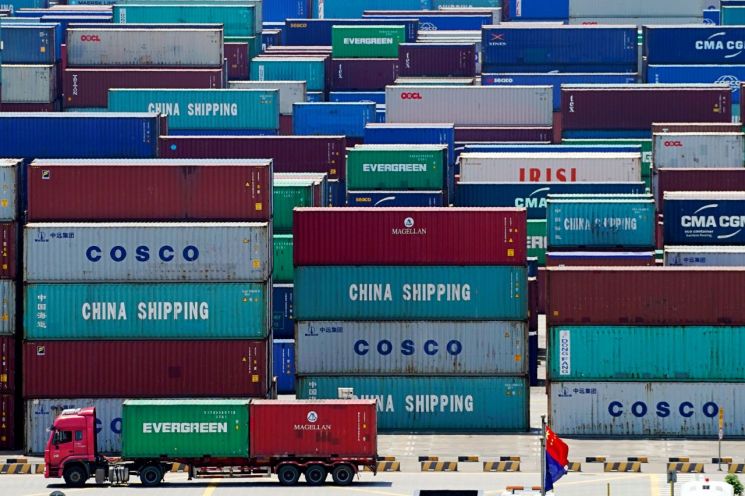
[Asia Economy Reporter Jeong Hyunjin] Last year, due to the impact of the US-China trade war, China's import volume decreased by nearly $60 billion. Among the quantities imported by China, the reductions from the United States and South Korea ranked first and second. The two-year trade war between the US and China before the Phase One agreement appears to have affected specific countries and industries, reshaping the global market.
On the 9th (local time), the Wall Street Journal (WSJ) analyzed China's tariff statistics from Trade Data Monitor (TDM) and found that China's import volume decreased by $59 billion last year. Among the 15 countries with significant changes in exports to China last year, imports from 8 countries declined. Exports to China from the United States, South Korea, Switzerland, Japan, Iran, Taiwan, Venezuela, and Angola decreased compared to 2018. In particular, the United States ($32.41 billion) and South Korea ($31.07 billion) were the top two countries from which China reduced imports the most. Considering that the US was a party to the trade war, South Korea suffered the greatest damage. Previously, the Korea International Trade Association reported that South Korea's exports to China decreased by $26 billion last year.
On the other hand, the country from which China increased imports the most last year was Australia ($15.62 billion), and China also imported more products from Malaysia, Saudi Arabia, and Argentina compared to the previous year.
These changes were caused by the US-China trade war. According to the International Monetary Fund (IMF), the global trade growth rate last year was 1%, gradually declining compared to 6% in 2017 and 4% in 2018. Experts analyzed that although several factors affected the global market, the US-China trade war was the biggest cause due to the slowdown in trade caused by tariffs and other measures.
Last year, the United States also experienced changes in its import countries. According to TDM statistics, the US import volume decreased by $42 billion last year. Among the 15 countries with significant changes in exports to the US compared to the previous year, imports increased from 11 countries but decreased from 4. The country with the largest increase in imports was Vietnam, followed by Mexico, which increased exports to the US due to the US-China trade war.
Vietnam benefited positively from the decline in Chinese exports and factory relocations targeting low-wage labor. Last year, the US imported $66 billion worth of Vietnamese products, one-third of which were clothing. Imports of mobile phones, furniture, telecommunications equipment, and semiconductor components from Vietnam to the US are also rapidly increasing. The import volume of Vietnamese mobile phones increased by $6.12 billion last year alone. Additionally, WSJ reported that some East Asian and Southeast Asian countries, including South Korea, Taiwan, Thailand, Malaysia, and the Philippines, slightly increased exports to the US.
The US-China trade war has benefited some sectors in Europe and Japan. The European Union's (EU) total exports to the US increased by 10.3% last year. The Netherlands and France each saw a $5 billion increase, Ireland $4 billion, Belgium $3 billion, and Italy $2 billion in sales. In particular, due to the grounding of Boeing's 737 Max aircraft, France's Airbus aircraft exports increased. The US imports of French aircraft engines and aircraft increased by $3.7 billion over the past year. Additionally, pharmaceutical sales from Ireland and Italy increased, and US imports of Dutch petrochemical products also rose.
Experts evaluate that Japanese automobile manufacturers benefited from the US-China trade war. China reduced tariffs on cars imported from countries other than the US, which was advantageous. Accordingly, WSJ analyzed that Toyota Motor's sales of Lexus lines exported to China increased. Last year, Toyota Lexus sales in China reached 202,000 units, a 25% increase compared to the previous year, and total Toyota sales in China increased by 9% year-on-year.
WSJ cited the IMF forecast that with a trade truce between the US and China this year, global trade growth is expected to expand to 3%, but the novel coronavirus (Wuhan pneumonia) is expected to add uncertainty to world trade. It also analyzed that the impact of China's imports of US products due to the Phase One US-China trade agreement on global trade should be closely watched.
© The Asia Business Daily(www.asiae.co.kr). All rights reserved.
![Clutching a Stolen Dior Bag, Saying "I Hate Being Poor but Real"... The Grotesque Con of a "Human Knockoff" [Slate]](https://cwcontent.asiae.co.kr/asiaresize/183/2026021902243444107_1771435474.jpg)
















