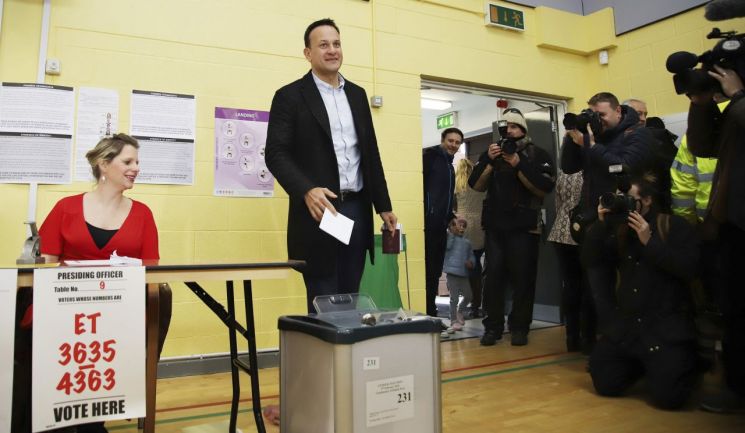
[Asia Economy Reporter Hyunwoo Lee] In the Irish general election, it is predicted that the ruling Fine Gael party, the main opposition Fianna F?il party, and the third party Sinn F?in will all receive similar vote shares, making it unlikely for any single party to secure a majority of seats on its own. As a coalition government becomes inevitable, concerns are growing that it will take a long time to form the government.
According to exit polls conducted on the 8th (local time) jointly commissioned by The Irish Times, Ireland's public broadcaster RTE, TG4, and University College Dublin, the ruling Fine Gael party led by Prime Minister Leo Varadkar is expected to receive 22.4% of the vote. The Fianna F?il party, led by Miche?l Martin, is projected to get 22.2%, and Sinn F?in is expected to obtain 22.3%. Following the three major parties, the Green Party is estimated at 7.9%, the Labour Party at 4.6%, the Social Democrats at 3.4%, 'Solidarity People Before Profit' at 2.8%, and independents and others at 14.5%. The margin of error is ±1.3%.
Since all three major parties are expected to record similar vote shares within the margin of error, it is difficult to predict how the actual seats will be distributed. Ireland uses a unique proportional representation system called the Single Transferable Vote (STV), where if a voter's top-choice candidate either meets the election quota or is eliminated, the vote is transferred to the voter's second or third choice candidate.
If the three parties obtain roughly equal seats, it is expected to be difficult to form a coalition government without any party securing a majority on its own. In the 2016 general election, it also took a considerable amount of time to form a coalition government. Fine Gael was unable to form a coalition government for over two months before finally launching the government through an agreement with Fianna F?il.
© The Asia Business Daily(www.asiae.co.kr). All rights reserved.

















