[Asia Economy Intern Reporter Lim Juhyung] A Chinese university research result suggests that the novel coronavirus may have been transmitted to humans via the pangolin.
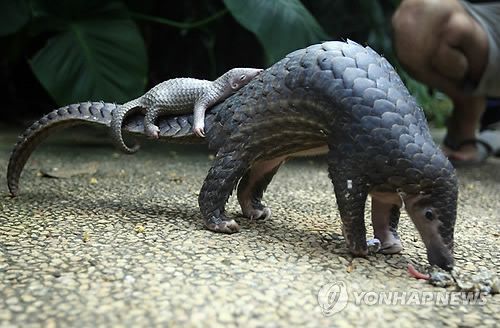
The pangolin is an endangered species known to be trafficked in places such as China and Vietnam for use in traditional medicine and as a luxury food ingredient.
On the 7th (local time), Huazhong Agricultural University held a press conference stating, "The pangolin is a potential intermediate host of the novel coronavirus," and "After testing 1,000 samples extracted from wild animals, the strain found in pangolins shows 99% homology with the novel coronavirus."
According to Huazhong University, this discovery holds significant meaning for the prevention and control of the novel coronavirus.
However, the university clarified that the samples used in the experiment were not from the Huanan Seafood Market in Wuhan, the epicenter of the novel coronavirus. They also explained that the transmission route from pangolins to humans has not yet been identified.
Previously, the Chinese Academy of Sciences speculated that the novel coronavirus originated from bats and was transmitted to humans through other animals as intermediaries. The Shanghai Pasteur Institute of the Chinese Academy of Sciences and the Military Medical Research Institute stated in a paper, "The natural host of the novel coronavirus is likely bats," and "There is a high possibility of an unknown intermediate host mediating between bats and humans."
Meanwhile, the pangolin identified as a potential intermediate host in this study is a small to medium-sized mammal measuring 30 to 90 cm in body length, feeding on insects such as ants.
Although the pangolin is an endangered species, it is known to be trafficked as a health food ingredient in some areas of China and Vietnam.
© The Asia Business Daily(www.asiae.co.kr). All rights reserved.

















