Increased Social Participation of Women
More Childcare and Household Support from Mothers-in-Law and Mothers-in-Law's Families
Son-in-Law Struggles with Nitpicking Interference
Especially Rapid Increase Among Dual-Income Young Couples
Serious In-Law Conflicts Leading to Divorce
"Interference and Involvement Must Respect Boundaries and Mutual Respect"
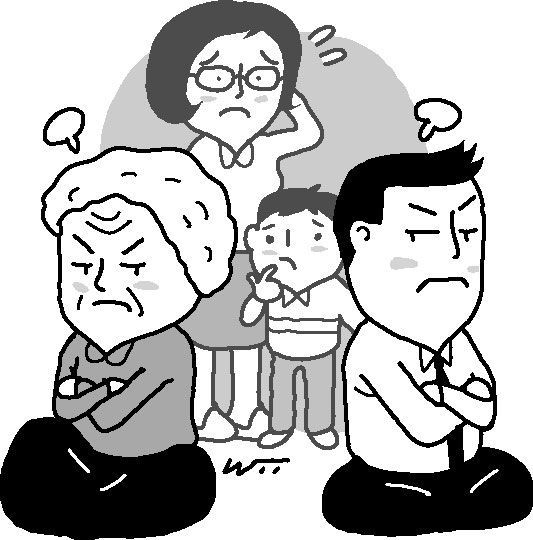
[Asia Economy Reporter Donghoon Jung] #Sim Inbo (36, pseudonym), who lives in Seongnam, Gyeonggi-do, has been living separately from his wife after five years of marriage. The cause was conflicts with his mother-in-law, who was helping care for their four-year-old son. Sim said that whenever he came home from work, the house where he should feel comfortable felt suffocating. He said, "My mother-in-law took charge of everything from childcare to cleaning and cooking, so there was nothing I could do freely at home," adding, "It was not uncommon for my wife to compare me to friends’ husbands who had better jobs. My wife said, 'If you argue with my mother, the conversation drags on,' and she didn’t even try to mediate."
Conflicts between mothers-in-law and sons-in-law have become central family issues. As women’s social participation and economic power increase, cases where wives receive support for childcare and housework from their families, especially from mothers-in-law, are on the rise. While mothers-in-law act as childcare assistants and provide support, their increasing interference in household matters deepens the sons-in-law’s distress. The chronic cause of family problems, traditionally known as mother-in-law and daughter-in-law conflicts, is shifting toward 'jangseo conflicts' (conflicts between mothers-in-law and sons-in-law).
According to Statistics Korea, the percentage of dual-income couples receiving living support (including childcare, cleaning, meal preparation, etc.) from the husband’s parents decreased from 14% in 2006 to 7.9% in 2016. In contrast, the percentage of couples receiving help from the wife’s parents increased from 17% to 19% during the same period. This means couples are growing closer to the wife’s family and more distant from the husband’s family.
It is also understood that cases where jangseo conflicts lead to divorce are increasing. According to a 2018 survey by OnlyU, a remarriage-specialized matchmaking company, of 512 men and women who experienced divorce, women cited personality differences (34.4%), economic problems (29.3%), infidelity (19.1%), violence/assault (7.4%), and fifthly mother-in-law conflicts (2.3%) as reasons for deciding to divorce. Men, on the other hand, cited personality differences (56.6%), infidelity (11.3%), and jangseo conflicts (10.9%). Jangseo conflicts have thus become a more significant cause of divorce than mother-in-law conflicts.
Shin Eunsook, a divorce specialist lawyer, said, "Recently, divorces due to jangseo conflicts have been increasing among young couples," adding, "In cases that lead to divorce, it is often because mothers-in-law or others do not respect boundaries of interference and involvement. Although sons-in-law are family members, it is necessary to remember that they are adults who deserve respect."
Jangseo conflicts are emerging as a serious problem especially among young couples. For couples in their 20s and 30s, most of whom are dual-income, mothers-in-law increasingly interfere in household finances, chores, and even child planning. From the mother-in-law’s perspective, she may feel that her cherished daughter is being treated unfairly and having a difficult marriage, which can lead to a negative attitude toward the son-in-law or criticism of his shortcomings. Reflecting this reality, a new term 'Cheoworld' has become popular, paralleling 'Siworld' (referring to the hardships of living with the husband’s family) to describe the mother-in-law’s world.
Many sons-in-law feel alienated in the household due to the strong bond between mother and daughter. Baek Minwoo (34), married for three years, said, "My wife discusses everything with her mother, from our marital relationship to financial issues," adding, "Even though we are a couple, I often keep things to myself, worried that my mother-in-law might hear, and suffer alone."
© The Asia Business Daily(www.asiae.co.kr). All rights reserved.

















