[Hidden Business Story] Rising to No.1 in Fast Fashion Faster and Cheaper
Facing Crisis as 'Main Culprit of Environmental Destruction' with Net Profit and Stock Price Both Halved
Recovery with 'Eco-Friendly' Goal of 100% Recycled and Sustainable Materials by 2030
 H&M
H&M
[Asia Economy Reporter Shinwon Yoon] Swedish H&M, considered one of the top three global SPA brands alongside Japan's Uniqlo and Spain's Zara, is the leader in the fast fashion industry with a brand value reaching 21.6 trillion KRW. However, in recent years, as consumers' interest in the 'environment' has increased, there has been a strong movement to avoid fast fashion, and H&M has also faced a crisis. How is H&M overcoming this crisis?
H&M's history began in the 1940s. Erling Persson, the founder of H&M, traveled to the United States, which was booming after World War II, and was inspired by department stores. He returned to Sweden and established the women's clothing manufacturer 'Hennes' in 1947. Thanks to selling stylish clothes at affordable prices, it gained popularity among middle-class customers. Twenty years later, in 1968, Hennes acquired the hunting goods company 'Mauritz Widforss' and launched men's clothing. At this time, the two companies' names were combined to create 'Hennes & Mauritz,' or H&M.
H&M began to make its name known globally in earnest from the 1970s. Although H&M stores opened in Nordic countries starting with Norway in 1964, it succeeded in listing on the Stockholm Stock Exchange in 1974 and opened its first store outside the Nordic region in London, UK, in 1976, marking the start of its overseas expansion. In 1982, Stefan Persson, the founder's son, took over the company and began expanding overseas stores. In particular, entering the US and Spanish markets became a major turning point for H&M to leap into a global fashion company. At that time, the New York store was so crowded with customers that security guards had to control entry. Subsequently, H&M entered the Asian market from 2007 and currently operates about 4,900 stores in over 70 countries.
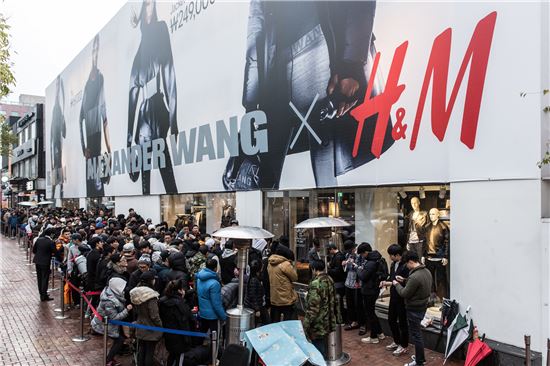 H&M Apgujeong Store
Faster, Cheaper! H&M at the Center of 'Fast Fashion'
'Fast fashion,' which maximizes turnover by quickly distributing products reflecting the latest trends, dominated the global fashion market. Brands that offered the most fashionable clothes the fastest and at lower prices gained the upper hand. H&M surpassed other global SPA brands such as Zara, Uniqlo, and Forever 21 to reach the top.
Fast fashion grew to threaten the luxury fashion market, and H&M thrived. In fact, in the early 2010s, H&M's annual sales approached 20 trillion KRW, and its overall fashion company brand power ranking was second only to Louis Vuitton.
Besides H&M, the company launched fashion brands such as Weekday, Cheap Monday, Monki, COS, and & Other Stories, becoming a global leading fashion company with over 140,000 employees worldwide.
The Crisis of Fast Fashion... Stigmatized as the 'Main Culprit of Environmental Destruction'
During the era when fast fashion led the fashion market, consumers could buy the trendiest clothes at low prices, so discarding clothes and buying new ones became a routine. This caused environmental problems. There were continuous criticisms that fast fashion caused environmental pollution and destruction from manufacturing to disposal.
Fast fashion was identified as a major cause of environmental destruction alongside plastic, and consumers began to avoid SPA brands. 'Conscious consumption,' which considers the impact on the environment and society in purchasing decisions, emerged as a consumer trend. Accordingly, the famous US SPA brand Forever 21 failed to adapt to the new consumer trend and went bankrupt. Media outlets such as The New York Times poured out negative evaluations like 'The End of Fast Fashion' and 'Fast Fashion Reaching a Tipping Point.'
H&M was no exception. It had a strategy of producing large quantities of clothes in advance and selling them cheaply to customers, but due to decreased demand, inventory piled up to $4 billion (about 4.7 trillion KRW). Although sales increased annually through discount policies, growth slowed to the 3% range in 2018 compared to 14.4% in 2014. Net profit also halved during the same period, and the stock price dropped by more than 60%.
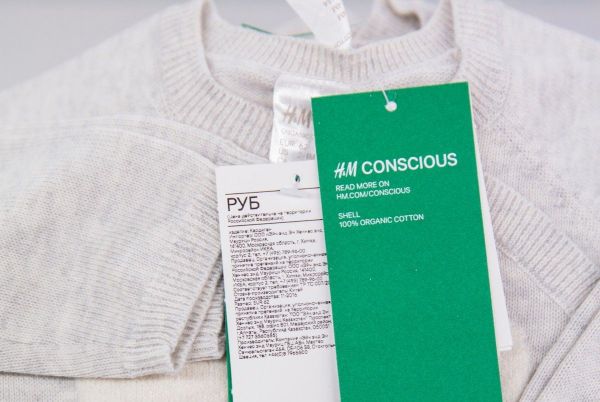
H&M Captures Consumers by Emphasizing 'Eco-Friendliness'
H&M, once criticized as a major cause of environmental destruction, has sought to overcome the crisis by emphasizing eco-friendliness. It launched the Conscious Exclusive line based on eco-friendly materials and sustainability, showcasing products made from environmentally friendly materials such as orange fiber, natural leather extracted from pineapple leaves, and leather made from grape residues left after wine production. Entering the resale market selling secondhand goods and starting a clothing rental business are part of the same approach.
As a result of focusing on 'sustainability' in recent years, H&M raised the proportion of recycled and sustainable materials from just 20% of total products to 57% by the end of 2018. H&M's goal is to increase this to 100% by the end of 2030. Accordingly, it is gradually phasing out original cashmere fabrics that threaten the environment and animal welfare, and consumers have started returning to H&M. In the 2019 fiscal year, H&M's sales rose 11% year-on-year, and net profit, which had halved, increased by 1.3%. The stock price also rose more than 40% in the past year. H&M's efforts are reflected in these results. Analysts and experts say, "We cannot be certain whether H&M's performance growth will continue, but it is moving in the right direction," expressing a positive outlook.
© The Asia Business Daily(www.asiae.co.kr). All rights reserved.

















