[Hidden Business Story] From 'Daiso Knockoff' to a Global Company with Annual Sales of 3 Trillion Won
Over 800 Employees Working at R&D Center... Launching 500-1000 New Products Monthly
"Affordable Does Not Mean Low Quality" Proven by Focusing on Offline Stores... Surpassing 3,600 Stores in 80 Countries
Planning to List on Hong Kong or US Stock Exchange... Raising $1 Billion to Reach 10,000 Stores by 2023
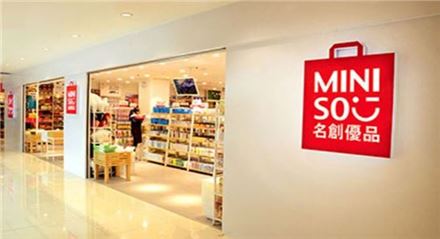 Photo by Miniso website
[Asia Economy Reporter Shinwon Yoon] Following Xiaomi, the Chinese lifestyle SPA brand known as the "Second Mistake of the Continent," MINISO (名創優品). Due to its name and logo that seem reminiscent of something seen somewhere in Japan, it was once nicknamed a "Daiso knockoff" or "Muji knockoff," but now it records annual sales of 18 billion yuan (about 3 trillion KRW) and is mentioned as a competitor to Daiso and Muji.
MINISO was jointly founded in 2013 by Chinese entrepreneur Ye Guofu (葉國富) and Japanese designer Junya Miyake (三宅順也). After opening its first global store in Japan the following year, it has opened about 3,600 stores in over 80 countries including China, Singapore, Hong Kong, the United States, and Canada. Although it has since withdrawn, it was the first global chain to open a branch in Pyongyang, North Korea. In South Korea, it opened its first store in Sinchon, Seoul in 2016 and currently has about 70 stores in the country alone. It surpassed 2 trillion KRW in annual sales within three years of its founding. It is now preparing for listing on the Hong Kong or U.S. stock exchanges. How did MINISO achieve such remarkable growth in a short period?
MINISO Shakes Off the 'Daiso Knockoff' Stigma
From its debut, MINISO was followed by the nickname "Daiso knockoff." Its name is similar to Daiso’s, and its logo feels like a combination of Uniqlo and Muji. Its sales method and store atmosphere were also similar. In fact, MINISO benchmarked Japan’s 200-yen shops (about 2,200 KRW), so there were many similarities.
However, MINISO soon shed that nickname. By appropriately combining the strengths of Muji and Daiso, it created a brand image of "best cost-effectiveness." While its quality aligns with Muji’s relatively higher-priced products, it adopts a low-margin, ultra-low-price strategy like Daiso. Despite excellent functionality, its low prices attracted the 20s and 30s generation who value "cost-effectiveness," leading them to pay attention to MINISO as the "mistake of the continent."
Another reason MINISO draws attention is its dedication to design development, unlike other Chinese brands that focus solely on "copying." Co-founder Junya Miyake recruited many designers from Northern Europe, including Sweden and Denmark. These designers travel to famous cities worldwide to draw inspiration and reflect it in their designs. Moreover, MINISO’s new product development center employs about 800 staff who develop 500 to 1,000 new products monthly. By integrating design, manufacturing, and retail processes, it eliminates intermediate distribution margins. Once a design is developed, products are displayed in stores at low prices within three weeks.
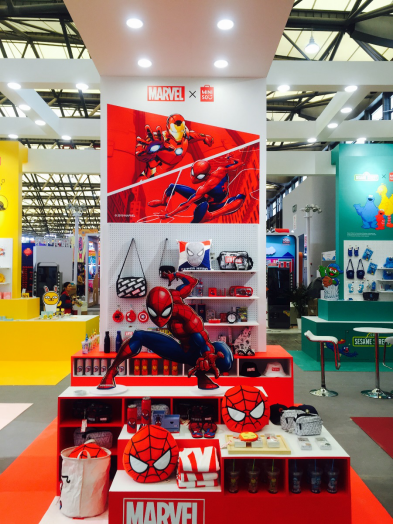
MINISO’s emphasis on design is evident in its various collaborations. In 2018, it collaborated with Norwegian design studio "Permafrost," attracting attention. Recently, it released products in collaboration with Pantone, the American color research institute that announces the "Color of the Year" annually, and Marvel, the American company famous for "Avengers" and "Iron Man."
Competing Offline in a Market Dominated by Online
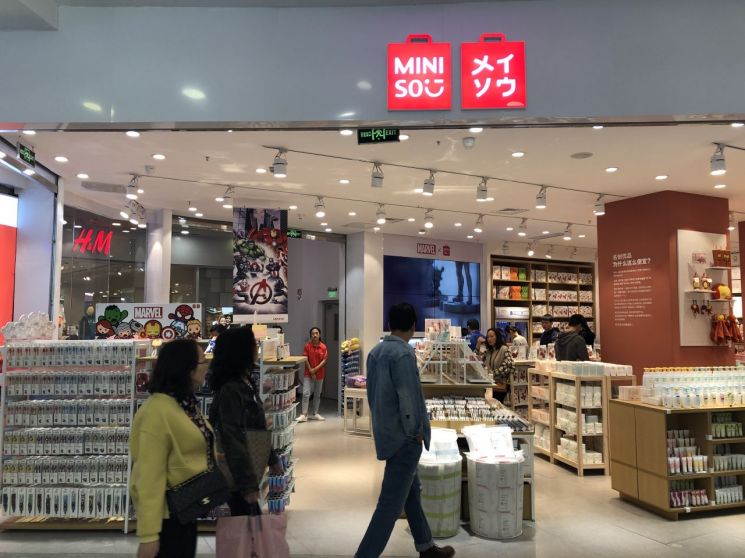
While the distribution industry focuses on online channels, MINISO pays more attention to offline. This is because ultra-low prices can undermine product trust. Instead, it employs a strategy of placing test products in stores so customers can directly verify quality.
It also opens stores in high foot traffic areas so consumers can easily visit, browse products, and make purchases. MINISO has a unique approach to product display called the "two-finger rule." This means leaving gaps between displayed products wide enough to fit two fingers. This small consideration gives a sense of moderate display and allows consumers to take products out comfortably. Staff are trained not to engage in aggressive sales promotions to avoid making consumers feel pressured.
MINISO aims to grow into a top-tier global company like Uniqlo, which succeeded with low-margin products, or the Spanish SPA brand Zara. Through an initial public offering (IPO), it plans to raise 1 billion USD (about 1.18 trillion KRW) and open 10,000 stores in over 100 countries worldwide by 2022.
© The Asia Business Daily(www.asiae.co.kr). All rights reserved.
![Clutching a Stolen Dior Bag, Saying "I Hate Being Poor but Real"... The Grotesque Con of a "Human Knockoff" [Slate]](https://cwcontent.asiae.co.kr/asiaresize/183/2026021902243444107_1771435474.jpg)

















