Department Stores and Marts Hit Hard by Sales Decline... Restaurants Quiet and Cultural Center Refund Inquiries Surge
'Buying Essentials via Mobile' Online Shopping Soars... Dining Out Avoided, Delivery Orders Increase
Sharing Economy Avoided, 'Ttareungi' Unused... People Avoid Crowded Places Like Bathhouses and Hospitals
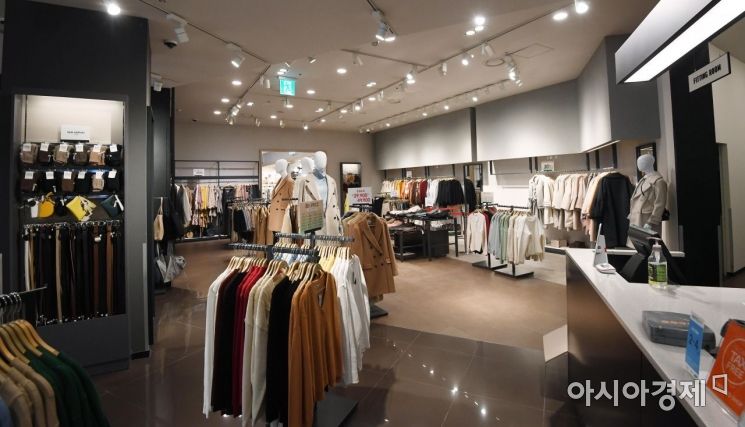 On the 2nd, when the number of confirmed cases of the novel coronavirus infection increased to 15, a clothing store in a shopping mall in Seoul showed a quiet scene. Photo by Hyunmin Kim kimhyun81@
[Asia Economy Reporters Lee Seon-ae, Lim Hye-seon, Cha Min-young] "A secondary infected person got infected while dining together at a restaurant, and I’m too anxious about other people’s saliva splashing to go to restaurants. For the time being, I’m avoiding crowded department stores and marts, shopping online instead, and planning to use food delivery services. I’m also uneasy about subways and buses that are touched by many hands, and I’m not using the public bike system, Ddareungi, either."
As the novel coronavirus infection (COVID-19) spreads, consumer behavior is shifting to 'untact'?contactless?purchasing and dining. People are refraining from going out and choosing to stay indoors, causing offline stores to be empty, while online transactions and deliveries are surging, rapidly changing daily life patterns.
◆Department stores, duty-free shops, and marts are deserted... Restaurants are gloomy= On the afternoon of the first weekend after the emergence of domestic secondary and tertiary infections on the 2nd, major department stores and large marts in Seoul were nearly empty of customers, presenting a desolate scene. In the children's clothing section of Department Store A in Seodaemun-gu, Seoul, not a single customer was seen. A staff member at the children's clothing section said, "No families with children came during the weekend," adding, "Of course, sales have to decline."
During weekend lunchtime, many restaurants that were usually packed with people had many seats unoccupied, with some places having more masked employees than customers. An employee at a restaurant said, "Weekends used to be fully packed, but weekend sales seem to have dropped by about 50% compared to usual," lamenting the situation.
Cultural centers were also quiet. A cultural center official explained, "Since many classes are related to children, we are currently receiving a flood of cancellation inquiries."
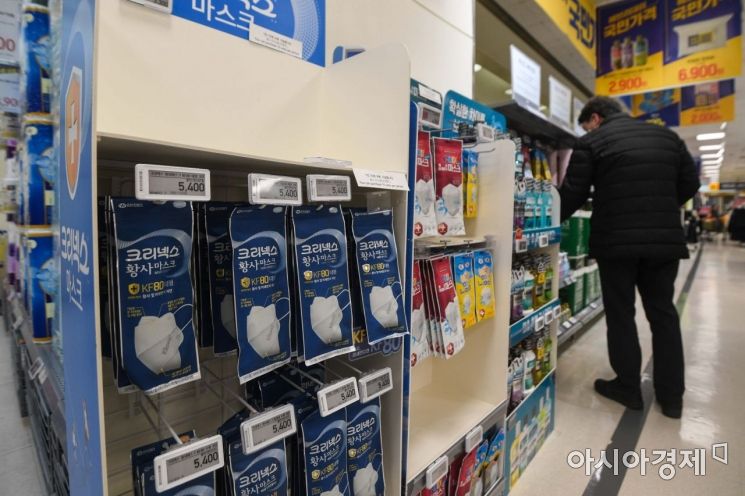 A customer is purchasing masks and other hygiene products at a large supermarket in Seoul.
 Photo by Jinhyung Kang aymsdream@
A housewife covering her face with a mask left Mart B in Guro-gu, Seoul, in less than 10 minutes after arriving. She said, "I shopped online, but the usual dairy brand I buy was out of stock, so I hurried here to buy it," adding, "I plan to buy only this and leave quickly." The restaurant areas were similarly quiet. A restaurant employee who used to have long waiting lines on weekends complained, "Whenever an epidemic breaks out, business inevitably suffers." According to the Korea Foodservice Industry Research Institute, during the Middle East Respiratory Syndrome (MERS) outbreak, dining-out businesses saw sales drop by more than 34% within a month.
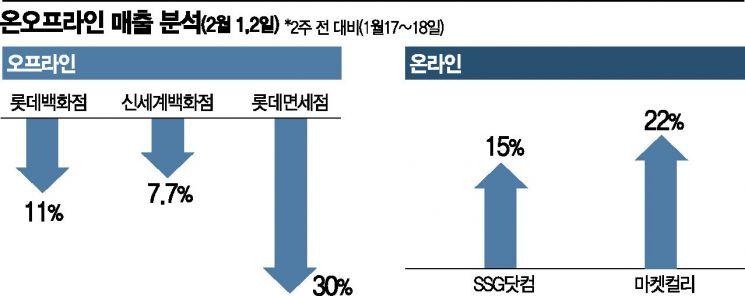
Department stores and duty-free shops are taking a direct hit from the sharp decline in customer visits, resulting in significant sales drops. Shinsegae Department Store’s weekend sales decreased by 12.6% compared to the previous year, and by 7.7% compared to two weeks ago. Lotte Department Store is in a similar situation. A Lotte Department Store official explained, "The main store’s weekend average daily visitors, which used to be 70,000 to 80,000, dropped by more than 30%, causing main store sales to fall by 30%. Overall sales decreased by about 11%." The situation is even more severe at duty-free shops confirmed to have been visited by COVID-19 patients. Lotte Duty-Free reported that sales on the 1st and 2nd dropped by 30% compared to two weeks ago.
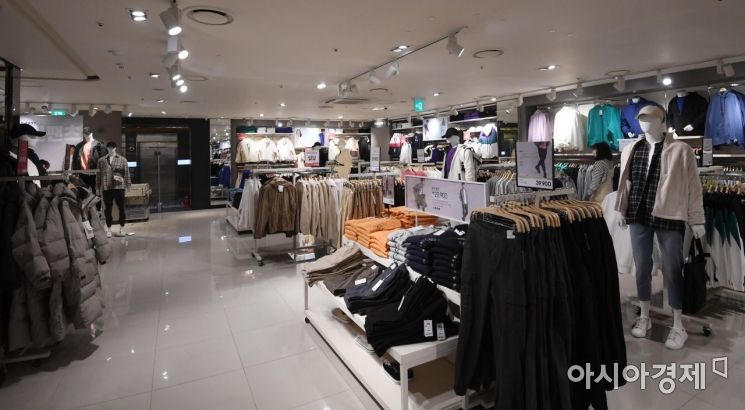 On the 2nd, when the number of confirmed cases of the novel coronavirus infection increased to 15, a clothing store in a shopping mall in Seoul showed a quiet scene. Photo by Kim Hyun-min kimhyun81@
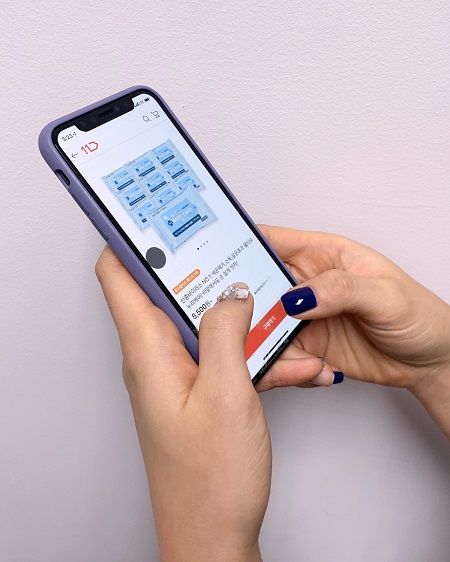
◆"Homebodies by choice" Shopping from home= Consumption is shifting online. SSG.com reported that sales on the 1st and 2nd increased by 15% compared to two weeks ago. On 11st, from the 27th of last month when the fourth domestic confirmed case was reported until the 1st of this month, sales of daily necessities more than doubled compared to the previous week. Semi-prepared and home meal replacement (HMR) products surged by 1095% compared to the previous month, and orders for ramen (129%), bottled water (116%), frozen and convenient fruits (103%), and instant rice (58%) also increased. On the 28th of last month, Coupang’s Rocket Delivery shipments reached a record high of 3.3 million, and Market Kurly’s average daily sales over the past three days rose by 22%. The items driving sales growth were fresh foods and HMR products like eggs, milk, and galbitang (beef short rib soup) that can be easily eaten at home.
Food delivery is also on the rise. During the Lunar New Year holiday period (January 24?27), the number of orders received by the delivery specialist Baedal Minjok increased by 60% year-on-year, reaching 5.4 million orders. Baemin stated, "Usually, right after the Lunar New Year holiday, orders decrease by about 15% compared to usual because many people eat holiday food, but this year, on the 31st of last month and the 1st of this month, orders increased by about 10% compared to usual," explaining that order numbers continue to rise.
Park Hye-yeon (32) said, "Ordering online is convenient because it arrives the next day," adding, "I have no desire to go to the mart with anxiety, and I’m almost not leaving the house, substituting dining out with delivery."
◆Sharing economy becomes 'cold rice'... Changed wedding guest scenes= Due to reluctance to use 'things others have used' or to be 'in the same space as others,' the sharing economy quickly became unpopular. Choi Chung-hyun (35), an office worker in Yeouido who uses Seoul’s shared bike system Ddareungi, said, "Honestly, hygiene is not guaranteed when bikes are parked in the middle of the street," adding, "I’m uneasy about subways and buses, so I plan to use my car for the time being." According to Seoul City, the number of Ddareungi users from the 27th to the 30th of last month decreased by 5% compared to the previous week.
Places traditionally vulnerable to infectious disease fears, such as bathhouses, swimming pools, gyms, and hospitals, have also become places to avoid. A jjimjilbang (Korean sauna) official in Guro-gu said, "It’s like a lie, but customers have decreased by 90%," adding, "We have hand sanitizers available, but there’s nothing we can do; it’s frustrating." A clinic in Seodaemun-gu said, "People don’t seem to come to the hospital unless they are really very sick," adding, "Usually, there are many patients with colds around this time of year, but patient visits are almost none."
The wedding hall scene has also changed. At a wedding hall in Cheongdam-dong, Seoul, guests wearing masks continued to arrive. Most young guests in their 20s and 30s and children with weak immune systems were wearing masks. Except for the wedding planner in the reservation consultation room, most parking attendants and staff were also wearing masks. Hand sanitizers were placed at the entrances of the wedding hall, banquet hall, and parking lot. A wedding hall in Mapo-gu, Seoul, posted notices at the main entrance encouraging the use of masks and hand sanitizers and requested guests’ cooperation. A wedding planner said, "I’m a bit worried because of COVID-19, but we have placed hand sanitizers everywhere and just hope that guests wear masks properly," adding, "We cannot check and screen every guest before entry, and we hope this situation passes safely," speaking with a worried tone.
© The Asia Business Daily(www.asiae.co.kr). All rights reserved.



















