Pursuit of Political Correctness... Koreans' Dissatisfaction
Expert: "We Must Accept the Tilted Playing Field"
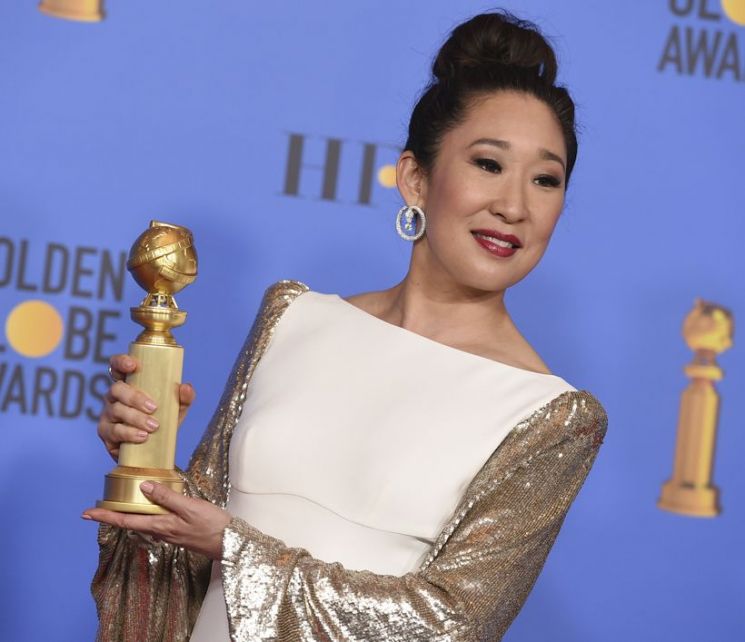 Korean-American actress Sandra Oh won the Best Actress in a Drama award at the 76th Golden Globe Awards held on January 6 last year (local time) at the Hilton Hotel in Beverly Hills, Los Angeles, California, USA. Photo by AP Yonhap News
[Asia Economy Reporter Kim Ga-yeon] "Racism is the harshest against East Asians, so I don't understand why Koreans get angry about 'political correctness.'"
Recently, as discrimination based on race, gender, and minorities has been recognized as a global issue, movements pursuing 'PC' have spread across Hollywood movies, TV shows, dramas, and more.
PC stands for Political Correctness, meaning political correctness. It refers to a movement to break the socially defined 'normalcy' and move away from white-centered, male-centered culture to pursue equality. This movement is also influencing cultural industries such as domestic film and publishing.
Recently, the British Academy of Film and Television Arts (BAFTA) sparked another racial discrimination controversy when it announced its award nominees. The reason was that none of the nominated actors were people of color.
Overseas netizens criticized BAFTA with the hashtag #BAFTAsSoWhite, calling it white-centric. The American daily newspaper The Washington Post strongly criticized, saying, "BAFTA is considered a major predictor of the American Oscars, but not a single actor of color was nominated."
The situation is no different at the American Academy Awards. Since 2015, when black female lawyer April Reign launched the hashtag campaign #OscarsSoWhite on social media, the Academy has made efforts to secure diversity. However, this time too, it could not escape criticism for being male- and white-centered. Some pointed out, "All the nominees are white, but black and Asian actors were presented during the nominee announcement just to fill the quota."
Some domestic netizens raised their voices against such criticism, saying, "Stop excessive PC." They argue that movements for equality actually cause reverse discrimination against existing vested interests.
One netizen said, "An award ceremony is literally about giving awards to those who did well," adding, "Among those who did well, the proportion of white males is high. Simply including women, black people, or minorities as nominees or giving them awards just because their proportion is low is actually discrimination against whites and males."
This is not the first time political correctness has sparked controversy in Korea. Last year, when it was announced that black actress Halle Bailey was cast as the lead in Disney's live-action film The Little Mermaid, controversy arose. Also, when black female actress Lashana Lynch was chosen as the lead in the 007 series Bond 25 the same year, there was strong backlash.
At that time, members of male-centered communities criticized, saying things like, "It's hard enough to accept black people, but a woman? I hope it's a rumor," and "If 'Black Panther' were cast with white actors, black people would be furious. Isn't this reverse discrimination? If you want to cast black actors, don't change existing characters; create new ones."
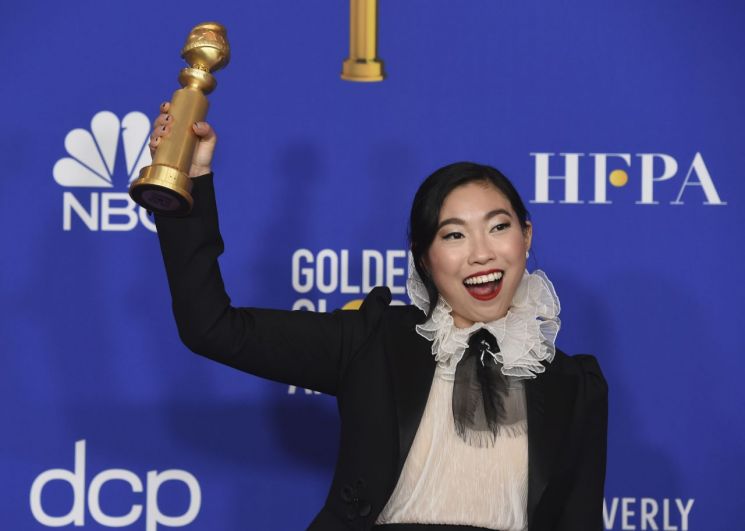 Asian American actress Awkwafina won the Best Actress award in the film category at the 77th Golden Globe Awards held on the 5th (local time). Photo by AP Yonhap News
Other netizens expressed that they could not understand the criticism of 'political correctness.' This is because Asian actors face even more discrimination than black or Hispanic actors overseas.
Last year, the Golden Globes gave the host position to an Asian American actor for the first time in its 76th ceremony. Korean American actress Sandra Oh, who hosted the Golden Globes for the first time as an Asian, won the Best Actress award in the TV drama category for the BBC drama Killing Eve, becoming the first Asian to be both a winner and a host.
Also, at the 77th Golden Globe Awards held on the 5th (local time), an Asian actor won the Best Actress award in the Musical or Comedy category for the first time. Asian American actress Awkwafina (real name Nora Lum), who played the role of 'Billi' in the film The Farewell, received the award.
Office worker A (27) said, "In fact, when you go abroad, racism against East Asians is always the most severe," adding, "When racial discrimination controversies arise at English-speaking cultural award ceremonies, they always point out unfairness against black actors. The suffering of East Asians is not even mentioned."
He continued, "Even in this situation, I can't understand Koreans who claim 'PC is excessive.' Discrimination must be continuously mentioned and challenged to improve," adding, "Recently, they shout for fairness on other issues like the 'Cho Kuk incident,' but ironically get angry at acts pursuing fairness and equality."
Experts pointed out that some claims that 'political correctness is reverse discrimination' stem from not acknowledging the existence of discrimination itself.
Popular culture critic Hwang Jin-mi said, "Even though they are not part of the ruling class, they have accepted the ideology representing the ruling class's interests as their own," adding, "So they think it is universal."
Critic Hwang said, "Especially in Korean society, men have been treated as first-class citizens, so they identify themselves with white men in the First World. Because they have always belonged to the mainstream, they argue reverse discrimination," adding, "If you look globally, they themselves are discriminated East Asians, but they don't think that far."
He continued, "Currently, society is already a tilted playing field, and systems like quotas have been created to correct the results of discrimination," adding, "However, because they deny the existence of discrimination itself and do not accept the premise of a tilted playing field, they claim that gender or racial issues are 'unfair.'"
© The Asia Business Daily(www.asiae.co.kr). All rights reserved.
![User Who Sold Erroneously Deposited Bitcoins to Repay Debt and Fund Entertainment... What Did the Supreme Court Decide in 2021? [Legal Issue Check]](https://cwcontent.asiae.co.kr/asiaresize/183/2026020910431234020_1770601391.png)
















