This Year’s Seoul Middle School Freshman Allocation Results Show 7.02% Increase in Student Numbers
Gangnam-Seocho Sees 10.33% Sharp Rise … 615 of 884 Students Concentrated in 'Daechi-Dogok'
Anxiety Over Consecutive Education Policy Changes … Return to Gangnam and Education Special Zones
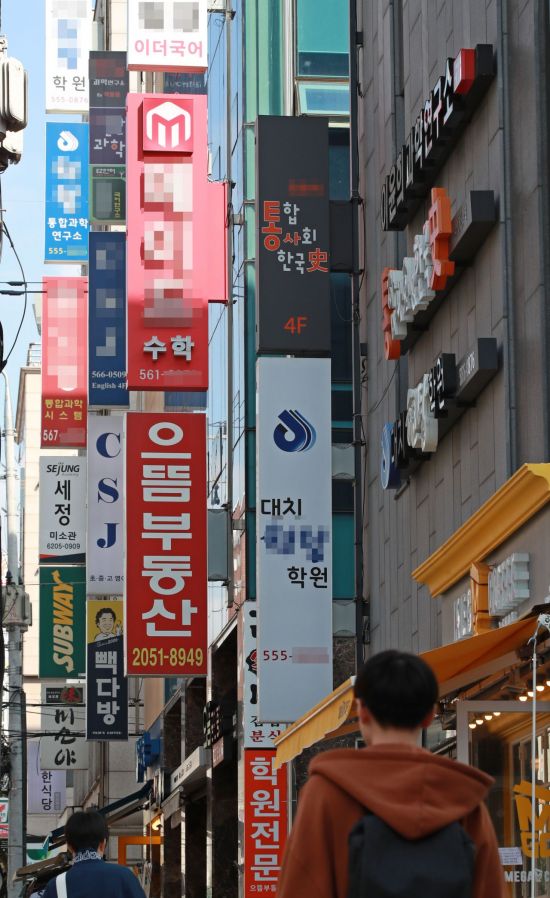
[Asia Economy Reporter Jo In-kyung] Concerns that a series of educational policy changes, including the abolition of autonomous private high schools, would exacerbate the 'Gangnam concentration phenomenon' are becoming a reality. This trend is clearly evident when looking at the statistics for middle school admissions this year. In Seoul alone, 73,615 students entered middle school this year, which is a 7.02% increase compared to the previous year. These students were born in 2007, the so-called 'Golden Pig Year,' a year that saw a temporary rise in birth rates. Interestingly, the student population growth rate was particularly pronounced in areas densely populated with so-called 'prestigious middle and high schools' such as Gangnam Seocho, Gangseo Yangcheon, and Gangdong Songpa. In contrast, the growth rates in other regions did not meet the average.
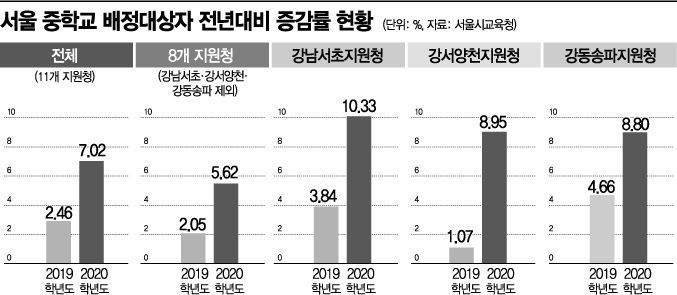
According to the Seoul Metropolitan Office of Education's recent three-year data on middle school freshmen allocation as of the 31st, the number of middle school freshmen in Seoul increased by 2.46% (1,652 students) from 67,134 in 2018 to 68,786 in 2019, but surged by 7.02% (4,829 students) this year compared to the previous year. The Seoul Metropolitan Office of Education explained this change as a temporary effect due to the enrollment of the 'Golden Pig Year' cohort.
Meanwhile, the number of middle school students in the Gangnam Seocho Education Office increased by 3.7% in 2019 compared to the previous year, followed by a sharp rise of 10.33% this year, the highest among the 11 education support offices in Seoul. In the Gangseo Yangcheon Education Office, which includes the Mokdong school district, the increase rate rose from 1.07% last year to 8.95% this year, and Gangdong Songpa Support Office showed a notable increase from 4.66% to 8.8%. In contrast, the other eight regions, excluding these three support offices, saw middle school student growth rates of only 2.05% last year and 5.62% this year.
When dividing the Gangnam Seocho area into four school districts, the increase rate of freshmen in the 2nd district, 'Daechi Dogok,' stands out. Of the total increase of 884 students across the four school districts in Gangnam Seocho, the majority, 615 students, were from the Daechi Dogok district.
Experts interpret these changes as reflecting parents' anxiety caused by frequent changes in the college entrance system and policies abolishing autonomous private and specialized high schools. These policy changes are accelerating the concentration phenomenon toward Gangnam and educational special zones. With the government planning to abolish autonomous private and specialized high schools altogether by 2025 and applying high school blind admissions in college entrance exams, there has been an increase in movement toward school districts where students can better manage their school records and receive private education benefits. The introduction of the free semester system, where no academic evaluations are conducted during the first year of middle school, also fuels this anxiety.
Lim Seong-ho, CEO of Jongro Academy Haneul Education, diagnosed, "Until now, there was a perception that autonomous private high schools, foreign language high schools, and Gangnam general high schools, which had fierce internal grade competition, were disadvantaged under the student record-based admissions system. However, with the policy shifting toward expanding regular admissions, the disadvantage of Gangnam has disappeared." He added, "Parents who previously sought general high schools in other regions favorable for internal grades are now returning to Gangnam and Daechi."
With the increase in middle school freshmen due to the Golden Pig Year, the Gangnam concentration phenomenon has further intensified, leading to complaints about school assignments in the area. According to parents living near Daechi-dong, cases of middle school assignments to distant schools, which were rare in previous years, are now occurring frequently.
A representative from the Gangnam Seocho Education Support Office, the jurisdictional authority, explained, "Even when setting the legal maximum number of students per class at 36, we could not accommodate all students, so some were assigned to nearby schools, and there were chain changes in assigned schools within the district." A teacher in the Gangnam area said, "Due to policy uncertainties such as the abolition of autonomous private high schools and the expansion of regular admissions, preferred areas are clearly divided even within the Gangnam region. Among elementary schools in Daechi-dong, there are schools where 150 students transfer in annually from grades 5 to 6, many of whom come from Seocho or Yangjae areas."
© The Asia Business Daily(www.asiae.co.kr). All rights reserved.


















