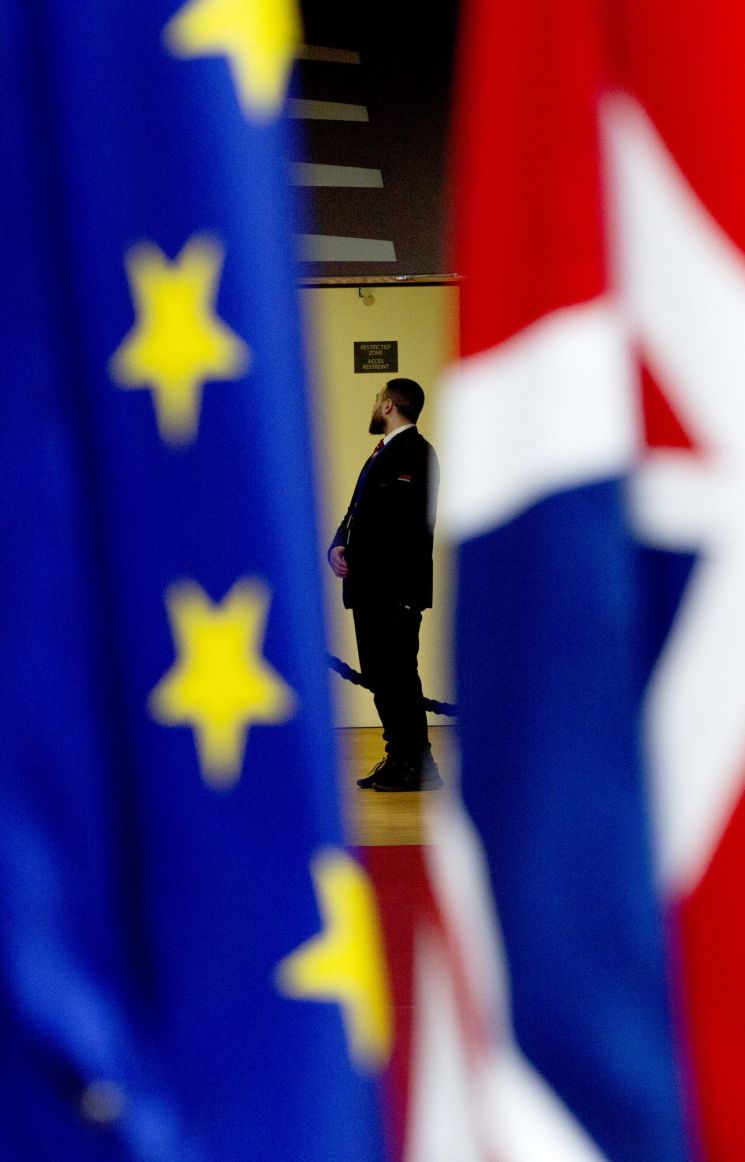
[Asia Economy Reporter Jeong Hyunjin] As the European Parliament's ratification of the Brexit (the United Kingdom's withdrawal from the European Union (EU)) agreement becomes more likely, the UK is entering a 'new path' that no one has tread before. After being part of the European Community for over 40 years, it now faces the reality of having to navigate all issues on its own. For now, there are expectations that UK Prime Minister Boris Johnson will maintain a tough stance in trade negotiations with the EU, the US, and others, while announcing large-scale economic stimulus measures. This is because policies aimed at realizing Johnson's vision of a 'decade of prosperity and opportunity' are inevitable.
◆ Uncertainty Remains After Brexit = The UK government plans to include expanded public investment in its first budget after Brexit, scheduled for March 11. Sajid Javid, the UK Chancellor of the Exchequer, stated that the 'post-Brexit budget' will "increase public investment to address regional inequalities."
The economic stimulus card is a strategy to eliminate the three years of uncertainty caused by Brexit and to find new growth engines. The plan is to inject funds into infrastructure and environmental sectors to open a new chapter for the UK economy. Mark Gregory, EY UK's Chief Economist, emphasized that regarding the UK's fiscal input, "the goal should be to encourage corporate investment and increase consumer spending."
Above all, there is a sense of crisis that if no agreement is reached by the end of this year, the deadline of the transition period, the UK and the EU will be subject to World Trade Organization (WTO) rules. Depending on the negotiation results, uncertainty in the global financial markets could increase, and concerns have been raised that prices of consumer goods and labor costs in the UK may rise. In particular, manufacturers worry that the movement of relatively low-wage EU-origin workers will become difficult, increasing operating costs within the UK. Considering this, automobile manufacturers and others have successively relocated factories ahead of Brexit.
Although the possibility is low, if a trade agreement between the UK and the EU is finalized within the transition period, uncertainty in financial markets will significantly decrease, and the UK economy is expected to recover faster than anticipated. The International Monetary Fund (IMF) recently forecasted that "if a gradual transition period is observed, the UK's GDP growth rate for 2020-2021 (1.4-1.5%) will be higher than the EU's (1.3-1.4%)." Monique Melis, Managing Director at Duff & Phelps, said, "If the UK government creates a favorable regulatory environment and becomes independent from unnecessary EU regulations, it could reclaim its throne."
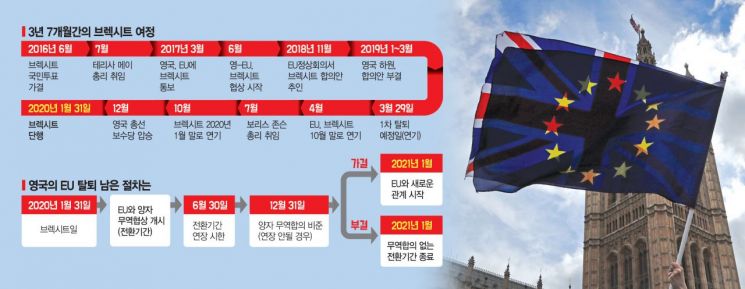
◆ Complete Breakup Not Yet... Challenges in EU and US Trade Negotiations = Against this backdrop, the UK is expected to stake everything on future relationship negotiations with the EU. Preparations will take place in February, with formal negotiations likely to begin in March. It is anticipated that Prime Minister Johnson and Ursula von der Leyen, President of the European Commission, will face off at the negotiation table for the first time in a tense tug-of-war. The core issues are trade in terms of content and whether to extend the transition period in terms of form.
The EU demands that products traded within the single market comply with EU regulations. In contrast, the UK wants a trade agreement that applies zero tariffs and zero quotas on goods without legally binding regulatory provisions. Michel Barnier, the EU's Chief Negotiator for Brexit, emphasized on the 27th that there will be "absolutely, absolutely, absolutely no compromise" regarding single market access in future trade negotiations with the UK. According to BBC, Stephen Barclay, UK Secretary of State for Brexit, said that the goal in the free trade agreement (FTA) with the EU is to "maintain zero tariffs and zero quotas," adding, "The UK will not simply be a rule-taker of EU regulations." The UK government plans to soon disclose its goals and priorities for the negotiations.
The differences between the two sides are also intertwined with trade negotiation issues between the UK and countries like the US and Japan. US Treasury Secretary Steven Mnuchin expressed hope to conclude trade negotiations with the UK within the year, but conflicts may arise over regulatory items and other aspects in multilateral trade talks. For example, if the UK accepts US food safety standards banned by the EU, it may become difficult to export agricultural products to the EU.
The EU has proposed extending the transition period until 2022, but Johnson has already signed the EU Withdrawal Agreement Act, which prohibits extending the transition period, effectively drawing a line in the sand. Since President von der Leyen has repeatedly mentioned the necessity of extending the transition period, intense debates over this issue are expected to continue until June, when a decision must be made.
© The Asia Business Daily(www.asiae.co.kr). All rights reserved.