Chinese Tourists Visiting Korea Surpass 6 Million Last Year... Potential Contraction Due to COVID-19 Crisis
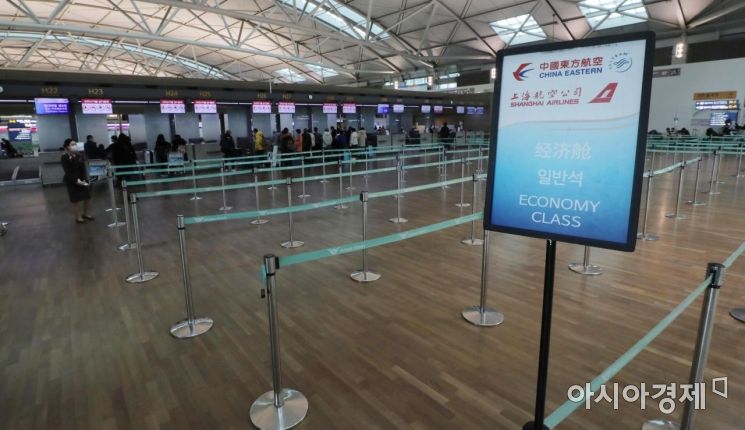 As the number of confirmed cases of the novel coronavirus infection (Wuhan pneumonia) reached four domestically, the infectious disease crisis alert was raised from caution to warning. On the 28th, the check-in waiting area for Chinese national airlines at Incheon International Airport appeared quiet.
 / Yeongjongdo - Photo by Kim Hyun-min kimhyun81@
[Asia Economy Reporter Yu Je-hoon] As the novel coronavirus infection (Wuhan pneumonia) situation spreads, related industries that had been expecting a 'Youker (遊客·Chinese tourists) Season 2' are facing a setback. The industry predicts that if this situation prolongs, damage will spread to multiple sectors such as aviation and tourism.
According to the Korea Tourism Organization on the 29th, the number of Chinese nationals who visited Korea last year was provisionally counted at 6,024,200, an increase of 25.8% compared to the previous year. The number of Chinese visitors to Korea surpassing 6 million is the first time in two years since 2017, approaching the levels recorded during 2014-2016 (an average of 6.7 million), when Youker visits were at their peak.
The background of this upward trend is attributed to the recovery of Korea-China relations, which had been strained since the 2016 Terminal High Altitude Area Defense (THAAD) incident. With the restoration of bilateral relations, there is even speculation about a visit to Korea by Chinese President Xi Jinping (習近平) after four years.
The Hyundai Research Institute (HRI), reflecting this trend, recently identified 'Youker Season 2' as one of the key themes for this year in its 'Top 10 Domestic Trends of 2020' report. Unlike before, the number of visitors for study purposes has increased, and online commerce through Weishang (微商·online commerce via the mobile messenger 'WeChat') and Doushang (?商·online commerce via the video platform 'TikTok') is growing, differing from previous cash and credit card transactions, which could positively impact related industries.
HRI analyzed, "Korea-China exchanges are expected to revive starting this year," adding, "With the increase in visitors for study purposes and changes in payment types, the domestic tourism industry is expected to enter a new Youker season."
However, as the novel coronavirus situation rapidly worsens, the outlook is pessimistic. The Chinese authorities banned group tours for Chinese citizens both domestically and abroad starting from the 25th, and the day before, they also advised against individual overseas travel.
The sectors that will be primarily affected are aviation and tourism. The aviation industry had considered Chinese routes as alternatives to Japan and Hong Kong routes, which saw demand shrink due to last year's boycott and political instability, but it is now difficult to avoid significant losses due to this situation.
Currently, Air Seoul has suspended all Chinese routes (Incheon~Zhangjiajie·Linyi), and Jeju Air and Eastar Jet have also decided to indefinitely suspend some routes. As of the third quarter of last year, the proportion of revenue from Chinese routes for each airline was 19% for Asiana Airlines, 15% for Jeju Air, 14% for Jin Air, and 5% for T'way Air, making a considerable decrease inevitable.
If the aviation and travel industries suffer damage, it is predicted that related sectors such as hotels, tourism, and distribution (duty-free shops) will also be affected. Yang Ji-hwan, a researcher at Daishin Securities, said, "The first quarter is the seasonal peak for the aviation industry, but due to the impact of the novel coronavirus, demand is shrinking, and airline performance in February and March is likely to fall below market consensus (average forecast)." He added, "In fact, during the 2002-2003 period when Severe Acute Respiratory Syndrome (SARS) affected the market, the decrease in outbound travelers began to impact three months after the outbreak."
© The Asia Business Daily(www.asiae.co.kr). All rights reserved.

















