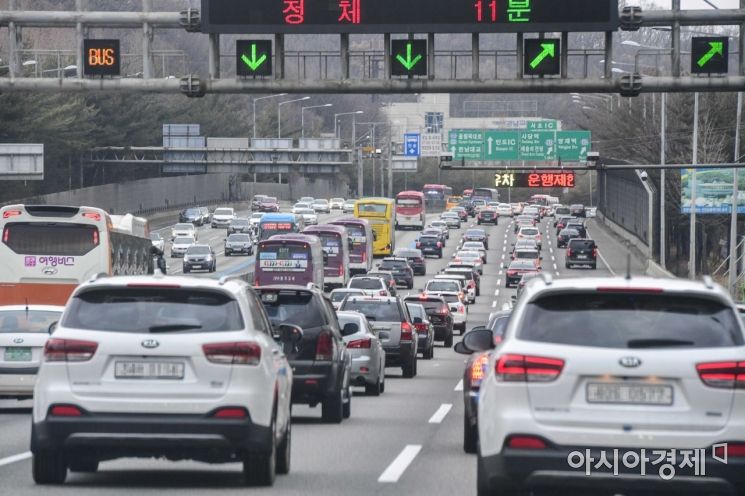
 On the last day of the Lunar New Year holiday, the section between Yangjae IC and Seocho IC on the Seoul-bound side of the Gyeongbu Expressway is crowded with vehicles returning home. Photo by Jinhyung Kang aymsdream@
[Asia Economy Reporter Oh Hyung-gil] KB Insurance is raising car insurance premiums starting today. Other non-life insurance companies are also expected to announce consecutive car insurance premium hikes by next month.
However, due to last year's severe deterioration in car insurance loss ratios, there is already speculation about additional increases within this year.
According to the insurance industry on the 29th, KB Insurance is increasing car insurance premiums by an average of 3.5% starting today.
According to the Non-Life Insurance Association's car insurance premium disclosure, Hanwha General Insurance plans to raise car insurance premiums by 3.5% on the 3rd of next month, and DB Insurance will increase by about 3.4% on the 4th. Samsung Fire & Marine Insurance and Hyundai Marine & Fire Insurance have also announced plans to raise car insurance premiums by around 3% in early February.
Following major companies, small and medium-sized insurers are also expected to raise car insurance premiums.
Within the insurance industry, the prevailing view is that this premium increase did not properly reflect cost increases due to financial authorities' price interventions. There are also expectations that additional car insurance premium hikes may occur in the second half of the year depending on loss ratio trends.
The car insurance loss ratio recorded the worst situation last year. In December, all major insurers such as Samsung Fire & Marine Insurance, Hyundai Marine & Fire Insurance, DB Insurance, and KB Insurance exceeded a loss ratio of 100%, and some small and medium-sized insurers saw it soar up to 120%.
The insurance industry considers an appropriate car insurance loss ratio to be around 77-78%.
As the loss ratio soars, the scale of car insurance deficits is also expected to set a record high. Up to November last year, non-life insurers' car insurance operating deficits reached 1.2938 trillion KRW, surpassing the previous record of 1.5369 trillion KRW in 2010.
Last year, the increase in repair shop labor costs, revisions to the standard policy, and the extension of the working age for manual laborers overlapped, continuously expanding the scale of car insurance deficits. Additionally, there is a growing trend of excessive oriental medicine treatments such as manual therapy.
Initially, the non-life insurance industry argued that a premium increase of over 5% was necessary, but financial authorities reportedly ordered them to reflect a 1-1.5% reduction effect due to scheduled improvements in car insurance-related systems this year.
The financial authorities plan to raise the accident burden charge for drunk driving from 4 million KRW to a maximum of 15 million KRW and to implement system improvements such as establishing review procedures and organizations for treatment fees related to oriental medicine.
An industry official said, "If cost increases are not timely reflected in premiums, the car insurance pricing structure will inevitably become distorted," adding, "It is necessary to reasonably raise the accident burden charge for drunk driving offenders and establish detailed review guidelines for oriental medicine treatment fees."
© The Asia Business Daily(www.asiae.co.kr). All rights reserved.

















