A Place Where the Elite Live and Gather... Beyond Residential Space, Serving as a Venue for Socializing
‘San Remo,’ a luxury apartment located on Central Park West in New York, is known as a residence for the top 1% of America’s wealthiest elite and a prominent social hub. In fact, this place is home to renowned figures such as Tiger Woods, Steven Spielberg, U2, and other members of America’s top 1% wealthy class, who form their own league to share information and opinions.
Where is the Korean version of ‘San Remo’? It is known that wealthy Koreans have long exchanged information and opinions based on their residential areas. The beginning was affluent neighborhoods formed in northern Seoul. Seongbuk-dong in Seongbuk-gu, Pyeongchang-dong in Jongno-gu, and Hannam-dong in Yongsan-gu are representative examples.
These areas were densely populated with single-family homes of prominent chaebol families and high-ranking government officials. Therefore, the wealthy built networks by interacting within these neighborhoods. As a result, living in Seongbuk-dong, Pyeongchang-dong, or Hannam-dong was the greatest goal for the wealthy at that time.
As time passed and Gangnam was developed and emerged as a new affluent area, the residences and social venues of the wealthy shifted to the Gangnam region. Apartments in Apgujeong-dong, Daechi-dong, and Gaepo-dong in Gangnam attracted lawyers, professors, and executives from large corporations, who began creating their own new social circles, just as the affluent neighborhoods in northern Seoul had done in the past.
▣ The emergence of ‘Tower Palace’ changes the meaning of wealthy residences
Until the early 2000s, the residences and social venues of the wealthy were defined by ‘regions,’ but with the supply of Tower Palace in the mid-2000s, the residential facility itself began to serve as both the residence and social venue for the wealthy.
‘Tower Palace,’ supplied in Dogok-dong, Gangnam-gu, featured a groundbreaking high-rise luxurious exterior, spacious medium-to-large floor plans, swimming pools, golf practice ranges, and more. The housing prices were nearly twice the average at the time, positioning itself as a home for the wealthy.
This immediately attracted the attention of the wealthy. In particular, Tower Palace openly declared its intention to become a social venue for the wealthy, and those dreaming of a differentiated ‘their own league’ beyond the Gangnam area quickly gathered here.
An industry insider said, “Before that, the criterion for dividing the wealthy was regional names like ‘living in Hannam-dong’ or ‘living in Gangnam,’ but after the emergence of Tower Palace, it changed to the name of the residential facility itself,” adding, “Since then, saying ‘I live in Tower Palace’ or living in a luxury apartment has become the standard for defining wealth.”
▣ Luxury residential facilities evolving to meet the standards of the wealthy
This change became an opportunity for the wealthy to establish their residences and social venues across the country. With the emergence of Tower Palace breaking away from regional significance, the wealthy began to take interest in luxury apartments and high-end residential facilities located nationwide, beyond Seoul and Gangnam. This explains why representative luxury residential facilities have been established in places like Haeundae in Busan and Suseong-gu in Daegu.
In Busan’s Haeundae-gu, Marine City is representative. The area around Marine City, developed on the former Suyeong Bay landfill, is filled with high-rise mixed-use complexes and is Busan’s premier affluent neighborhood, boasting skyline views comparable to New York, Tokyo, and Shanghai. Landmarks associated with Busan, such as Haeundae I’Park and Doosan We've the Zenith, are all gathered here. Within Marine City, Tiffany 21 buffet cruise ship docks, the Hyatt Hotel, and Hanwha Resort have been developed, establishing it as Busan’s definitive luxury residential area.
In Daegu, an affluent neighborhood has formed around Beomeo Intersection, known as ‘Daegu’s Manhattan’ due to its cluster of high-rise buildings. Doosan We've the Zenith, completed in 2009 (54 floors, 178 meters tall), features penthouses with private gardens and a rooftop helipad. Across the street from Doosan We've the Zenith, ‘Suseong Beomeo W,’ supplied this year with 59 floors?the tallest in Daegu?has once again reshaped the skyline of Daegu’s affluent neighborhood.
▣ Social venues of the wealthy move to hotels and luxury residences
While the wealthy were somewhat satisfied with beautiful landscaping, various community facilities, and convenience in residential life, they now desire residential facilities that further enhance their value.
In response to these needs, hotels and luxury residences have recently emerged as new residential facilities favored by the wealthy. It is known that domestic conglomerate chairpersons have moved from luxury apartments to hotels and luxury residences, and the rapidly increasing number of 20- to 30-year-old young rich also tend to prefer these over luxury apartments.
The reason hotels and luxury residences have recently gained popularity among the wealthy is simple: they offer convenience and a dignified lifestyle. In these places, one can enjoy the comfort of home and hotel-style services simultaneously, freeing residents from the stress of household chores or employing staff. Additionally, with separate banquet halls and lounges, there is no worry about hosting guests, and these spaces effectively serve as social venues.
Abroad, hotels and residences are already recognized as symbols of wealth and one of the lifestyles of the wealthy. The aforementioned ‘San Remo’ on Central Park West in New York is also operated as a luxury residence.
A representative example in Korea is the ‘Signiel Residence’ located in the Lotte World Tower in Jamsil. This complex is managed and operated by a five-star hotel, providing hotel-grade services such as 24-hour doormen, concierge, and room service. It also applies the highest quality imported luxury finishing materials, offering an unprecedentedly comfortable living environment. As a result, it has attracted attention as a residence for famous celebrities and the wealthy.
A real estate expert said, “As income levels rise and Korea joins the ranks of developed countries, the top tier of society is adopting overseas luxury residential cultures,” adding, “Therefore, hotels and luxury residences are gaining popularity among the wealthy in Korea as residences and social venues, quickly establishing themselves as a new form of residential culture.”
▣ Creation of social venues for the wealthy in Busan’s Haeundae, the second-largest city
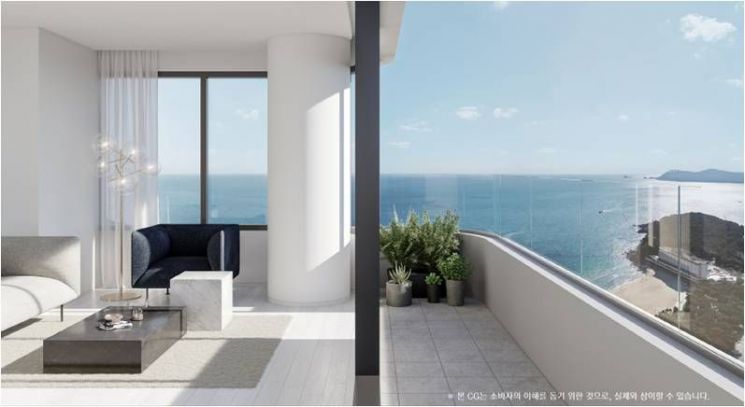
In Busan, Korea’s second-largest city, where landmarks such as LCT, I’Park, and Doosan We've the Zenith are located, a social venue for the top 1% is expected to be created along the Haeundae beach belt. Demolition work is underway in the area of Udong 645-5, located at the very center of the Haeundae beach belt and highly anticipated for development. Here, Shinsegae Construction’s residential brand ‘Beliv’ will launch the ultra-luxury residence ‘Beliv Paragraph Haeundae,’ aiming to be a lifestyle platform.
Comprising a total of 284 units, the space offers various floor plans ranging from studio types to family suites, reflecting different tastes and lifestyles. Amenities located on the top floors include an infinity pool, sauna, and clubhouse, providing an exceptional residence life for influential residents. Daily life at ‘Beliv Paragraph Haeundae’ sets a new standard for luxury living and is expected to become a new landmark forming a cultural and social venue for asset owners.
Meanwhile, ahead of its groundbreaking in March, Beliv Paragraph Haeundae plans to invite a leading group pioneering new lifestyles to the JW Marriott Seoul VIP lounge to showcase its advanced lifestyle. The VIP lounge invitation event will offer an opportunity to experience the community residence of leaders who have reached the pinnacle in various fields.
© The Asia Business Daily(www.asiae.co.kr). All rights reserved.

















