[Subscription Economy Part 1] A Global 600 Trillion Won Market Has Opened
The "subscription economy" is permeating our daily lives and emerging as a new business model that is revolutionizing industries across the board. This economic model, where consumers pay a monthly subscription fee to receive goods or services, is expanding its reach into industries closely related to our lives, such as content, food, fashion, health, and automobiles, injecting vitality into the economy. The consumption paradigm is shifting from purchasing and owning to "subscribing and using."
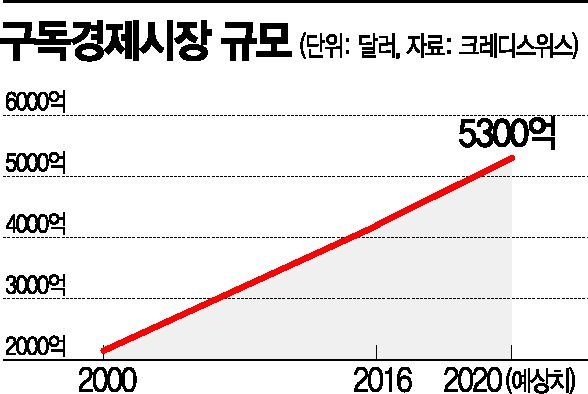
Global investment firm Credit Suisse forecasts the global subscription economy market size to reach $530 billion this year. According to the firm, the subscription economy market has more than doubled in size over 20 years, growing from $215 billion in 2000. It is currently on a steep growth curve, with an expected 26% increase compared to $420 billion in 2016.
This growth in the subscription economy market is due to the continuous increase in industries adopting this model. Global market research firm Gartner announced that over 70% of companies worldwide have either implemented or are considering adopting the subscription economy model, and it predicts that 75% of companies will offer subscription services by 2023.
In South Korea, the spread and expansion of the subscription economy model are also progressing notably. In particular, the increase in "economically capable" single-person households due to dual-income families, low birth rates, and non-marriage has fueled the growth of the subscription economy. The Korea Institute for Industrial Economics and Trade projects that the consumption expenditure share of single-person households in Korea will rise to 15.9% this year and exceed 20% by 2030, reaching 194 trillion won, surpassing the total consumption expenditure of four-person households. In line with this, the industry explains that subscription economy services, which conveniently provide small quantities of needed products, are rapidly increasing. Based on this, companies like Coway and Bodyfriend have steadily grown, and startups such as Ridibooks have laid the groundwork to become "unicorns."
Professor Wi Jeong-hyun of the Department of Business Administration at Chung-Ang University explained, "The rise of the subscription economy is intertwined with consumers' desire to enjoy diverse consumption within a limited budget and the shift in consumption trends focusing on usage rather than ownership."
What is the Subscription Economy? = The "subscription economy" is an economic model where consumers pay a regular subscription fee to receive goods or services at specific intervals. Traditionally, subscribing to newspapers or magazines and having milk delivered to the home every morning are classic examples of the subscription economy. The subscription economy expanded its base by applying to media content sectors where users pay monthly fees to enjoy music or movies, and recently, it has extended into industries closely related to our consumption life, such as food, beauty, fashion, health, and automobiles.
The term was first used by Tien Tzuo, founder of Zuora, a company specializing in enterprise payment and billing solutions. He defined the subscription economy as "an industrial environment where recurring revenue is generated through service provision rather than product sales, and customers transition from buyers to subscribers." This means that consumers do not simply pay to own goods or consume services but prepay a fixed amount regularly and consume goods or services during that period.
Another difference from traditional purchasing is that services are provided with the subscribed products. For example, when subscribing to home appliances like water purifiers or bidets, the product’s condition is regularly checked and maintained. However, ownership varies depending on the product type. Items like water or razor blades are owned by the subscriber, but high-priced products such as automobiles are returned after the subscription period ends. The growth outlook for the subscription economy is very positive. The shift toward buying fewer goods and more services is accelerating, and consequently, the market size is expected to expand.
© The Asia Business Daily(www.asiae.co.kr). All rights reserved.

















