Zigbang "Impact of Large Complex Move-ins Including Godeok Arteon"
272,157 Households Moving Nationwide... 14% Decrease Compared to Previous Year
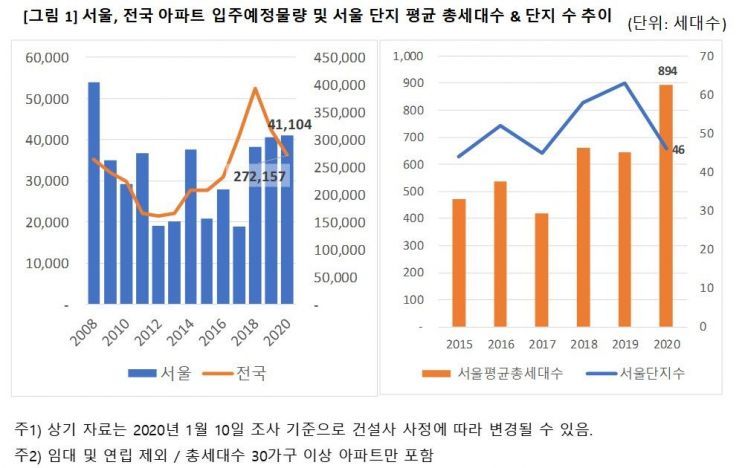
[Asia Economy Reporter Onyu Lim] This year, the volume of apartment move-ins scheduled in Seoul is expected to be the highest since 2008, due to the emergence of mammoth-scale complexes such as Godeok Arteon. On the other hand, the nationwide volume of apartment move-ins is expected to decrease for the second consecutive year.
According to Zigbang on the 28th, a total of 41,104 households will move into apartments in Seoul this year. This is the largest volume in 12 years since 53,929 households moved in in 2008. The total consists of 46 complexes, which is fewer than last year's 63 complexes, but the average size per complex is 894 households, significantly exceeding the recent 5-year average of 546 households. Ham Young-jin, head of Zigbang Big Data Lab, analyzed, "Mammoth-scale complexes with more than 2,000 households are scheduled to move in in Gangdong-gu, Yangcheon-gu, and Eunpyeong-gu, leading to an increase in Seoul's volume in 2020."
Representative complexes include Godeok Arteon in Sangil-dong, Gangdong-gu, and Mokdong Central I'Park Weave in Sinwol-dong, Yangcheon-gu. Godeok Arteon is a complex rebuilt from Godeok Jugong 3rd complex, consisting of 4,066 households. It features exclusive areas ranging from 59 to 114 square meters and is scheduled for move-in at the end of next month. It is adjacent to Sangil-dong Station on Subway Line 5, and a new station on Subway Line 9 is planned nearby. Mokdong Central I'Park Weave is scheduled for move-in in March. It consists of 3,045 households across 35 buildings. Within the complex is Sinnam Elementary School, and Sinnam Middle School and Gangsin Middle School are also nearby.
Meanwhile, the nationwide volume of apartment move-ins scheduled for this year is a total of 272,157 households. This marks a decrease for the second consecutive year since 2018 (393,426 households), and is expected to decrease by about 14% compared to last year (318,016 households). By region, the metropolitan area will see 143,651 households, a 9% decrease, while the provinces will see 128,506 households, a 19% decrease. In Gyeonggi-do, 87,626 households will move in, a decrease of about 16% compared to last year, but mammoth-scale complexes in Seongnam, Gimpo, Siheung, and Ansan are attracting attention.
© The Asia Business Daily(www.asiae.co.kr). All rights reserved.

















