[Asia Economy Reporter Byunghee Park] The Golden Lion Award at the Venice Biennale is the highest honor bestowed upon artists. The Venice Biennale is the oldest international art exhibition in the world, holding a unique status. Today, many international art exhibitions adopt the biennale format, held every two years, which began with the Venice Biennale in 1895. Currently, exhibitions by two American artists who have won the Golden Lion Award at the Venice Biennale are being held domestically.
Jenny Holzer (70), the artist of the commission project "For You: Jenny Holzer" currently held at the National Museum of Modern and Contemporary Art, is the artist who brought the Golden Lion Award for national pavilions to the United States at the 44th Venice Biennale in 1990. Gary Hill (69), the artist of "Gary Hill: Momentombs" held at Suwon Museum of Art, received the Golden Lion Award in the sculpture category at the 46th Venice Biennale in 1995.
Jenny Holzer is a world-renowned conceptual artist who has addressed social, personal, and political themes through text for over 40 years. In the late 1970s, Holzer gained international fame by posting her own aphorisms (Truisms) in the form of maxims, proverbs, or sayings on the streets of New York, focusing on historical and political discourse and social issues.
In 1990, Holzer was selected as the representative artist for the U.S. Pavilion at the 44th Venice Biennale and led the U.S. Pavilion exhibition. The U.S. Pavilion, led by Holzer, won the Golden Lion Award at the Venice Biennale that year. The Venice Biennale operates independent exhibition spaces by country and awards the highest prize, the Golden Lion, to one of the national pavilions. There is also a Golden Lion Award given to individuals outside of the national pavilions.
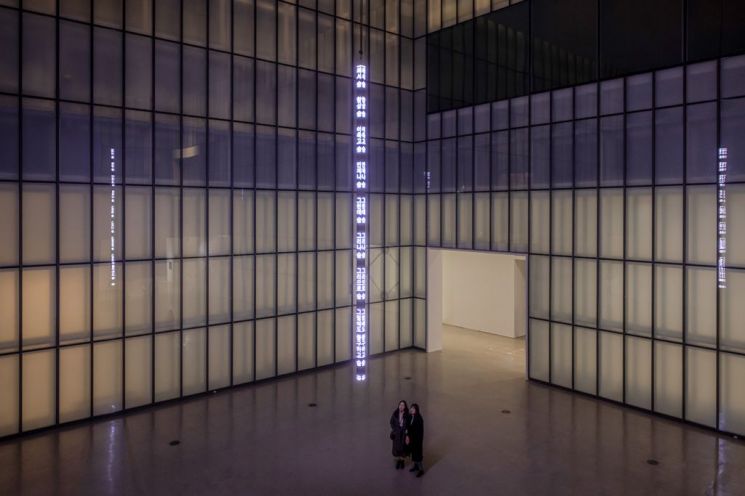 Jenny Holzer 'For You', 2019, robotic LED sign, 640.1x12.7x12.7 cm [Courtesy of National Museum of Modern and Contemporary Art]
The commission project "For You: Jenny Holzer" has been ongoing for about three years since 2017, showcasing works. Over 1,000 posters of Holzer's early works, "Truisms (1977?1979)" and "Inflammatory Essays (1977?1982)," are installed on the lobby walls of the Seoul Pavilion.
In the Seoul Box of the Seoul Pavilion, a new work sharing the same name as this project and the first to present Korean and English texts together, the robotic light-emitting diode (LED) sign "FOR YOU (2019)" is installed. Texts from literary works selected by the artist flow across the LED screens surrounding the four sides of a 6.4-meter-long rectangular pillar. Texts from works by five contemporary writers?Kim Hyesoon, Han Kang, Emily Jungmin Yoon, Svetlana Alexievich, and Hawzhin Azeez?are continuously displayed on the LED screens of a square pillar hanging approximately 16 meters high from the ceiling. The texts presented in "FOR YOU" trace the thoughts of those who have experienced or witnessed historical tragedies, disasters, or social atrocities, transforming the museum into a space of empathy and confrontation, communication, and healing.
Holzer also presents an installation work permanently engraving 11 selected phrases from her "Truisms" on a stone bridge in the outdoor sculpture park of the National Museum of Modern and Contemporary Art, Gwacheon.
Gary Hill is a world-renowned American media artist who is credited with expanding the field of media art through video works mediated by language and the body. Originally a sculptor, he transitioned to media art in the early 1970s and has presented works utilizing video and text.
The exhibition "Gary Hill: Momentombs" is a retrospective covering Hill's works from the 1980s to new works from 2019 and is the largest exhibition of its kind in Asia. It features 24 representative works reflecting on language and image, body and technology, and virtual and real spaces. The exhibition comprehensively covers Hill's 30-year artistic journey of continuous media experimentation through various approaches such as video installations and video projections.
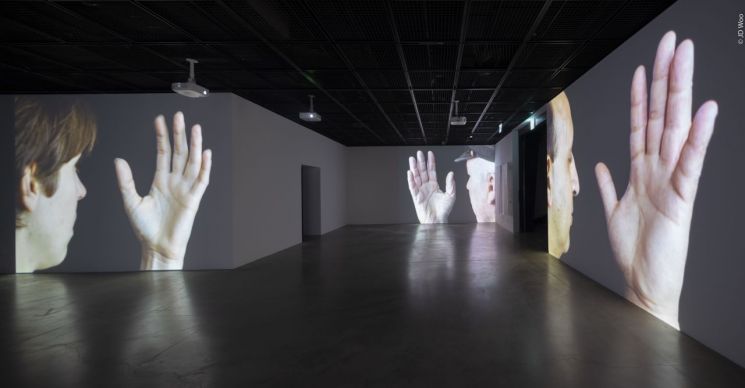
The exhibition title Momentombs is a compound of Moment, Momentum, and Tomb, inspired by the way images, language, and sound in the artist's works repeatedly combine, separate, disappear, and are reborn over time.
The Venice Biennale began in 1895. It was initiated by the city of Venice to commemorate the silver wedding anniversary (25th wedding anniversary) of King Umberto I of Italy and Queen Margherita. It is the prototype of the world's leading international art exhibitions. The word biennale itself is Italian for "every two years."
In 1931, the Venice Biennale was elevated to an event organized by the Italian Fascist government. With increased funding, it diversified into various forms of art festivals in the 1930s. The music festival began in 1930 and became an annual event in 1937. The first film festival was held from August 6 to 21 in 1932, marking the start of the Venice Film Festival. The Venice Film Festival was initially biennial but became annual from 1935. A theater festival was added in 1934 and has been held annually since 1936. An architecture festival was added in 1980 and is held every two years. Currently, the Venice Biennale holds the art exhibition in odd-numbered years and the architecture exhibition in even-numbered years. A dance festival was added in 1999.
© The Asia Business Daily(www.asiae.co.kr). All rights reserved.
![Clutching a Stolen Dior Bag, Saying "I Hate Being Poor but Real"... The Grotesque Con of a "Human Knockoff" [Slate]](https://cwcontent.asiae.co.kr/asiaresize/183/2026021902243444107_1771435474.jpg)

















