Ministry of Land, Infrastructure and Transport Survey Results Announced
Nationwide Land Prices Show Slower Growth for the First Time in 6 Years
Land Prices Also Contract Due to Government Housing Price Regulations
[Asia Economy Reporter Moon Jiwon] Last year, nationwide land prices rose by 3.92% compared to 2018. Although land prices have been increasing annually since 2013, the growth rate slowed down last year for the first time in six years.
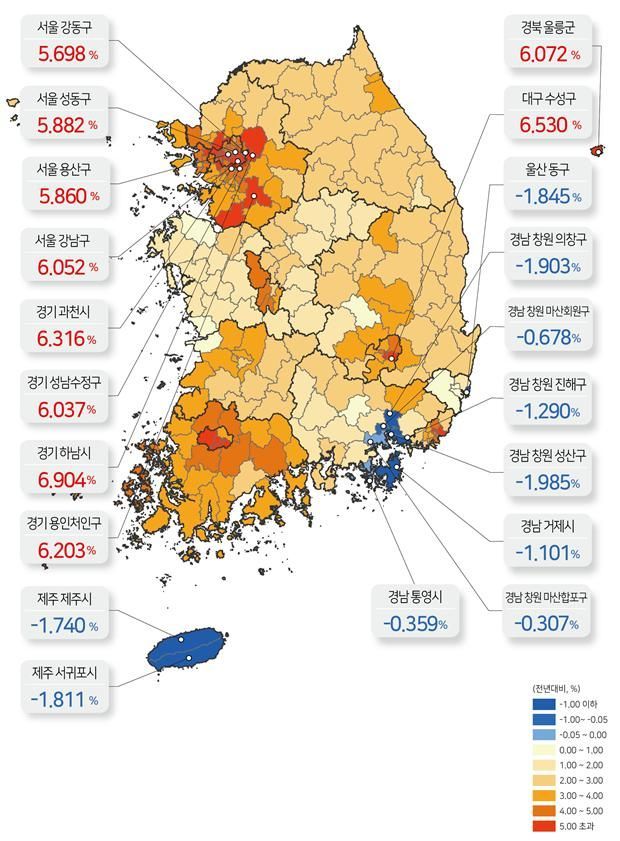
The region with the highest increase in land prices nationwide was Hanam-si in Gyeonggi Province. Jeju Island was the only city/province to experience a decline in land prices, dropping by 1.77%, marking a downward trend for the first time in 10 years.
According to the Ministry of Land, Infrastructure and Transport on the 27th, the national land price index rose by 3.92% last year. This is a 0.66 percentage point decrease from the previous year (4.58%).
In the metropolitan area, the increase slowed from 5.14% to 4.74%, and in provincial areas from 3.65% to 2.51%. This is interpreted as a natural contraction in land prices due to the government's continuous real estate regulations aimed at curbing housing prices.
By city/province, Seoul (5.29%), Sejong (4.95%), and Gwangju (4.77%) showed the highest increases.
In the metropolitan area, Seoul, Gyeonggi (4.29%), and Incheon (4.03%) had the largest increases. In Seoul, Gangnam-gu (6.05%) saw a significant rise in land prices due to expectations from the Hyundai Motor Company’s new headquarters, the Global Business Center (GBC), the metropolitan complex transfer center, and development projects around Yeongdong-daero.
In provincial areas, Sejong (4.95%) had the highest growth rate, followed by Gwangju (4.77%), Daegu (4.55%), and Daejeon (4.25%), all exceeding the national average.
The Ministry of Land explained, "Sejong’s land prices rose due to progress in the development of Sejong IC, the Smart National Industrial Complex, and increased investment demand in nearby areas."
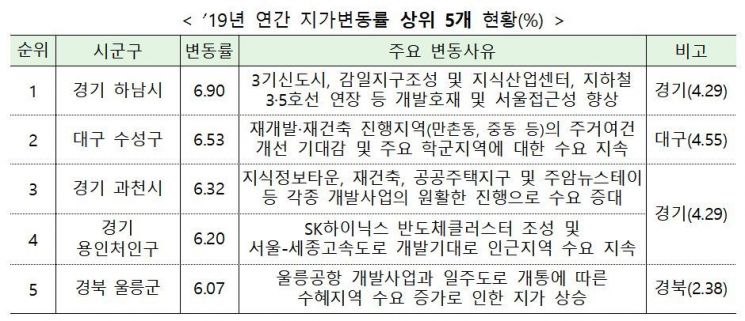
Among cities, counties, and districts, Hanam-si in Gyeonggi Province had the highest increase at 6.90%. Positive factors such as the 3rd New Town, Gam-il District, and extensions of subway lines 3 and 5 appear to have influenced this rise.
Other areas with high growth rates included Suseong-gu in Daegu (6.53%), Gwacheon-si in Gyeonggi (6.32%), Yongin Cheoin-gu in Gyeonggi (6.20%), and Ulleung-gun in Gyeongbuk (6.07%).
Ulleung-gun’s land prices rose due to the development of Ulleung Airport and the opening of the circular road.
On the other hand, land prices fell in Seongsan-gu (-1.99%) and Uichang-gu (-1.90%) in Changwon, Gyeongnam, Dong-gu in Ulsan (-1.85%), Seogwipo-si in Jeju (-1.81%), and Jeju-si (-1.74%).
Jeju Island was the only city/province to experience a decline, dropping by 1.77%. This is the first decline since 2008 (-0.02%).
In Jeju-si, sluggish progress in regional development projects such as the Ora Tourism Complex and economic downturns dampened buyer sentiment and investment demand. In Seogwipo-si, delays in the second airport development project and perceptions of a real estate peak reduced both investment and actual demand.
Last year, nationwide land prices by land-use zone showed the highest increases in residential areas (4.42%), commercial areas (4.32%), green spaces (3.35%), planned management areas (3.34%), agricultural and forest areas (2.94%), production management areas (2.44%), and industrial areas (2.24%).
By usage, commercial land (4.44%), residential land (4.05%), rice paddies (3.31%), dry fields (3.26%), factory sites (2.33%), others (2.22%), and forest land (2.21%) showed the respective increases.
© The Asia Business Daily(www.asiae.co.kr). All rights reserved.
![Clutching a Stolen Dior Bag, Saying "I Hate Being Poor but Real"... The Grotesque Con of a "Human Knockoff" [Slate]](https://cwcontent.asiae.co.kr/asiaresize/183/2026021902243444107_1771435474.jpg)

















