Barclays, Citi, and Others Expect South Korea to Keep Base Interest Rate Steady This Year
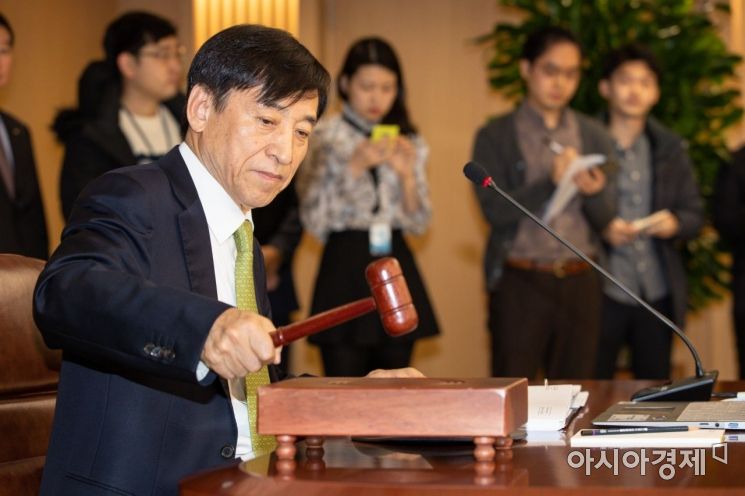 Lee Ju-yeol, Governor of the Bank of Korea, is striking the gavel at the 'Monetary Policy Direction Financial Monetary Committee' held at the Bank of Korea in Jung-gu, Seoul on the 17th. Photo by Kang Jin-hyung aymsdream@
[Asia Economy Reporter Kim Eunbyeol] On the 17th, the Bank of Korea (BOK) kept the base interest rate unchanged, and major investment banks (IBs) also expect the BOK to maintain the base rate freeze for the time being. This outlook reflects the view that, given South Korea's favorable economic indicators, it is necessary to monitor the economic trend for now, and that a rate cut could lead to a concentration of funds in the real estate market.
According to the investment banking industry on the 27th, Barclays recently raised its forecast for South Korea's base interest rate this year from 1.0% to 1.25%. In November last year, Barclays had expected the BOK to lower the base rate to 1.0% in the first quarter of 2020 and maintain it at 1.0% through the third quarter. However, this month, it revised the forecast upward to 1.25%, indicating consensus with the BOK's decision to hold rates steady.
Citigroup also projected that the BOK would maintain the base rate at 1.25% through the fourth quarter of this year. At the end of last year, UBS, which had initially forecast a possible cut to 0.75% in 2020, also raised its base rate forecast to 1.0%.
The IBs appear to share the view that it is necessary to observe South Korea's economic recovery more closely, that funds could flow into the real estate market, and that major central banks worldwide are likely to keep rates steady for the time being.
Another reason IBs agree with the rate freeze is that the GDP growth rate for the fourth quarter of last year, released after the rate freeze, was higher than expected.
Capital Economics (CE) focused on the GDP growth rate and stated, "We no longer expect the BOK to cut rates this year," forecasting that the BOK will keep rates unchanged throughout the year. The GDP growth rate for Q4 last year was 1.2% quarter-on-quarter and 2.2% year-on-year, surpassing expectations. Although the government’s fiscal spending contributed to exceeding the forecast, IBs are focusing solely on the figures themselves.
The fact that advanced economies such as the United States and the European Union (EU) are unlikely to change their monetary policy stance significantly this year is also a reason IBs expect the BOK to maintain the rate freeze. The biggest factor influencing South Korea’s base rate is the Federal Reserve’s (Fed) expected rate freeze this year.
The European Central Bank (ECB) also kept its policy rate unchanged on the 23rd. The ECB explained that it expects to maintain rates at the current level or lower until inflation sufficiently converges to the 2% target. The ECB also announced that it will continue its net asset purchases of about 20 billion euros per month, which began in November last year, as planned.
Meanwhile, internally, the BOK expects the Bank of England (BOE) to possibly cut rates on the 30th of this month. It is judged that a rate cut is necessary to prepare for Brexit (the UK’s withdrawal from the EU). However, the British pound is considered to have relatively little impact on South Korea’s base rate, so the effect on monetary policy is expected to be limited.
© The Asia Business Daily(www.asiae.co.kr). All rights reserved.

















