Kim Jong-un's Aunt and Executed Jang Song-thaek's Husband
Alongside Kim Yo-jong and Ri Sol-ju, Showcasing 'Baekdu Bloodline'
Internal Unity Image Amid 'Direct Breakthrough' Campaign
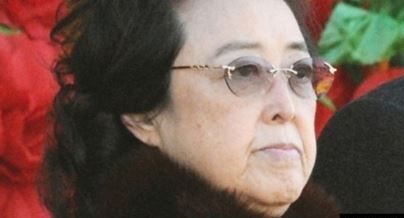
Kim Kyong-hui, the aunt of North Korean State Affairs Commission Chairman Kim Jong-un and former secretary of the Workers' Party, made a public appearance at an official North Korean event for the first time in six years, showcasing her continued presence. This appearance dispelled rumors of Kim Kyong-hui's poisoning that had circulated since the execution of her husband, Jang Song-thaek. Her emergence is interpreted as a propaganda effort to remove the image of conflict and discord that had clung to the Kim family and the "Baekdu bloodline" following Jang Song-thaek's execution.
On the 26th, North Korean state media Korean Central News Agency reported, "Comrade Kim Jong-un, together with Mrs. Ri Sol-ju, watched the Lunar New Year commemorative performance at the Samjiyon Theater on January 25."
The broadcast mentioned that Comrade Kim Kyong-hui also attended, naming her second after Choe Ryong-hae. Upon photo verification, she was confirmed to be Kim Kyong-hui, the younger sister of Kim Jong-il, former secretary of the Workers' Party, and wife of the executed Jang Song-thaek.
Born in 1946, Kim Kyong-hui wore a black hanbok and sat in the same row as Kim Jong-un, between his wife Ri Sol-ju and younger sister Kim Yo-jong.
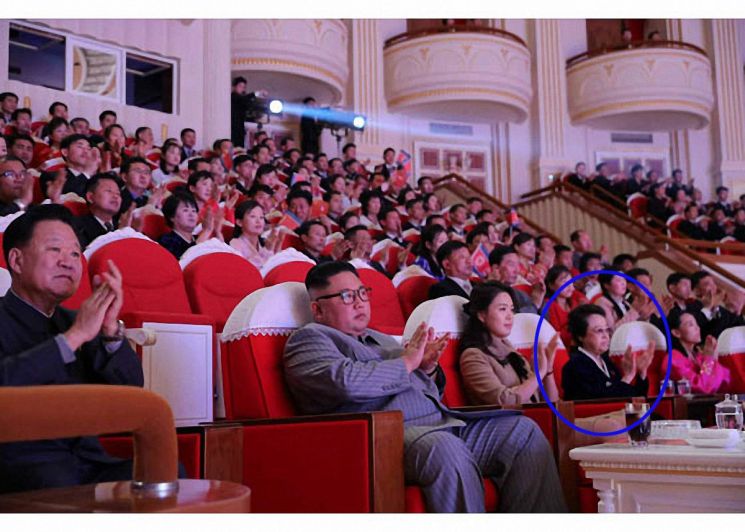 North Korean State Affairs Commission Chairman Kim Jong Un watched a holiday commemorative performance at Samjiyon Theater on the 25th, Lunar New Year's Day, together with his wife Ri Sol Ju, the Korean Central News Agency reported on the 26th. Kim Kyong Hui, former Workers' Party secretary (blue circle), who is the younger sister of Kim Jong Il, chairman of the National Defense Commission, and the wife of Jang Song Thaek who was executed, appeared in public for the first time since September 9, 2013.
 Kim Kyong-hui, Kim Jong-un's aunt, was a key figure during Kim Jong-il's regime and served as a mentor after Kim Jong-un came to power, but she had not appeared in public since Jang Song-thaek was executed in December 2013.
Her last public activity was attending the 65th anniversary parade of the establishment of the regime with Kim Jong-un on September 9, 2013, and watching a performance by the Korean People's Army Internal Security Forces Ensemble.
Kim Kyong-hui's appearance is seen as related to the unity of the "Baekdu bloodline" and the internal support for Kim Jong-un's "line of frontal breakthrough" declared this year.
Jung Sung-jang, head of research planning at the Sejong Institute, interpreted, "This is to dispel the image of discord and conflict within the Kim family after the execution of Jang Song-thaek and the assassination of Kim Jong-nam, to externally demonstrate the unity of the Baekdu bloodline and the harmony of the Kim family, and to internally strengthen Kim Jong-un's frontal breakthrough campaign."
In fact, not only Kim Kyong-hui but also Kim Yo-jong, Kim Jong-un's younger sister, attended the performance, showing the full mobilization of North Korea's "Baekdu bloodline."
Professor Lim Eul-chul of Kyungnam University's Institute for Far Eastern Studies also said, "It can be interpreted as an intention to further solidify internal cohesion by showing the united appearance of the Baekdu bloodline during the Lunar New Year."
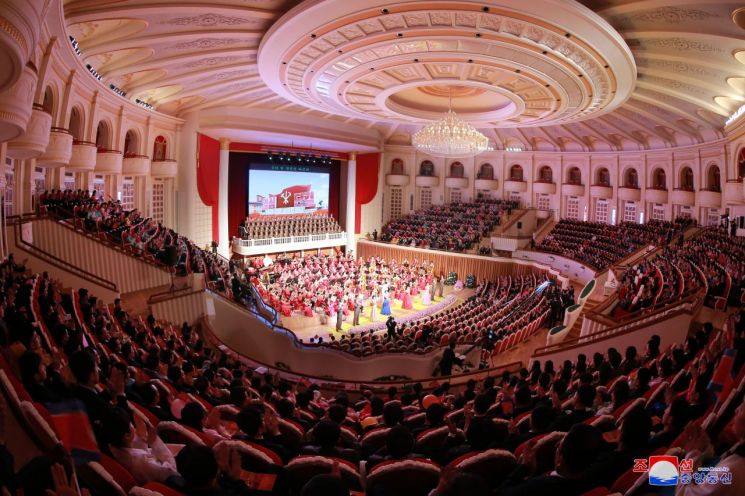 On the 25th, Lunar New Year's Day, a commemorative performance for the New Year was held at the Samjiyon Theater in Pyongyang.
 Attending the performance were Kim Jong Un, Chairman of the State Affairs Commission of North Korea, and his wife, Choe Ryong Hae, First Vice Chairman of the State Affairs Commission, and Kim Yo Jong, First Deputy Department Director of the Party. Additionally, Kim Kyong Hui, former Secretary of the Workers' Party, sister of Kim Jong Il and wife of the executed Jang Song Thaek, appeared in public for the first time on September 9, 2013.
Furthermore, there is speculation that Kim Kyong-hui may return to the political stage.
Professor Lim said, "From Kim Jong-un's perspective, who wants to declare victory on October 10, the 75th anniversary of the founding of the Party, through the frontal breakthrough campaign decided at the Party plenary meeting while emphasizing the revolutionary spirit of Baekdu, it can also be interpreted as a sign that he may actively utilize Kim Kyong-hui, the 'elder' of the 'Baekdu bloodline.'"
Meanwhile, Kim Kyong-hui has been associated with rumors of poisoning and illness.
Around 2013, Kim Kyong-hui was undergoing surgery and treatment for conditions such as renal failure, hypertension, brain tumor, and toe problems.
She was hospitalized in a Singapore hospital in 2012, received treatment for a brain tumor in Paris in May 2013, and underwent surgery in Russia from September to November of the same year for a toe deformity.
After being listed on the state funeral committee announced on December 15, 2013, she received treatment in Switzerland and returned to North Korea, but her health deteriorated further, leading to a prolonged hospitalization.
Although Kim Kyong-hui's health was once very critical, it is known to have gradually improved, and judging from her attendance at the Lunar New Year commemorative performance on January 25, she appears to have recovered considerably.
The National Intelligence Service also reported to the National Assembly Intelligence Committee that Kim Kyong-hui was secluded near Pyongyang undergoing medical treatment.
© The Asia Business Daily(www.asiae.co.kr). All rights reserved.



















